Families with Wi-Fi dead spots on multiple floors
If you want to watch family videos in living rooms and bedrooms on different floors, check the signal where you actually use your devices and consider where additional Wi-Fi points could be placed.


If your router and internet connection are working properly, it often makes more sense to extend your Wi-Fi coverage where needed than to replace the router straight away. An additional access point or repeater can cover one poorly served area; for multiple floors, you may need several Wi-Fi points. Before choosing, check whether existing LAN cabling, a reliable wireless connection between the points or the internet connection itself is the main bottleneck.
If you want to watch family videos in living rooms and bedrooms on different floors, check the signal where you actually use your devices and consider where additional Wi-Fi points could be placed.
Existing network cables can connect additional Wi-Fi points, so the connection between floors doesn’t have to rely solely on a wireless link.
If your router and internet connection are working properly and only a distant area has a weak signal, a targeted extension could be a better option than replacing the whole device.
The key questions are whether you can stream videos where you want to, and how the additional Wi-Fi points will connect to your home network.
| What matters | What to check before buying | Who should pay particular attention? |
|---|---|---|
| Signal where you use your devices | Check the signal in the rooms affected and consider possible locations for additional Wi-Fi points. | If I want to watch family videos in rooms that currently have a weak signal, I need a reliable connection there. Around 36% of consumers put coverage in these rooms first. |
| Connection between floors | Check for existing LAN cabling and Ethernet backhaul; without cables, test suitable locations for the wireless connection between nodes. | If you use video across different floors, you’ll also want to plan a reliable connection between the Wi-Fi points and your home network. Around 29% of consumers prioritise this backhaul. |
| Existing router and internet connection | Compare the connection near the router with the one in the affected rooms; check the connection type and operating mode of any replacement device. | If I want to keep using my existing router, I first need to work out whether the Wi-Fi, router or internet connection is causing the delay. Around 21% of consumers put checking their existing network first. |
| Security and ongoing costs | Check for firmware updates and Wi-Fi encryption; find out the terms of any optional security services before activating them. | Consumers looking for a secure, easy-to-maintain solution with manageable extra costs should also consider optional services. Around 14% focus on security and ongoing costs. |
Walls and ceilings affect wireless connections, and mesh nodes also need a reliable connection to one another. So an advertised range doesn’t automatically tell you how well your own rooms will be covered.
Check the connection where you use your devices and plan where to place the nodes before deciding how many units you need.
If some floors are still out of reach, you may need additional Wi-Fi points or cabling.
A new standalone router won’t necessarily overcome obstacles in your home. If your existing router works, you may be able to extend it with a suitable access point or repeater.
Compare the signal near the router with the signal where you need it before planning a complete replacement.
Replacing a device unnecessarily adds cost and hassle without necessarily fixing the dead spot.
Powerline uses your existing electrical wiring, so the connection you can actually achieve depends on your home. Electrical wiring can also cause electromagnetic interference. This is highlighted by the Committee for Technical Regulation in Telecommunications at the Federal Network Agency.
Test the sockets you plan to use. If you already have LAN cabling between floors, check whether your chosen devices support a suitable wired connection instead.
For the Orbi 770 offer, NETGEAR lists Armor as an optional service with a trial period followed by subscription terms.
Before activating the service, check its duration, cancellation terms and what it includes.
An optional service may involve ongoing charges after the trial period.
For extending a compatible FRITZ! home network: according to FRITZ!, the FRITZ!Repeater 3000 AX can connect wirelessly or be used as a LAN bridge.
According to TP-Link Germany, the Deco BE25 range offers mesh configurations with wireless and wired backhaul.
According to ASUS, ZenWiFi BT8 is an AiMesh option for homes planning to use multiple Wi-Fi points and, optionally, a wired backhaul.
Magic 2 WiFi 6 next is a Powerline Wi-Fi alternative if there’s neither LAN cabling between floors nor a reliable wireless connection.
The Orbi 770 system is a multi-unit Tri-Band Wi-Fi 7 option. NETGEAR also lists wired 2.5 Gbit/s backhaul.
This selection includes a DSL router, wireless mesh devices, standalone repeaters and an access point for an expandable home network. Before buying, check that the connection type, existing devices and operating mode you need are compatible.
 No image available
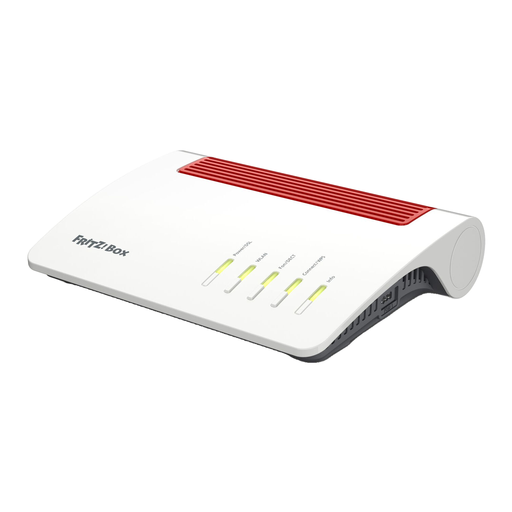
Could work as your main router with FRITZ!Mesh Master functionality if the integrated modem is compatible with your DSL connection.
Integrated ADSL/VDSL modem with VDSL Supervectoring 35b; four Gigabit LAN ports and WPA2/WPA3. Other connection types require a suitable external modem.
Before buying, check the conformity requirements for the specific version sold in the EU market; the model name alone doesn’t confirm compliance.
 No image available
This set of two mesh units is designed to provide Wi-Fi coverage across your home, provided you can place the second unit within range of the first.
Wi-Fi 7, Dual-Band, WPA3 and three Gigabit ports per unit.
Before buying, check the conformity requirements for the specific version sold in the EU market; the model name alone doesn’t confirm compliance.
 No image available
Could improve coverage in one poorly served area, as long as the extender can still receive a usable signal from your existing router where it’s placed.
AX3000 Dual-Band, Gigabit port and access point mode; a signal strength indicator is listed.
Before buying, check the conformity requirements for the specific version sold in the EU market; the model name alone doesn’t confirm compliance.
 No image available
Could provide an additional Wi-Fi point if you can place it within range of your existing router.
Dual-Band Wi-Fi 7, EasyMesh compatibility and 2.5 Gbit/s Ethernet port.
Before buying, check the conformity requirements for the specific version sold in the EU market; the model name alone doesn’t confirm compliance.
 No image available
Suitable as an additional Wi-Fi point for a wired home network, provided you have a compatible PoE+ switch or PoE+ injector.
Tri-Band Wi-Fi 7, 10-GbE uplink and wireless meshing. This is an access point, not a router or modem; a PoE+ switch or PoE+ injector is required and not included.
Not just to stream within your home network. If you’re streaming videos from the cloud or uploading them, and the connection is slow even near the router, check your internet connection separately from your Wi-Fi. The Federal Network Agency provides tools to help you do this.
With wireless mesh, every additional node needs a sufficiently strong connection to your home network, so don’t put it right at the outer edge of the dead spot. If you have LAN cabling between floors, check the Ethernet backhaul instructions for your specific system and its operating mode.
The Federal Office for Information Security recommends changing insecure default login details, using a suitable Wi-Fi password and keeping your router’s firmware up to date. Also check whether your router and connected devices support WPA2 or WPA3.
Depending on your setup, you may need additional nodes or cables; optional services may also be chargeable. NETGEAR lists a trial period and subsequent subscription terms for Armor Plus. Check these before activating it.
Relevant radio equipment placed on the EU market must meet EU conformity requirements, including CE marking. The European Commission and the Federal Network Agency provide further information. For Wi-Fi in the 5945–6425 MHz band, the Federal Network Agency lists a general allocation from 2025, which revoked Order 12/2025. This doesn’t mean that every imported version or setting is approved.