
Lieferung heute & morgen

Qualitätsgarantie

Willkommens-Angebote freischalten: KOSTENLOSE Lieferung | Bis zu 80 % RABATT | Kostenlose 30-Tage-JoyPlus-Testphase
App herunterladen
A multi-function food processor can replace several individual appliances: a food processor with blender, food processor, chopper, mincer or hand blender with whisk. However, the wide range of options can make choosing difficult. Wattage figures, accessory lists and automatic programmes may sound impressive, but on their own they reveal little about whether an appliance suits your cooking routine.
A high rated power is a relevant technical specification, but it is not a complete indicator of quality. The blade design, power transmission, speed control and permitted operating time are also important. A 350-watt appliance may be sufficient for smaller quantities, while families are more likely to benefit from a larger bowl and a motor designed for dough, meat or larger portions.
A comprehensive set is not automatically practical. If you mainly prepare soups and smoothies, you may not need a mincer or several slicing discs. For regular baking, dough hooks, beater attachments and whisks are more important than a small blending container. Before buying, make a list of the functions you will actually use.
A large number of individual parts often means more cleaning and requires additional storage space. A dishwasher-safe food processor can make care easier, but this only applies to the removable parts approved by the manufacturer. The motor unit, cable and electrical connections must never be immersed in water. The appliance’s dimensions and weight should also be suitable for your worktop and available storage space.
For a 4-in-1 hand blender or compact chopper, two speed settings and a pulse function are often sufficient. They allow you to process soft ingredients, cooked vegetables, herbs or smaller portions of meat with control. An appliance with several settings or variable speed control offers more flexibility when preparing creams, dough and ingredients with different consistencies.
For a powerful food processor designed for larger quantities, the appliance’s load capacity and recommended operating time are also important. Follow the manufacturer’s specifications, particularly when processing firm dough, ice or hard foods. A motor should not be operated continuously beyond its intended capacity.
A 500- to 800-millilitre beaker is suitable for individual portions, baby food, dressings or small quantities of ingredients for chopping. Larger containers are more practical for families. Models such as the Philips 7000 Series Food Processor HR7962/21 combine a 5.5-litre bowl with a 1.5-litre blender attachment, according to the product specifications.
It is important to distinguish between total capacity and usable working capacity. Liquids must not be filled right to the rim. When preparing hot food, you should also check whether the container is designed for this purpose. When blending hot soups, splash protection, the lid lock and the manufacturer’s instructions are particularly important.
A mincer or chopper should have sturdy blades and a stable bowl. Stainless steel parts are often durable and can be rinsed straight after use. Take care when handling cutting discs and blades: hands and utensils must never be placed inside containers while the appliance is running.
For keen bakers, a sufficiently large mixing bowl as well as dough hooks, whisks and beater attachments are essential. A food processor with blender also expands the range of uses to include smoothies, sauces and soups. Bowl and lid locks, a stable base and clear operating instructions are practical safety features.
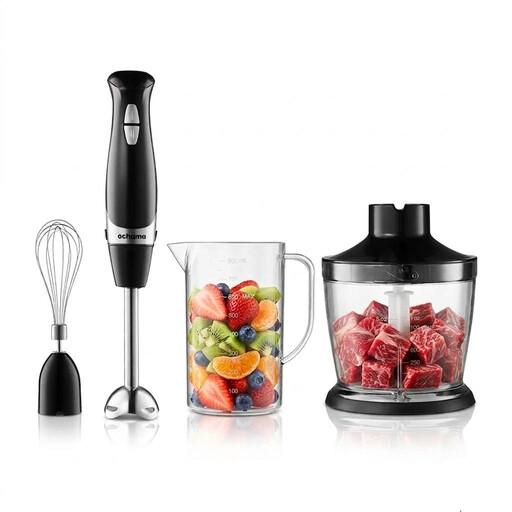
Why this product suits the profile: This set combines a hand blender, whisk, mincer and 500-ml chopper. With 600 watts, two speed settings and an 800-ml measuring jug, it is suitable for smaller households and a wide range of everyday tasks.
The clearly specified contents prevent you from having to budget for important attachments separately. The detachable design makes cleaning easier.
Compact 4-in-1 design, two speed settings and accessories for soups, purées, desserts and small portions of meat.
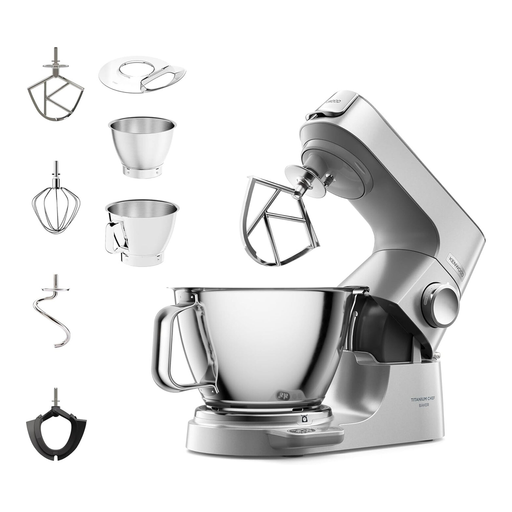
Why this product suits the profile: According to the product specifications, this food processor has 1,200 watts, a 5-litre bowl and a 3.5-litre bowl, as well as a K-beater, whisk, Flexi beater and dough hook. The integrated EasyWeigh scales let you weigh ingredients directly in the bowl.
Two bowl sizes reduce unnecessary transfers between containers. The documented contents are specifically designed for stirring, whisking and kneading.
Two bowl capacities, variable speed control and accessories for baking dough and mixtures.
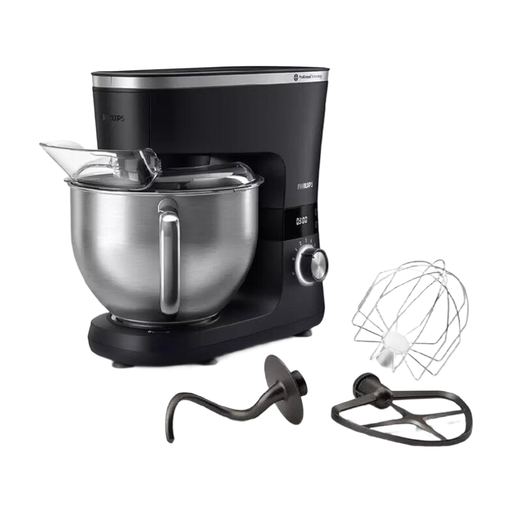
Why this product suits the profile: The combination of a 5.5-litre bowl, 1.5-litre blender, 1,000 watts and eight speed settings is aimed at families and users who regularly prepare larger quantities.
The capacities are clearly stated, making meal planning easier. Removable parts that are dishwasher-safe according to the product description can reduce cleaning time.
Large working bowl, separate blender and functions including kneading, grinding, slicing, grating and chopping.
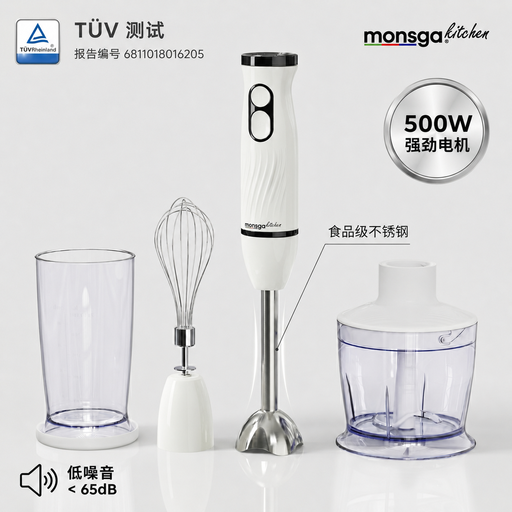
Why this product suits the profile: The 36.5 cm shaft reaches deep into pots. Standard and turbo modes, a chopping container, whisk and 500-ml beaker cover typical tasks when preparing soups, smoothies, purées and desserts.
The splash and pot protection is clearly described as part of the design. According to the product specifications, the removable accessories are BPA-free and dishwasher-safe.
Long blending shaft, two operating modes and easy-to-access attachments for everyday preparation.
We have put together a complete, regularly updated list of products that fully meet these strict selection criteria and the safety regulations applicable in the EU.
Both a hand blender and a countertop blender can be suitable for soups and smoothies. A hand blender processes soup directly in the pot and usually requires less storage space. A countertop blender, on the other hand, has a fixed container and is suitable for larger or repeated blending tasks. When preparing hot food, the container and lid must be explicitly approved for this purpose.
It is not possible to give a reliable general lifespan. It depends on the load placed on the motor, frequency of use, cleaning and correct handling. By observing the maximum filling level, processing hard ingredients only as instructed and allowing the motor to cool between demanding tasks, you can reduce avoidable strain.
Power consumption depends on the rated power and the actual operating time. In theory, a 1,000-watt appliance uses around 0.167 kilowatt hours during ten minutes of operation. In everyday use, operating intervals are usually short. Running costs therefore depend not only on the wattage, but also on how long and how often the appliance is used.