
Lieferung heute & morgen

Qualitätsgarantie

Willkommens-Angebote freischalten: KOSTENLOSE Lieferung | Bis zu 80 % RABATT | Kostenlose 30-Tage-JoyPlus-Testphase
App herunterladen
Whether you are cutting timber, creating mitres, building furniture or producing technical drawings, the right measuring tool often determines whether edges meet cleanly. However, many buyers focus only on a prominent angle scale or a robust appearance. Unclear measurements, hard-to-read markings and an unsuitable design can make the tool much more difficult to use.
As a Joybuy Product Recommendation Officer, I have assessed the most important selection criteria objectively. This makes it easier to decide which multi-function square for woodworking is right for your project, materials and workflow.
The term “multi-angle ruler” alone says little about the tool’s actual range of functions. What matters is which angles can be marked or checked directly. For many woodworking tasks, 30, 45, 60 and 90 degrees are important. Other projects may require additional adjustment options or an integrated protractor function.
Therefore, check that the scale is actually present on the tool and easy to read. A product description that simply mentions “multifunction” is no substitute for specific information about the angle range.
A very thin or flexible ruler may bend when placed against a workpiece. Even a small deviation can affect long cutting lines or several connected components. For a woodworking measuring tool, a rigid body and straight edge are therefore important.
Aluminium is lightweight and is described for the products mentioned as a corrosion-resistant material. Even so, the tool should not be dropped, bent excessively or used as a lever. Aluminium can also become distorted by impacts.
Laser-engraved markings can be more durable than printed scales. However, the contrast between the surface and the lettering remains important. A black surface with light markings, or a coloured surface with a high-contrast scale, makes it easier to read in the workshop.
Also check whether millimetre, centimetre and inch scales are included. For DIY enthusiasts in the UK, a metric scale is usually sufficient; an additional imperial scale can be useful when working from imported plans or technical drawings.
An aluminium angle finder or aluminium ruler is easy to transport and suitable for mobile work. According to the product description, an anodised surface can help improve resistance to corrosion and wear. For consistently accurate results, the quality of the edges, joints and contact surfaces is also important.
A traditional try square or carpenter’s square, on the other hand, is designed for specific tasks. A fixed 90-degree square is suitable for checking right angles. A speed square generally combines a reference edge, angle scale and marking guide.
For simple woodworking, a square with fixed markings is often sufficient. Anyone marking out mitres, roof structures, frames or geometric patterns can benefit from having several commonly used angles readily available.
A 30 45 60 90-degree angle square is practical if these values are used regularly. With a multi-function model, it should also be clear whether it is intended only as a template or can also be used as a guide, saw guide and angle finder.
Compact tools fit neatly into a toolbox and are well suited to small workpieces, model making or detailed tasks. For furniture panels and larger components, a longer straight edge may be more useful. Check the actual length rather than relying solely on the product name.
For additional length measurements, a 3-metre tape measure with EU accuracy class 2 may be suitable. However, it cannot replace an angle finder, as it does not provide a fixed geometric reference for right or sloping angles.
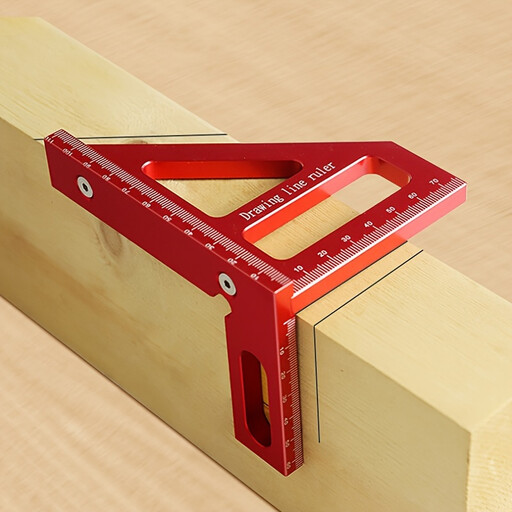
Why this product suits this user profile: This compact aluminium ruler is designed for occasional woodworking, drawing and DIY projects. The laser-engraved markings are intended to make readings easier.
The clearly visible engraving addresses the problem of hard-to-read scales. The aluminium construction is lighter than many solid steel tools.
Laser-engraved scale; compact design; intended for technical drawings, model making and woodworking.
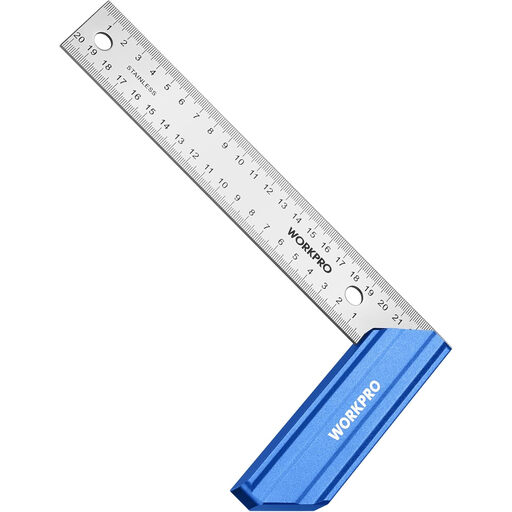
Why this product suits this user profile: This fixed-angle square is designed for users who regularly check and mark 90-degree lines.
The three-pin fixing joins the handle and blade. This reduces the risk of a loose connection during normal use, although drops should still be avoided.
200mm stainless steel blade; aluminium handle; metric and imperial scales; designed for 90-degree checks.
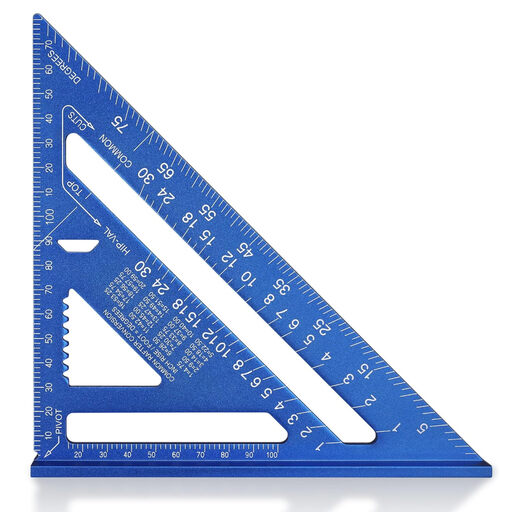
Why this product suits this user profile: This 180mm tool combines an angle finder, marking guide, ruler and potential saw guide for construction, roofing and woodworking tasks.
The functions are clearly specified: protractor scale, pivot point, marking guide and reference edge. This makes the range of applications easier to understand than a purely promotional claim.
Aluminium alloy; angle scale from 0 to 90 degrees according to the product details; metric and imperial graduations; 180mm design.
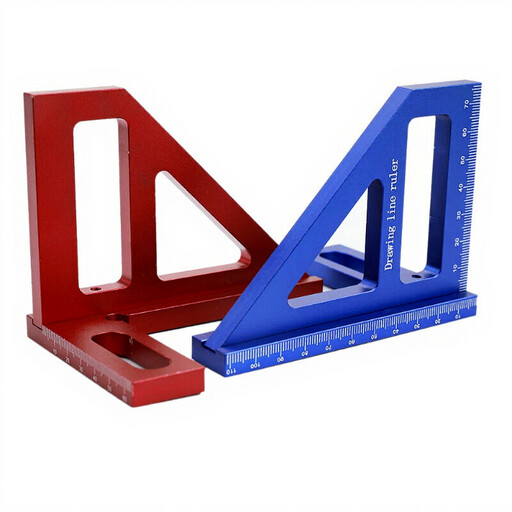
Why this product suits this user profile: This aluminium ruler is intended for technical drawings, model making and creative projects where several angles are needed within a limited working area.
The laser-engraved scale is designed for lasting use. The rigid aluminium construction addresses the risk of a flexible precision ruler shifting when marking out.
Anodised aluminium according to the product description; laser-engraved scales; intended for woodworking, drawing and model making.
For additional measuring tasks, you can find more suitable products in the Measuring Tools for Wood category.
We have put together a complete, regularly updated list of products that fully meet these strict selection criteria and the safety regulations applicable in the EU.
A fixed square with 90-degree geometry is suitable for checking and marking right angles. If you also need 30-, 45- or 60-degree lines, a multi-angle ruler or speed square with the appropriate scale is a good choice.
Its service life depends on the material, construction quality and how it is used. Aluminium is rust-resistant, but it can become distorted if dropped or subjected to sideways pressure. Store the tool in a dry place, clean the contact surfaces and do not use it as a lever or striking tool.
In many cases, yes. An angle finder checks geometric relationships, while a tape measure records lengths. For furniture making, interior fitting or larger timber panels, the two tools complement each other. For small drawing and model-making tasks, however, a ruler with a millimetre scale may be sufficient.