
Lieferung heute & morgen

Qualitätsgarantie

Willkommens-Angebote freischalten: KOSTENLOSE Lieferung | Bis zu 80 % RABATT | Kostenlose 30-Tage-JoyPlus-Testphase
App herunterladen
Written by: Joybuy Product Recommendation Officer Date: July 19, 2026
Long car journeys, whether it's the daily commute or a family holiday, put the batteries of modern mobile devices to the test. Often, multiple smartphones, a tablet, and perhaps even a laptop are all competing for the single 12V socket in the vehicle. The result is slow charging speeds and dead batteries upon arrival.
A multi-port car charger is a practical solution to this problem. However, the market offers a vast array of models with different power outputs, ports, and features. This article serves as your guide. It explains the key features you should look for when making your choice and presents a few models designed for different needs.
To find the right model for your needs, you should consider three central criteria: charging power, the type and number of ports, and the specific form factor.
The total power output of a charger is measured in watts (W). It determines how many devices can be charged simultaneously and how quickly. A simple 12-watt charger might be enough for a single smartphone, but for multiple devices or a tablet, higher power is necessary.
Look for support for fast-charging technologies. The two most common standards are:
For demanding tasks like charging a laptop in the car, a charger with a PD port that delivers at least 45 to 65 watts is a basic requirement.
A multi-port USB car charger should offer a combination of different port types to ensure maximum compatibility.
Consider how many devices you typically charge at the same time. Models with three or more ports offer flexibility for the driver, front passenger, and back-seat passengers.
The form factor affects practical, everyday use. Compact models sit flush with the dashboard and are very discreet. Other variants offer special features for specific needs:
Based on the criteria mentioned, we have compiled a selection of models that cover different use cases.
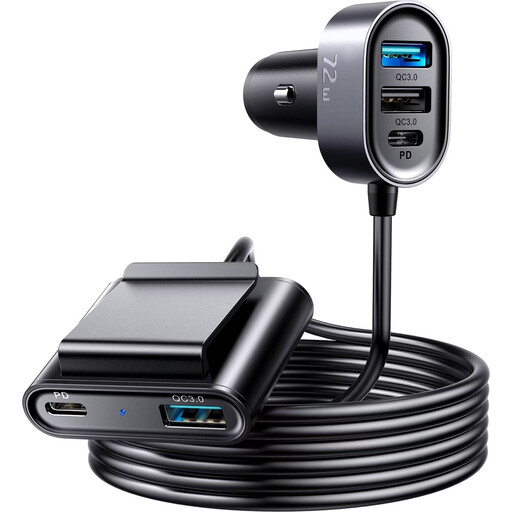
JOYROOM car charger 2xPD + 2xQC3.0 72W 1.5m black
Why it stands out: This model solves the problem of back-seat power with a separate hub connected by a 1.5-meter cable.
Advantages:
Who it's for: Ideal for families or carpools where back-seat passengers also need to charge their devices reliably and quickly.
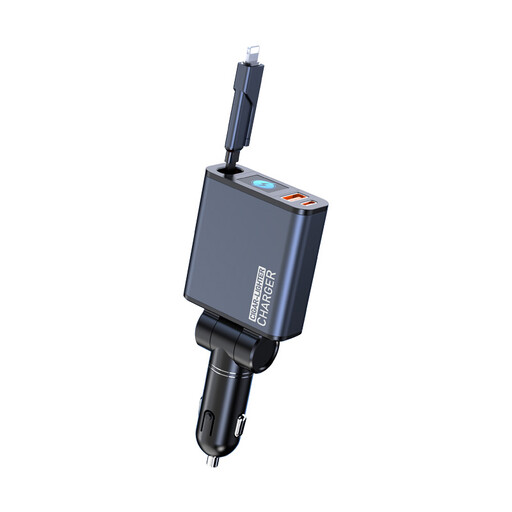
ATSHARK K006S 160W Car Charger Fast Charging
Why it stands out: With 160 watts of total power and two integrated, retractable charging cables, this device is designed for maximum performance and a tidy cockpit.
Advantages:
Who it's for: For commuters, field sales representatives, and tech enthusiasts who also want to charge a laptop in the car and value a clutter-free vehicle.
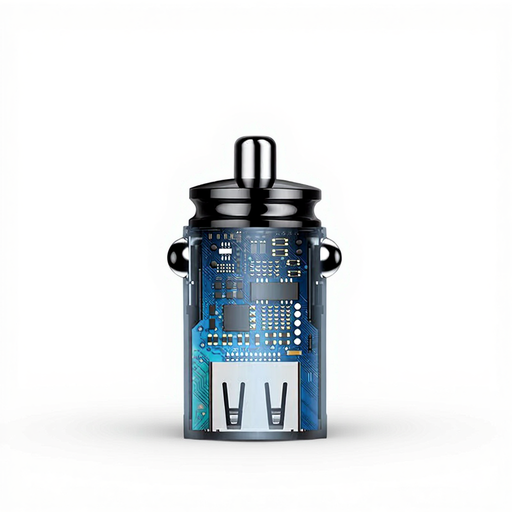
Baseus Circular Plastic A+C 30W PPS Car Charger Black
Why it stands out: An extremely compact and discreet charger that focuses on the essentials: fast and efficient charging for the driver or front passenger.
Advantages:
Who it's for: Perfect for individuals or drivers looking for a minimalist yet powerful charging solution for one or two devices.
If the models presented here don't exactly meet your requirements, you might find the right product in our broader selection of charging solutions. Discover more models and designs in the Car Charger Power Adapters category.
Modern car chargers have very low standby power consumption. In most vehicles, the power supply to the 12V socket is cut off anyway as soon as the engine is turned off. If the socket in your vehicle is permanently active, it is advisable to unplug the charger during long periods of non-use to prevent minimal battery drain.
These are two leading fast-charging standards. Power Delivery (PD) is a universal standard that primarily works via USB-C and can provide high power for a wide range of devices, including laptops. Quick Charge (QC) is a technology from Qualcomm, mainly used in Android devices. Many chargers support both standards to ensure broad compatibility.
The power requirement depends on the specific laptop model. Most modern ultrabooks require a charging power between 45 and 65 watts, delivered via a USB-C PD port. More powerful notebooks may require 100 watts or more. A look at the specifications of your laptop's original power adapter will provide clarity. A car charger that provides at least 65 watts on a single PD port is a good starting point.