
Lieferung heute & morgen

Qualitätsgarantie

Willkommens-Angebote freischalten: KOSTENLOSE Lieferung | Bis zu 80 % RABATT | Kostenlose 30-Tage-JoyPlus-Testphase
App herunterladen
Multicolour PLA 3D printer filament can make decorative models, figures, vases and gift ideas more varied without the need to change colour manually. The selection ranges from colour gradients to dual-colour filament, tri-colour filament and quad-colour filament. However, product images are not always enough to assess whether a filament is suitable for your own printer or intended project.
Three common purchasing misconceptions occur particularly frequently:
For many FDM printers, PLA filament 1.75 mm is the standard diameter. However, some devices use 2.85 mm. Before buying, compare the specifications of your printer and extruder with those of your existing filament holder.
The following are also important:
A PLA filament 1 kg spool is an economical choice for regular users, but it requires enough space on the spool holder. With an enclosed system, you should also check whether the spool fits inside the designated material compartment.
The finish has a greater effect on the visual appearance than the colour selection alone:
The terms “silk” and “matte” describe the surface appearance and do not automatically indicate greater dimensional accuracy or strength. For functional components, you should also consider temperature resistance, layer adhesion and mechanical requirements.
PLA is generally considered easy-to-print filament, provided it is stored in dry conditions and used with a suitable profile. Moisture may reveal itself through crackling during extrusion, stringing, bubbles or a rough surface.
Look out for:
With silk material, lower printing speeds and a small temperature test may be advisable. According to the product information supplied with the CaiLab Tri-Color filament, the stated nozzle temperature range is 195 to 220 °C; specific settings should nevertheless be adjusted to suit your printer, nozzle and model.
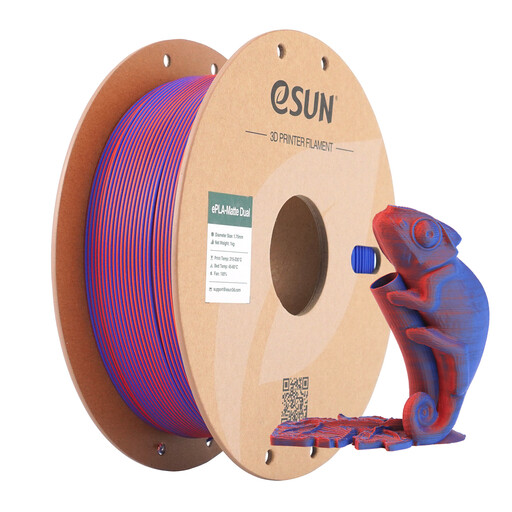
Why this product suits this profile: The 1.75 mm version and 1 kg spool are practical for many popular FDM printers. The red-and-blue combination creates a clearly recognisable two-colour effect for initial decorative projects.
The product description specifies a matte, non-glossy surface as well as a neatly wound, vacuum-sealed spool with desiccant. This makes it easier to check the filament before your first print.
1.75 mm, 1 kg, a matte two-colour appearance and low shrinkage according to the product information.
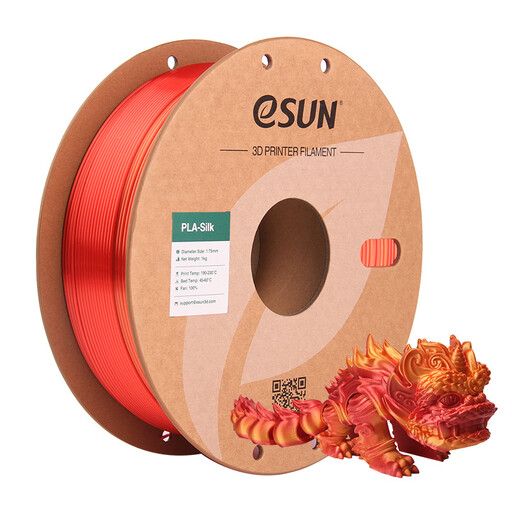
Why this product suits this profile: The combination of a colour gradient and silk finish is ideal for display pieces, vases and models where the way light interacts with the surface is an important design feature.
The specifications state 1.75 mm, a 1 kg spool, vacuum-sealed packaging with desiccant and tangle-free winding. You should still check that your printer is approved for use with it before buying.
Silk texture, rainbow colour gradient and stated suitability for most FDM printers.
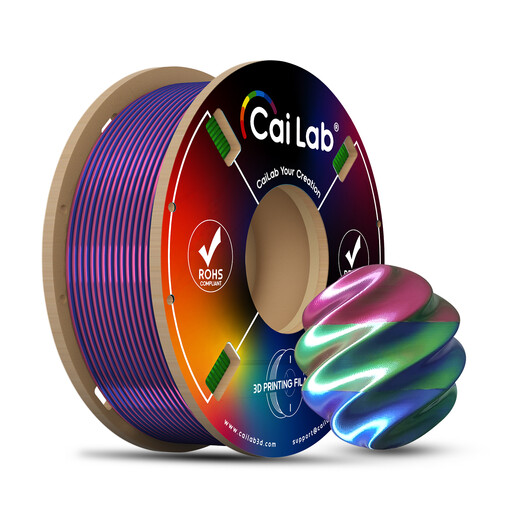
Why this product suits this profile: Three shades in a silk finish give model makers and craft enthusiasts more choice for figures, art objects and decorative series.
The product instructions explicitly recommend dry storage, a first-layer test and adjusting the temperature and speed. This allows the silk surface to be used more consistently.
Tri-colour version and documented guidance on storage, drying and printing settings.
We have put together a complete, regularly updated list of products that fully meet these strict selection criteria and the safety regulations applicable in the EU.
Before printing the complete model, it is worth carrying out a small temperature or colour-gradient test. This allows you to adjust the nozzle, printing speed and retraction without using an entire 1 kg spool or many hours of printing time. Actual running costs depend not only on the price per kilogram, but also on failed prints, support material, nozzle wear and electricity consumption.
For a longer service life, store filament in a sealed bag or container with desiccant after opening. If you notice excessive stringing or bubbles, drying it according to the manufacturer’s instructions may be necessary. Excessive temperature or an extruder that is set too tightly can affect the feed when using softer PLA.
Not automatically. First check the required filament diameter, available spool space and temperature range. For the products mentioned, the specification PLA filament 1.75 mm is particularly relevant. The wording “for most FDM printers” does not replace checking your own device’s technical specifications.
That depends on the model’s weight, infill, walls and support material. A small decorative object uses considerably less material than a large vase or a model with a high infill density. Slicer software displays an estimated material usage before printing.
The colour changes are arranged on the filament spool in a specific sequence and at specific lengths. As a result, a small model may show mainly one colour range, while a large or tall model reveals several transitions. For a predictable two-colour result, dual-colour filament is often easier to manage than a longer rainbow gradient.