
Lieferung heute & morgen

Qualitätsgarantie

Willkommens-Angebote freischalten: KOSTENLOSE Lieferung | Bis zu 80 % RABATT | Kostenlose 30-Tage-JoyPlus-Testphase
App herunterladen
A multifunction aluminium angle can do far more than a simple ruler when it comes to marking, measuring and checking mitres. At the same time, buyers are faced with many product promises that sound very similar. For joiners, carpenters, interior fitters and keen DIYers, it’s not just about a flashy colour or a long scale – what really matters are verifiable technical features.
A multifunction ruler with a protractor, saw guide and marking aid sounds versatile. However, if the scales are too small, poorly contrasted or inaccurately engraved, using them becomes unnecessarily difficult in dusty conditions, changing light or on dark materials. Hard-to-read markings can lead to measurement errors, especially on mitre cuts.
Aluminium is naturally lightweight and corrosion-resistant. But a very thin or poorly made version can deform under pressure. For a permanently reliable reference edge, the material needs to be sufficiently rigid. An anodised aluminium surface can help improve resistance to abrasion and surface corrosion, but it doesn’t replace careful handling.
If you work exclusively in millimetres, you don’t necessarily need an additional imperial scale. For technical drawings, international building plans or certain workshop projects, a combination of metric and imperial graduations can be handy. What matters is that the scales are clearly marked and permanently applied.
Look for a straight, cleanly machined aluminium edge with no visible burrs. With an aluminium square or a multi-angle ruler, the edge is the most important contact surface with your workpiece. It should sit flat on the wood and not shift easily under finger pressure.
An anodised surface is worthwhile for regular use because it can protect the markings and the surface from everyday wear and tear. For daily workshop practice, it’s still important to store the measuring tool dry and not to use it as a lever or stop.
Laser-engraved markings are less prone to rubbing off during normal use than printed lines. Check the following:
For technical drawings and model making, a precision ruler with a fine scale may be more suitable. For woodworking, a stable base and a clearly visible marking edge are also important.
A compact tool is easier to carry in a tool bag and works well in tight spaces. A longer version, on the other hand, can be an advantage when marking out boards, frames or parallel lines. For a saw guide, the straight edge should be long enough and sit securely against the workpiece.
Also consider the angle range. A protractor for woodworking with a scale from 0 to 90 degrees covers many standard tasks. For more complex geometries, you may need a differently designed multifunction ruler. The tool should suit the typical task, not just the number of integrated features.
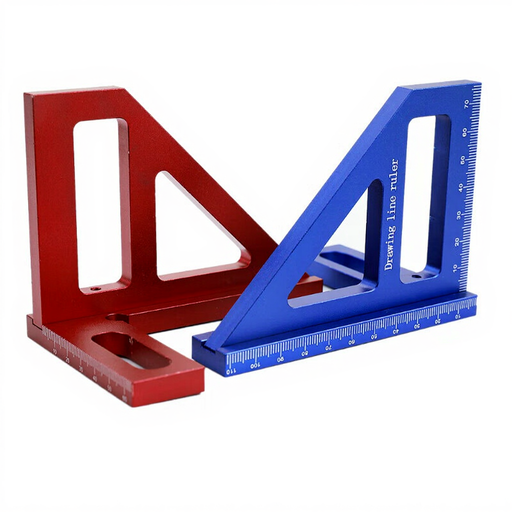
Why this product fits the profile: The blue version combines a lightweight anodised aluminium construction with a multi-angle design for simple measuring and marking tasks in the workshop, hobby room or on DIY projects.
According to the product description, the laser-engraved markings are designed for long-lasting readability and do not rely on a superficial printed scale.
Anodised aluminium; multi-angle design; laser-engraved markings according to the product description.
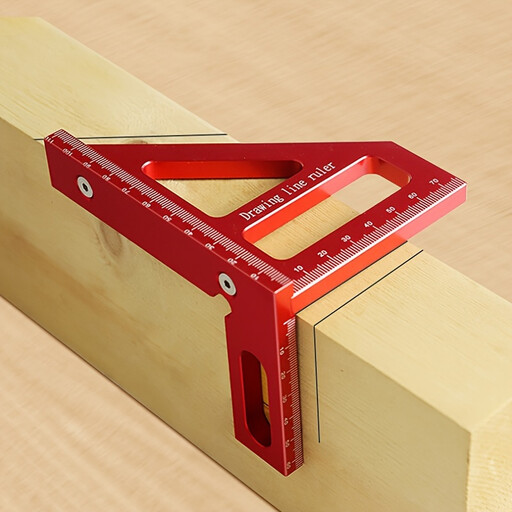
Why this product fits the profile: The red surface can stand out visually against light-coloured wood. The combination of metric and imperial scales suits users who work with different drawings or units of measurement.
The product description mentions laser-engraved metric and imperial graduations. This means the choice is based on specifically stated scales, not just on design.
Anodised aluminium alloy; two units of measurement; markings applied by laser according to the product description.
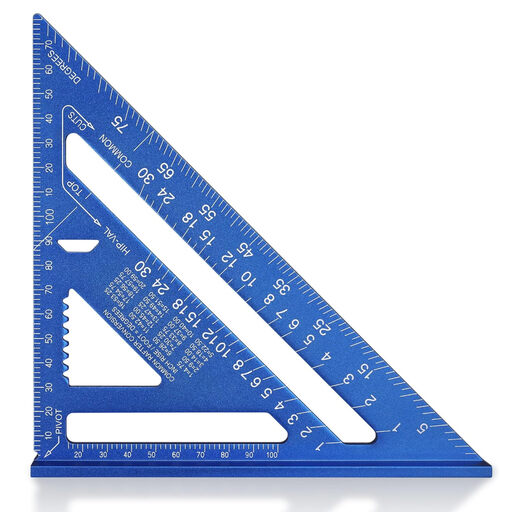
Why this product fits the profile: With a length of 180 mm, a pivot point, protractor, marking aid and saw guide, this carpenter’s square model is aimed at users with recurring tasks in timber construction, fitting or repairs.
The range of functions is clearly stated: protractor, mitre angle, linear saw guide, try square and ruler. This makes it easier to check whether the functions match your own workflow.
Aluminium alloy with a matt surface; scales in millimetres and inches; angle range 0–90 degrees according to the product description; weight 233 g.
We’ve put together a full, regularly updated list of products that fully meet these strict selection criteria and the safety regulations in force in the EU.
Before marking, place the multifunction angle fully against the edge of your workpiece. Check that no chips or dust are trapped between the stop and the wood. When using a saw guide, the tool should not slip during marking. For repeated measurements, it’s a good idea to mark a test piece first and then check the angle against a known reference.
For cleaning, a dry or slightly damp cloth is usually sufficient. Harsh cleaners can damage surfaces and markings. Store the measuring tool flat or protected from knocks. If an aluminium square becomes visibly bent, it should no longer be used as a reference for precise work.
It is used for measuring and marking lines, right angles, mitres and certain standard angles. Depending on the design, it can also be used as a try square, carpenter’s square or saw guide. Before buying, check that the angle range, length and stop suit your project.
The service life depends on the material thickness, workmanship and how it is handled. An anodised surface and permanently applied markings can reduce normal wear. However, drops, bending, moisture and using it as a lever can affect measuring accuracy.
For marking, such a tool can be suitable, provided the scale is clearly readable and the edge sits flat against the workpiece. The actual cutting accuracy also depends on the saw, workpiece fixation, cutting technique and checking the mark. A multifunction ruler therefore does not automatically replace every specialised mitre jig.