
Lieferung heute & morgen

Qualitätsgarantie

Willkommens-Angebote freischalten: KOSTENLOSE Lieferung | Bis zu 80 % RABATT | Kostenlose 30-Tage-JoyPlus-Testphase
App herunterladen
A multifunction sander can sand, polish, deburr, mill or remove paint, depending on its design. But the name alone tells you little about what it’s actually suitable for. A compact detail sander is designed for corners and furniture edges, while a 125 mm angle grinder is more suitable for metalwork and cutting tasks. A car polisher, meanwhile, needs different speeds and attachments from a sanding tool for wood.
So before you buy, it’s worth taking a closer look at the intended use, accessories and safety features.
A high no-load speed isn’t automatically suitable for every material. High speed can be useful for sanding metal or removing rust. But on plastic, painted surfaces or delicate finishes, it may remove too much material or generate heat. Variable speed gives you more control to match the tool to the workpiece and accessory.
Many listings mention a large number of attachments without clearly stating their dimensions or compatibility. Important details include:
A comprehensive set is only worthwhile if the included attachments suit your planned project.
Sanding wood, paint or rust creates fine dust. A dust collection bag can help keep your workspace cleaner, but it doesn’t automatically replace suitable personal protective equipment. A machine with a vacuum cleaner connection can be useful. Before buying, check whether an adapter is included and whether the connection fits your vacuum.
For corded tools, the wattage describes the electrical input power, but it doesn’t tell you on its own how quickly the tool will remove material. A 140 W or 200 W detail sander may be enough for light detail work. For larger polishing pads or longer sessions on vehicles, motor power, speed control and heat dissipation matter more.
A sander for wood should be easy to guide precisely along edges and into corners. Depending on the task, metalwork may call for a detail sander, a polisher or an angle grinder. Cutting work should only be carried out with discs designed for the job and a correctly fitted guard.
The right speed depends on the material, attachment and task. A mini rotary tool with several speed settings can be suitable for model-making, engraving, drilling and small polishing jobs. A cordless polisher with a low to medium speed, by contrast, is designed for waxing and polishing vehicle surfaces.
Look out for specifications such as:
A 125 mm angle grinder needs compatible discs and a secure guard. A polisher with 125 mm or 180 mm pads covers different areas from a 75 mm mini polisher. Cordless tools give you more freedom to move around, but you’ll need spare batteries or time to recharge. So check the voltage, battery capacity, charging time and what’s included. If the tool doesn’t come with a battery and charger, you may need to buy them separately.
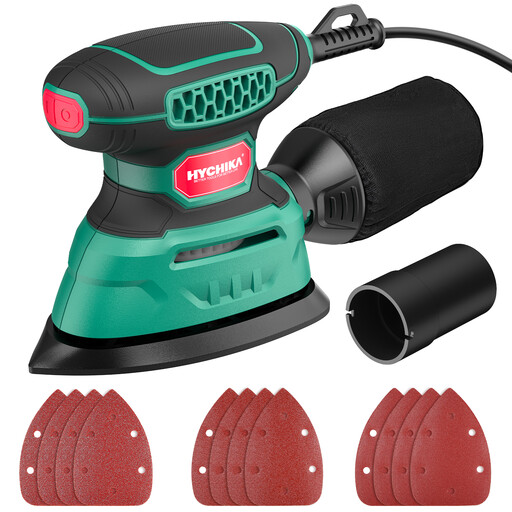
Why this product suits this type of user: This compact detail sander is designed for furniture, corners and smaller surfaces. With 13,000 OPM, three grades of sanding paper, a dust bag and a vacuum adapter, it covers typical DIY jobs.
The six-hole sanding plate, dust bag and adapter make dust extraction easier to understand than with tools that have no extraction option.
140 W motor, hook-and-loop fastening and 12 sanding sheets in P80, P120 and P240.
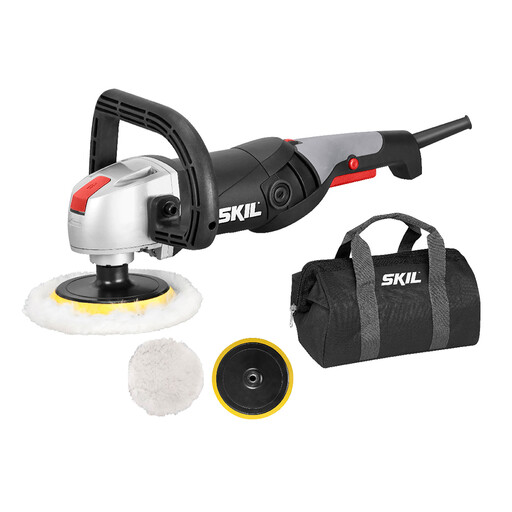
Why this product suits this type of user: With 1,300 W, soft start, constant speed and two polishing pads, this corded tool is designed for regular use on larger surfaces.
The adjustable speed and soft start reduce the risk of an abrupt start, while the included accessories clearly state which pad sizes are compatible.
125 mm and 180 mm polishing pads, D-handle, dust-protected ball bearings and replaceable carbon brushes.
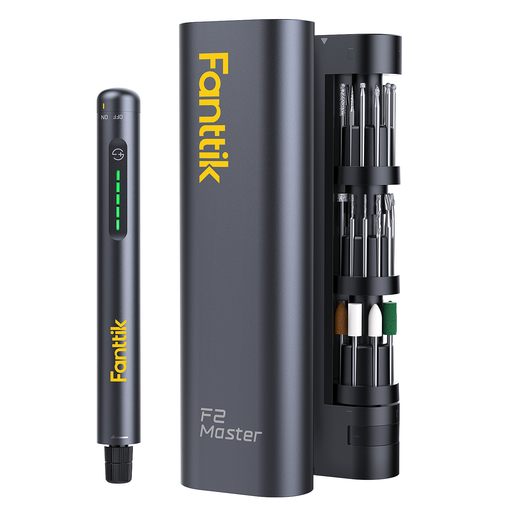
Why this product suits this type of user: This cordless mini rotary tool is aimed at model-makers, crafters and anyone who wants to engrave, drill, sand or polish in tight spaces.
The five speed settings and clearly specified 2.3 mm fitting make it easier to choose compatible accessories.
Up to 25,000 U/min, 35 accessories, USB-C charging and a stated weight of around 0.1 kg.
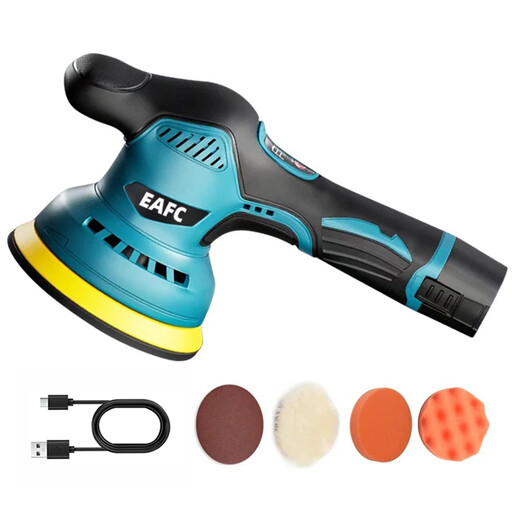
Why this product suits this type of user: This cordless polisher has a 125 mm pad, eight speed settings and an eccentric stroke. It’s designed for vehicle care and other polishing jobs.
The speed range of 2,800 to 5,500 U/min and the eccentric motion are specified more clearly than a vague claim about power.
12 V lithium battery, eight speed settings, 125 mm fitting and a stated eccentric stroke of 0.9 cm.
We’ve put together a complete, regularly updated list of products that meet these strict selection criteria and fully comply with the safety regulations in force in the EU.
Always wear safety goggles and suitable hearing protection before starting work. Depending on the material, you may also need a dust mask. When using an angle grinder, the guard, compatible accessories and a securely fixed workpiece are especially important. Only change accessories when the tool is switched off and unplugged, or when its battery has been removed.
Running costs include more than just electricity or replacement batteries. Sanding sheets, polishing sponges, cutting discs and carbon brushes may also need replacing regularly. In the long run, a tool that uses standard sizes and has accessories that are easy to find may be more practical than a seemingly cheaper model with specialist spare parts.
A detail sander with a compact base plate is well suited to furniture, edges and tight spaces. Look for a choice of sanding sheet grits, hook-and-loop fastening and dust extraction. For larger wooden surfaces, a different type of sander may be more cost-effective.
It depends on the area to be covered, how long you’ll be working and which accessories you need. A 125 mm pad, several speed settings and a spare battery are useful for mobile jobs. Before use, try the tool on an inconspicuous area at a low speed.
Check the guard, spindle lock, restart protection, handle positions and availability of compatible 125 mm discs. For cordless models, also consider the battery system, charger and what’s included. Cutting and grinding discs should only be used in accordance with their markings and the instructions.