
Lieferung heute & morgen

Qualitätsgarantie

Willkommens-Angebote freischalten: KOSTENLOSE Lieferung | Bis zu 80 % RABATT | Kostenlose 30-Tage-JoyPlus-Testphase
App herunterladen
A multi-function combination square can measure lengths, mark out angles and align workpieces when cutting. For joiners, carpenters, model makers, technical draughtspeople and DIY enthusiasts, it is therefore a practical addition to a folding rule, carpenter’s square and separate protractor. However, the design, scales and material quality can vary considerably.
Anyone who focuses only on a striking colour or a large number of printed angles may overlook important details. The following points will help you choose a suitable measuring tool for woodworking, technical drawings and craft projects.
A multi-angle square is only practical if it does not move while you are marking out. A smooth underside without a clearly defined reference edge can result in inaccurate lines on wood, paper or coated boards. A very thin construction can also deform easily under pressure.
Look for:
A scale is only useful if millimetres, centimetres and, where applicable, inches are clearly visible. Poorly printed markings, low contrast or a scale that does not extend to the actual edge can make precise marking out more difficult.
With an aluminium combination square, laser-engraved markings are generally worth considering over information printed onto the surface, as the product description states that they may remain permanently legible. Nevertheless, check before buying whether both sides are graduated and whether the scale suits the way you work.
A multi-function combination square can show fixed angles such as 30, 45, 60 and 90 degrees. However, freely adjustable or existing angles require a different design. For example, a carpenter’s square with a fixed 90-degree stop is particularly suitable for checking right-angled edges, while a speed square can also be used as a marking or sawing guide.
Aluminium is lightweight, corrosion-resistant and suitable for mobile use. With an anodised aluminium ruler, the surface may also be protected against wear and oxidation. However, this does not automatically mean that every model can withstand the same level of use. Check the material specifications, dimensions and edge construction carefully.
Stainless steel offers high durability and is suitable for users who frequently work in the workshop or with metal and wooden components. An aluminium-alloy handle can make the tool easier to use. It is still important not to use the tool as a lever or hammer and to protect it from falls.
For many German workshops, a metric scale in millimetres and centimetres is essential. An additional inch scale can be useful if you work with international building plans, imported products or English-language instructions.
Also check:
A short model is handy for model making and detailed work. For boards, furniture components or longer marking lines, a larger carpenter’s square or separate precision ruler may be more suitable.
A protractor for woodworking should suit the angles you actually need. For standard tasks, 90 degrees and common mitre angles such as 45 degrees are particularly relevant. A model with additional 30- and 60-degree lines is suitable for geometric marking and certain joint constructions.
An integrated roller, pivot point or non-slip edge can make guiding the tool easier. However, these features do not replace checking the workpiece. Before sawing or drilling, visually check the marking again and, if necessary, verify it with a separate measuring tool.
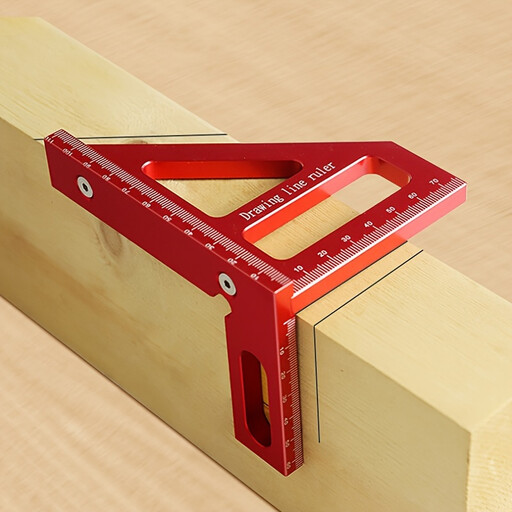
Why this product suits this profile: This compact multi-function aluminium combination square is designed for occasional woodworking, craft projects and technical sketches. The red surface makes it easier to find in your toolbox.
The product description refers to a robust aluminium construction and high-contrast, laser-engraved markings. This addresses two typical problems: difficult-to-read scales and a surface that wears quickly.
Lightweight aluminium construction and multi-angle design for various marking tasks on the workbench.
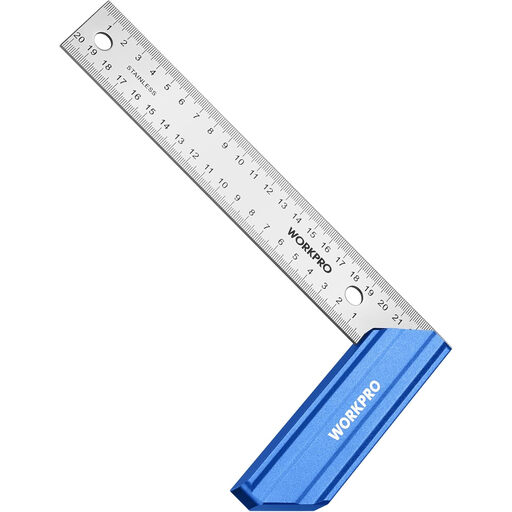
Why this product suits this profile: For joiners, carpenters and workshop users who frequently check right angles and need scales on both sides, this 200-mm model has a clearly defined purpose.
According to the product details, the stainless-steel blade is 2 mm thick and attached to the aluminium handle with three-point fixing. Passivated edges reduce sharp burrs during handling.
Stainless-steel blade, aluminium handle and metric and imperial scales on both sides; designed for 90-degree checks.
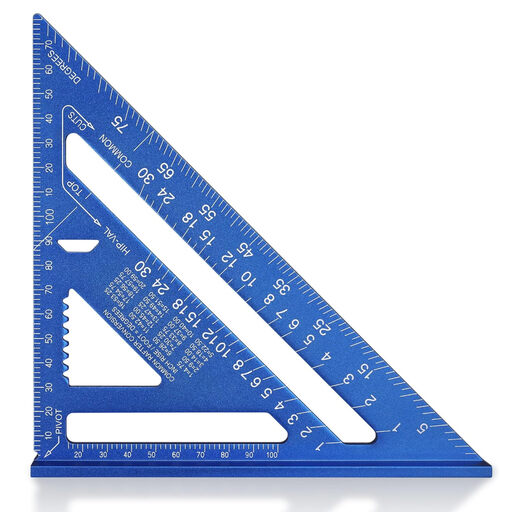
Why this product suits this profile: This speed square is aimed at users who want to combine angle measurement, marking out and potential sawing guidance in one compact tool.
The design combines a pivot point, protractor and straight guide. This makes its intended use clearer than a ruler with merely decorative extra markings.
Aluminium alloy, 180 mm length, metric and imperial scales, plus a stated angle range of 0 to 90 degrees.
We have put together a complete, regularly updated list of products that fully meet these strict selection criteria and the safety regulations applicable in the EU.
Place the ruler against a clean edge and keep it flat while marking out. On wood, remove dust, shavings and resin residue, as these can affect the support surface. For precise cuts, use a fine marking awl or a sharp pencil rather than a broad mark.
After use, a dry or slightly damp cloth is usually sufficient. Store the measuring tool in a dry place and avoid putting pressure on long, thin edges. A fall can affect its alignment or calibration. If you use it regularly, occasionally check a known 90-degree angle against a reference.
It is suitable for measuring lengths, marking out fixed angles and checking straight edges. Typical applications include woodworking, model making, technical drawings, furniture assembly and DIY projects. For freely adjustable angles, an adjustable protractor may be the more suitable addition.
Accuracy does not depend on the material alone. A straight edge, stable construction, correctly positioned scales and careful handling are all crucial. Aluminium can be dimensionally stable and lightweight, while plastic may offer greater flexibility for certain craft or drawing tasks.
There is no universal service life. It is influenced by the material, frequency of use, storage and protection from impacts. Clean the edges regularly, do not use the ruler as a lever and store it where it cannot be bent or placed under strain.