Which type of microphone is right for you?

Speakers recording from a fixed position

If you record commentary mainly sitting or standing in the same place, you can speak into a desktop microphone from a close, consistent distance. Shure explains that the distance between the sound source and the microphone affects the signal level.

Beginners recording on a computer

If you want to record without a separate audio interface and monitor your levels or voice as you speak, the specific model’s connections and controls are important. Audio-Technica describes USB as a way to connect a microphone to a compatible computer without a separate audio interface.

Speakers who need to move around

If you move away from your usual recording position, a lavalier microphone clipped to your clothing is more likely to stay with you than a desktop microphone. Zoom describes the F2 as a portable recorder with a lavalier microphone; check which version is right for you before buying.

What should you consider when choosing?

Buying consideration What to check before buying Who is it important for?
Clear speech in the room Polar pattern, microphone direction and a practical position close to your mouth; listen to a test recording made in the intended location. If I’m recording in an untreated room, I want to capture my voice as directly as possible and keep the distance consistent. Around 36% of consumers prioritise clear speech, even when room sound is audible.
Easy computer connection Check the available ports, the cables you’ll need and what’s included with the specific version; XLR requires a suitable microphone input. If I want to record on my computer without any fuss, I need a suitable connection that doesn’t make the setup unnecessarily complicated. Around 29% of consumers prioritise an easy way to get started with computer recording.
Freedom to move Consider whether you’ll actually leave your usual recording position; with a lavalier setup, test the clip and connection in a trial recording. If I move around while speaking, I want the microphone to stay with me rather than be left on the table. Around 21% of consumers prioritise freedom of movement.
Monitor your sound as you record Check whether the specific model has a headphone output and the level controls you need for your chosen connection method. If I want to monitor the sound during longer recording sessions, I need a way to check my voice and levels directly. Around 14% of consumers prioritise real-time monitoring and control.

Which mistakes should you avoid?

  • Assuming a cardioid polar pattern means a recording will be free from echo

    A cardioid polar pattern picks up sound differently depending on its direction of arrival; the room and your distance from the microphone still affect the recording. For the ATR2100x-USB, Audio-Technica describes reduced unwanted noise from the sides and rear, not the elimination of room echo.

    Point the microphone towards the speaker, keep the distance as consistent as possible and listen to a test recording made in the actual room.

  • Assuming USB/XLR means you can use the same accessories with either connection

    USB and XLR are different connection methods. XLR requires a suitable microphone input, and the cables and other accessories you need may vary depending on the product and what’s included.

    Decide which connection you’ll use first, then check the ports you need and what’s included with the version you’ve chosen.

    For an XLR setup, you may also need a suitable interface or a recorder with a microphone input.

  • Choosing a desktop microphone when you move around as you speak

    Your distance from a fixed microphone changes when you leave your recording position. This affects the conditions for recording your voice.

    If moving around is part of your routine, consider a portable lavalier setup and test the clip with the movements you expect to make.

Key microphone brands at a glance

Audio-Technica

The ATR2100x-USB is an option for recording your voice from a fixed position if you’re interested in both USB and XLR.

  • Audio-Technica describes this model as a dynamic microphone with a cardioid polar pattern, USB-C, XLR and direct headphone monitoring.
  • XLR requires a suitable microphone input, and speaking into the microphone from a close, consistent distance is still important.

RØDE

The dynamic PodMic USB combines USB-C and XLR for recording your voice from a fixed position.

  • According to RØDE’s datasheet, the model offers headphone monitoring via its digital output, as well as features to reduce plosive and vibration noise.
  • These features don’t prove that a recording in an untreated room will be free from echo. XLR requires a suitable recording device.

Shure

The dynamic MV7+ is a USB-C/XLR option with digital controls.

  • Shure promotes automatic level adjustment and digital noise processing for the MV7+.
  • This doesn’t independently confirm how well these features work in your room. Check app compatibility and choose a suitable stand option.

Sennheiser

The Profile USB is a USB-C condenser microphone for recording at a fixed computer setup.

  • Sennheiser lists controls for gain, mix and volume, as well as a headphone output.
  • Its desktop design is less suitable if you need to move around freely while speaking; a cardioid polar pattern alone won’t eliminate room echo.

Zoom

The F2 is a portable recorder with a lavalier microphone, making it a different option from a desktop microphone.

  • Zoom lists 32-bit float recording and a lavalier microphone with a locking connector for the F2.
  • These manufacturer specifications alone don’t tell you how the microphone will handle contact with clothing or how well it will record in a particular room. Versions with and without Bluetooth are not interchangeable.

Microphones for voice recording at Joybuy

The product options below include desktop microphones for recording from a fixed position and lavalier systems for recording your voice while moving around.

FIFINE AM8 USB/XLR microphone with desktop stand

FIFINE AM8 USB/XLR Microphone

For recording your voice from a fixed position with a USB or XLR connection.

USB-C, XLR and a headphone jack with volume control; a desktop stand is listed. According to the product description, an XLR cable and microphone arm are not included for XLR use; you’ll also need a suitable microphone input.

View at Joybuy

Razer Seirén V3 Mini White USB microphone

Razer Seirén V3 Mini White USB Microphone

For directional voice recording from a fixed position, with an adjustable tilt stand.

USB-C, a supercardioid polar pattern and tap-to-mute are listed for this version.

View at Joybuy

DJI Mic Mini 2S with two transmitters, one receiver and charging case

DJI Mic Mini 2S (2 TX + 1 RX + Charging Case)

A portable option for recording your voice, with a lavalier microphone attached to the speaker.

The product is listed as a set with two transmitters, one receiver and a charging case.

View at Joybuy
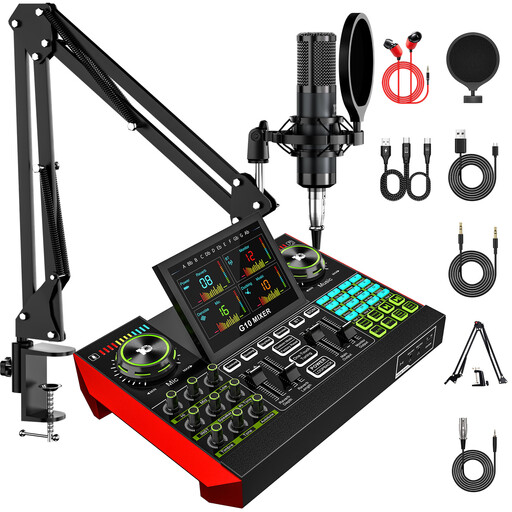
Yinkaer G10-P15-XB microphone kit with mixer and microphone arm

Yinkaer G10-P15-XB Microphone Kit

For a fixed recording position if you want a microphone arm and audio mixer as part of your setup.

The product title lists a 3.5 mm condenser microphone, an audio mixer or sound card, and a microphone arm. Check that the connections are compatible with your recording device.

View at Joybuy

Moman MS1X(C) wireless lavalier microphone for USB-C Android phones

Moman MS1X(C) Wireless Lavalier Microphone

For recording your voice while moving around, with the microphone clipped to your collar.

The set is listed with two transmitters and one receiver; according to the product details, the receiver is designed for USB-C Android phones.

View at Joybuy

Frequently asked questions

Do I have to use a dynamic microphone to deal with room echo?

No. Your distance from the microphone, its direction and the room itself all affect the recording. A directional microphone used at close range is a sensible starting point; check the result with a short test recording in the intended location. A cardioid polar pattern alone won’t guarantee a recording free from echo.

Do I need an additional audio interface for a USB/XLR microphone?

You don’t necessarily need a separate audio interface to record directly over USB on a compatible device. For the analogue XLR connection, you’ll need a suitable microphone input, such as one on an interface or recorder. Check the connections on the specific version.

How can I check my microphone setup before a longer recording?

Record a short passage from the planned position and listen back with headphones. Check that your distance stays consistent, and listen for plosives, level issues and background noise. If you’re using a lavalier, also test that it stays in place as you move as intended.

What should I check is included before buying for my setup?

Compare what’s included with the specific version against the equipment you already have. Depending on the connection method, you may need a stand or arm, cables, headphones and, for XLR, a suitable microphone input.

Can I record commentary directly in a museum?

There’s no single answer that applies to every museum in Germany. The Staatliche Museen zu Berlin require prior registration and approval for audio work in their buildings; check the rules with the museum concerned. Section 201 of the German Criminal Code (StGB) concerns the unauthorised recording of another person’s privately spoken words. Whether a statement is private must be assessed in its specific context.