Quiet voice at a speaking spot
If you record individual pieces of narration in a fixed spot, you can check the microphone distance and level before each recording.


For a fixed speaking spot, a USB microphone used close to the speaker is worth considering. For a tour, a lapel microphone is a suitable option as it stays with the person speaking. RØDE points out that placing a microphone too far away can make the voice sound distant and bring more of the room into the recording. So check the recording location, connections and number of speakers with a test recording rather than simply turning up the gain.
If you record individual pieces of narration in a fixed spot, you can check the microphone distance and level before each recording.
For someone who is speaking while moving around, a wearable microphone can keep a more consistent distance from their voice and leave their hands free.
If two people are speaking at the same time, check before buying that the specific set actually includes two transmitters or microphones.
| Buying consideration | What to check before buying | Who is this important to? |
|---|---|---|
| Recording a quiet voice clearly | Record one quiet sentence and one spoken at a normal volume using the actual speaker’s voice, then listen back through headphones. | If I’m recording individual, quiet pieces of narration, I want to hear the voice clearly at a fixed spot; around 31% of consumers put this first. |
| Keeping echo and background noise to a minimum | At the planned location, listen out for pauses, ventilation and typical background noise; if possible, also try recording at a quieter time. | Anyone recording in a noticeably lively space will want to stop the surroundings from overpowering the narration; around 25% of consumers prioritise this. |
| Moving freely while speaking | Attach the microphone to the clothes you’ll actually wear and listen for rustling and connection problems as you walk. | If I need my hands free during a tour, the microphone should stay with the person speaking; roughly 19% of consumers prioritise freedom of movement. |
| Recording two voices at the same time | Check how many transmitters are included and make a test recording with both voices together. | For conversations involving two people speaking at once, the equipment needs to work for both; around 13% of consumers focus mainly on this. |
| Choosing compatible connections and accessories | Check the recording device’s connections, the cable required and what is included with the specific set. | If I want to connect my existing recording equipment and microphone without incompatible connections, compatibility matters; around 12% of consumers put it first. |
If the microphone is too far away, increasing the gain can also make background noise more noticeable.
First, improve the distance, positioning and recording location. Then listen to a test recording of the actual speaker’s voice through headphones.
If the voice and room noise are amplified together, you may need to re-record or do additional editing.
DJI offers Mic Mini sets with one or two transmitters; a set for one person is not automatically equipped for two people speaking at the same time.
Decide how many people need to wear a microphone at once and check what’s included with the exact set variant.
If you need another transmitter, you’ll also need to set it up and test it before recording.
DJI describes the maximum range as a reference value measured in an open environment free from interference. A museum does not automatically offer these conditions.
Test the wireless connection along the actual recording route, and consider how close the microphone will be to the speaker when choosing.
USB, XLR and wireless models need different connections. Cables and mounts also vary by model and set.
Check the exact model and set name against the recording device’s connections and the listed contents.
DJI describes the Mic Mini as a wireless solution available in versions for one or two speakers.
Shure describes the MV7+ as a dynamic USB microphone for close-miking one voice at a fixed recording spot.
The Profile USB is described as a microphone for a fixed USB recording setup; the MKE 600 is a shotgun microphone with an XLR connection.
The AT2020USB-X is a USB condenser microphone for a fixed recording spot.
RØDE describes the Wireless Micro as a compact wireless solution for smartphones, with two clip-on transmitters.
The following Joybuy products include wired microphones for a fixed spot, as well as clip-on and wireless options for narration on the move. For each model, check that the connection, set and accessories are compatible with your recording device and the number of speakers.
 No image available
For a fixed speaking spot where the microphone can be positioned close to a quiet voice.
Dynamic microphone with USB and XLR connections, headphone jack, volume control and boom arm. For a better input level, the product description recommends a distance of 2–6 inches; it also states that an XLR cable is not included.
 No image available
For a fixed recording spot if you’re considering a set with USB and XLR connections.
The product name lists RGB, gain control, echo, mute and a table stand. Before buying, check which connections and accessories are compatible with the specific set variant and recording device.
 No image available
For a fixed PC recording setup if a USB condenser microphone is compatible with your existing device.
The product details list a headphone connection for direct monitoring. Before recording, check how the quiet voice and room noise sound in the planned location.
 No image available
For narration on the move when you want to wear the microphone on your clothes.
The product description lists a clip and a 3.5 mm connection. Check that this connection works with your recording device.
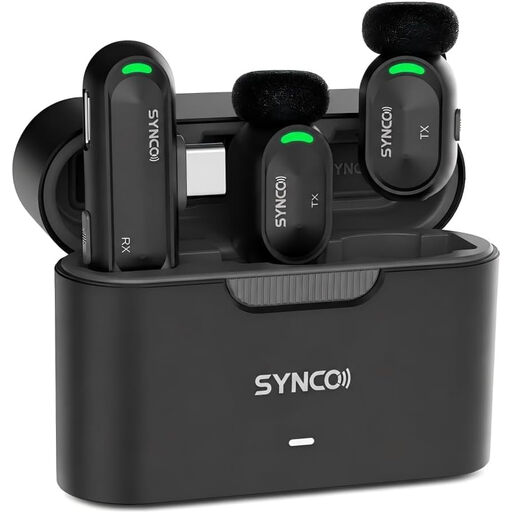 No image available
For recording speech on the move with an Android device, provided the USB-C connection is compatible with your recording device.
The product name describes a wireless microphone for Android devices with USB-C. Check the connection with your specific recording device before use.
Record one quiet sentence and one spoken at a normal volume at the actual recording location. Listen through headphones to check clarity, echo, contact with clothing and background noise. Adjust the position and distance first, rather than simply turning up the gain.
If both people are to wear a microphone, look for a set with two transmitters. DJI describes the Mic Mini as available with one transmitter for individual recordings and two transmitters for two people; check what’s included with the specific variant.
It depends on the model and the recording device you already have. The shock mount for the AT2020USB-X is optional; the Sennheiser MKE 600 needs a compatible XLR signal path and phantom or battery power. Check the mount, cable and recording device together.
Choosing a microphone does not in itself give you permission to record. Section 201 of the German Criminal Code (StGB) covers the unauthorised recording of another person’s privately spoken words. If personal data is being processed, the organisation responsible must establish an appropriate legal basis under the GDPR in advance; consent is one possible basis, but not the only one. Before recording and publishing, clarify the purpose, who will be affected and what permissions apply.