What should you look for when choosing?
First decide how you want to use the mushrooms. Then consider batch capacity, how you’ll check they are dry and the time and effort involved.
| Buying criterion |
What to look for |
Who should pay particular attention? |
| Batch capacity |
Compare tray dimensions and the stated total drying area with the size of your usual batch of mushrooms. |
If I want to lay out as many slices as possible in the fewest batches, I compare the usable area rather than just the number of tiers. Batch capacity is the top priority for around 36% of consumers. |
| Drying or freezing directly |
Before buying, decide whether you want dried mushrooms or prepared portions for the freezer. The National Center for Home Food Preservation describes steaming or pan-heating them before freezing. |
If portions of mushrooms from the freezer will suit me, I first check whether freezing them directly meets my needs. Around 29% of consumers prioritise this freezing method. |
| Drying and storage |
Look for information about air circulation and check the pieces before packing them away. The German Federal Institute for Risk Assessment identifies insufficient drying and incorrect storage as conditions that can encourage mould. |
If I have slices of different thicknesses, I want to check how dry they are rather than relying on the timer alone. Around 21% of consumers prioritise checking the drying process and storing mushrooms in a dry place. |
| Ease of use and ongoing costs |
Compare the timer range, cleaning instructions and availability of compatible replacement trays; the rated power alone doesn’t tell you how much electricity will cost. |
If I use the appliance frequently, I check how easy the trays are to clean and whether I can add more if needed. Around 14% of consumers put ease of use and potential ongoing costs first. |
Selected products at Joybuy
This selection is for anyone who wants to dry mushrooms to use as an ingredient. If you’d rather freeze prepared mushrooms directly, you don’t automatically need a dehydrator for this step.
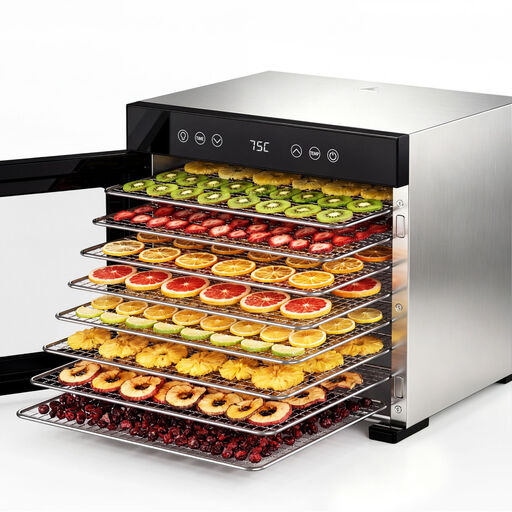 Image unavailable
Havenwell dehydrator with 8 stainless-steel drying trays
The product title specifically lists mushrooms as suitable for drying and mentions eight trays for drying food on several levels.
35–85 °C; timer: 48 hours; power: 650 W; touch display; interior light.
Before buying, check the details for the specific listing to see which parts are intended to come into contact with food.
View at Joybuy
Frequently asked questions
Do I need to dry mushrooms before freezing them?
No. For freezing mushrooms directly, the National Center for Home Food Preservation describes preparing them by steaming or pan-heating, then cooling and packing them. Drying is a separate method for keeping mushrooms dried, and isn’t required for this way of freezing them.
How should I prepare mushrooms for drying, and is the timer enough to tell me when they’re ready to pack away?
Use mushrooms that are in good condition and have been reliably identified as edible. Clean them and slice them for drying. Check how dry they actually are rather than relying on the timer alone: the German Federal Institute for Risk Assessment identifies insufficient drying and incorrect storage as conditions that can encourage mould.
Does drying or freezing make wild mushrooms safe to eat?
No. The German Federal Institute for Risk Assessment warns that wild mushrooms can be dangerously confused with poisonous varieties. Penn State Extension notes that cooking or drying doesn’t reliably remove mushroom toxins. Only store mushrooms that have been reliably identified as edible.
Is a guarantee the same as your statutory rights if a dehydrator is faulty?
No. The Verbraucherzentrale distinguishes statutory consumer rights against the seller from a voluntary guarantee. If a product is faulty, repair or replacement may be available in the first instance. Check the terms of any specific guarantee separately.
What requirements are relevant when buying a dehydrator in Germany?
On the EU market, parts intended to come into contact with food must meet the requirements for food-contact materials, including Regulation (EC) No 1935/2004. For electrical products, the Bundesnetzagentur lists CE marking, manufacturer identification and instructions in German among the points checked during market surveillance. These requirements don’t prove that a particular listing complies.


