For small batches of mushrooms and limited storage space, a compact stackable dehydrator is usually the better choice. If you regularly dry larger quantities, a model with pull-out trays and more drying space may be suitable, provided you have room for it in the long term. Manufacturers’ claims about quiet operation are not comparable noise measurements for a shared kitchen. The German Federal Institute for Risk Assessment warns that poisonous mushrooms can look very similar to edible ones. Only dry mushrooms you have identified with certainty, and check they are completely dry before storing them.
Which type of dehydrator is right for you?
Shared flat with limited kitchen space
If you dry smaller quantities and share your worktop and storage space, pay particular attention to the appliance’s footprint, whether the trays can be packed away, and whether its running time will suit your housemates.
Regular mushroom dryer
If you often dry larger batches, usable drying area and easy-to-access trays are key. A larger appliance is only practical if it can stay in the shared kitchen long term.
For easy cleaning
If the appliance is shared, trays that can be removed individually make it easier to reach the surfaces that come into contact with food. Always follow the cleaning instructions for your particular model.
What should you look for when buying?
Compact stackable dehydrator
A good fit if: You tend to dry smaller batches and want to put the appliance away after use. According to the manufacturer, the Rommelsbacher DA 350 has five removable, height-adjustable tiers and a footprint of 31,50 × 33,70 cm.
Consider: Check how much drying space is actually available per batch and how much clearance the appliance needs above it. Manufacturers’ claims about quiet operation do not allow for a direct comparison of noise levels.
Larger dehydrator with pull-out trays
A good fit if: You regularly dry larger quantities and have space to leave the appliance out. According to the manufacturer, the Graef DA506 has six removable racks and 0,65 m² of drying area; the Rommelsbacher DA 950 has six stainless steel trays and 0,6 m² of drying area.
Consider: More drying space takes up more room. So compare the appliance’s external dimensions, how easy the trays are to access, and how to clean them according to the manufacturer’s instructions.
| Feature |
What to check before buying |
Who should pay particular attention? |
| Space and consideration for others |
Check the external dimensions, storage requirements and airflow; don’t assume “quiet” means a measured dB level. |
If I need to set the appliance up in a shared kitchen and put it away afterwards, every bit of space matters. Around 25% of consumers prioritise space and consideration for others. |
| Thorough drying |
Compare the temperature settings, airflow and access to the trays; check the dried food before storing it. |
If I dry mushrooms for storage, I want to be able to check the batch rather than rely on the timer alone. Around 25% of consumers prioritise drying results. |
| Cleaning after use |
Check whether the trays can be removed individually and which cleaning methods are allowed in the instructions. |
If several people use the appliance, I want to be able to remove the trays easily and clean them according to the instructions. Around 20% of consumers focus primarily on ease of care. |
| Drying area per batch |
Compare the drying area, as well as the number and dimensions of the racks; allow space for air to circulate around the food. |
If I regularly process larger quantities, I need enough drying space without permanently taking over the shared worktop. Around 15% of consumers prioritise batch size. |
| Controls and energy consumption |
Check for a timer and automatic shut-off; measured kWh gives a more useful indication of a batch’s energy use than the rated power alone. |
If I want to plan running times and keep track of energy use, I need figures that reflect the actual drying process. Around 15% of consumers pay particular attention to controls and energy consumption. |
Which common assumptions should you avoid?
-
Assuming “quiet” means it’s suitable for a shared flat
Manufacturers’ descriptions of quiet operation are not noise measurements taken under the same conditions. You can’t use them to rank appliances for a shared kitchen.
Agree running times with your housemates, and don’t treat a description of the noise level as a measurement.
-
Assuming the timer ending means the mushrooms are completely dry
The German Federal Institute for Risk Assessment notes that inadequate drying and incorrect storage can encourage mould growth.
Check the dried food before storing it, regardless of the time set on the appliance.
-
Taking the wattage as the energy used for a batch
An appliance’s rated power doesn’t tell you how much energy a particular drying cycle uses.
Compare the energy used, measured in kWh, for a similar drying cycle rather than working it out from the wattage alone.
Which brands are worth considering?
Rommelsbacher
The DA 350 and DA 950 illustrate two different designs: a stackable model and a larger appliance with trays.
- Rommelsbacher specifies five removable, height-adjustable tiers and 0,42 m² of drying area for the DA 350. For the DA 950, the manufacturer lists six stainless steel trays and 0,6 m² of drying area.
- The manufacturer’s claims about quiet operation are not comparable noise measurements across the models.
WMF
The KÜCHENminis Snack to go food dehydrator is a compact model with stackable racks.
- WMF lists five stackable racks, a temperature range of 30 to 70 °C and a programmable timer of up to 24 hours.
- The description “quiet” does not include a comparable dB measurement for use in a shared kitchen.
Graef
The DA506 is a pull-out tray model with removable racks and a larger stated drying area.
- Graef specifies six removable plastic racks, 0,65 m² of drying area and a timer of up to 40 hours for the DA506.
- Before buying, check the model’s current instructions for its lowest temperature setting.
Food dehydrators at Joybuy
The Joybuy products below are food dehydrators for temperature-controlled drying across several trays. Compare the appliance dimensions with the space available in your kitchen.
 No image available
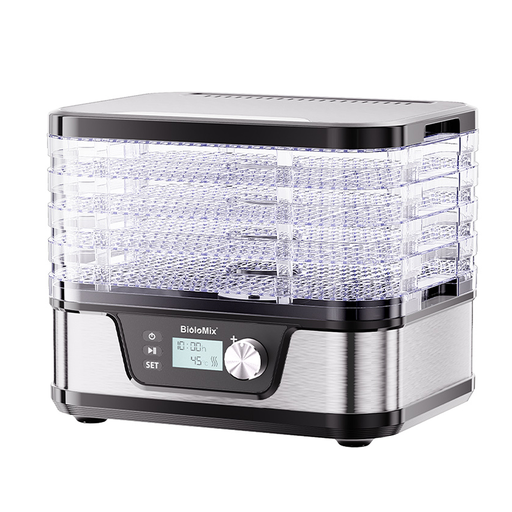
BioloMix BFD1300 food dehydrator, 5 trays
For temperature-controlled drying across several tiers, with an adjustable timer.
5 trays; 35–75 °C; timer up to 24 hours; 360° hot-air circulation.
View at Joybuy
Frequently asked questions
Does drying make unidentified, foraged mushrooms safe to eat?
No. Drying is no substitute for identifying mushrooms with certainty. The German Federal Institute for Risk Assessment warns that poisonous mushrooms can look very similar to edible ones. Only dry mushrooms that have been positively identified as edible, and seek expert advice if you’re unsure.
What should I check before storing dried mushrooms?
Check the batch for any remaining moisture and only store it once it is completely dry. The German Federal Institute for Risk Assessment lists inadequate drying and incorrect storage as conditions that can encourage mould growth.
How do I clean a food dehydrator after using it in a shared kitchen?
Remove the racks or trays and clean them according to the instructions for your appliance. Removable trays are not necessarily dishwasher-safe.
How do I compare the energy use for a batch of mushrooms?
Compare the measured kWh for a similar drying cycle. The wattage shown on the appliance alone doesn’t tell you how much energy a batch uses.
Who should I contact if my newly purchased appliance is faulty?
In Germany, the seller is generally responsible for statutory consumer rights; a voluntary guarantee is separate. The Verbraucherzentrale recommends keeping a written record of any assurances and guarantee terms where appropriate.


