Who is a food dehydrator for?

Batch cooks preparing larger quantities of mushrooms

If you want to prepare mushrooms for several future meals, compare the usable drying area, airflow and storage options. The Federal Centre for Nutrition and Rommelsbacher offer guidance on preparation and drying; choose a machine size that suits the batches you usually make.

Everyday cooks with changing mealtimes

If you prepare smaller stocks of mushrooms in advance, consider how well the temperature controls and timer fit into your daily routine. WMF and COSORI list these adjustment options in their product information.

Occasional users with limited kitchen space

If you only dry mushrooms now and again, weigh up the space it takes up and the effort involved in cleaning against the benefits of having another appliance. The Federal Centre for Nutrition describes oven drying as energy-intensive, while comparison results from Haus & Garten Test point to the potential storage benefits of stackable models.

What should you look for when buying one?

Compact stackable model

A good fit if: You prepare smaller batches and have limited worktop space.

Consider: Check the usable area and airflow. The number of trays alone does not tell you how much room your mushroom slices will actually have.

Pull-out tray model for larger batches

A good fit if: You regularly want to dry lots of mushroom slices at once.

Consider: A larger stated area does not automatically mean shorter drying times. Take into account the appliance’s footprint, usable area and cleaning requirements.

Use your oven instead of buying another appliance

A good fit if: You only dry a small amount occasionally and do not want to buy another appliance.

Consider: The Federal Centre for Nutrition describes oven drying as energy-intensive; its guidance is not a mushroom-specific drying programme.

Buying priority What to look for Who is it important for?
Space and airflow Usable area, tray spacing and whether mushroom slices can be arranged in a single layer with gaps between them. If I’m preparing a larger quantity for several meals, I want to dry as much as possible while allowing enough air to circulate. Around 33% of consumers put batch size first.
A predictable process Adjustable temperature range, running time and easy access to the trays for checking. If mealtimes vary, I want to fit the drying process into my daily routine while still being able to check the mushrooms. Around 27% of consumers focus above all on being able to plan ahead.
Worktop space External dimensions, space needed while the appliance is running and whether it can be put away. If I only dry small portions occasionally, I don’t want to give up kitchen space permanently for an appliance I rarely use. Around 20% of consumers prioritise a compact footprint.
Cleaning and storage Tray materials and care instructions, plus clean, airtight containers for fully dried mushrooms. If I’m storing mushrooms for future meals, I want to clean the parts that come into contact with food appropriately and seal the portions well. Around 20% of consumers focus mainly on care and storage.

Common buying and usage mistakes

  • Assuming the timer means the mushrooms are fully dried

    The time needed depends on factors such as the size and thickness of the pieces. As the German Federal Institute for Risk Assessment explains, insufficient drying and incorrect storage can encourage mould.

    Cut the mushrooms as evenly as possible, avoid overfilling the trays and check them before packing.

  • Judging capacity by the number of trays alone

    Mushroom slices need room for air to circulate. The usable area and the ability to arrange the pieces in a single layer are important too.

    Compare the usable area and external dimensions of the specific model with the size of your usual batch.

    If the usable area is too small, you may need to dry a batch over several cycles.

  • Assuming stackable and pull-out tray models are interchangeable

    The designs differ in their footprint, access to the levels and how warm air is supplied. Capacity alone does not tell you how well the mushrooms will dry.

    Choose a model based on the size of your usual batches and the space you have available while it is running.

Brands and models at a glance

WMF

The KÜCHENminis Snack to go is a stackable model suited to smaller batches.

  • WMF lists five trays made from Tritan and stainless steel, a temperature range of 30–70 °C and a timer of up to 24 hours.
  • Compare the usable area, not just the number of trays. Descriptions such as ‘quiet’ and ‘even’ are the manufacturer’s claims.

Rommelsbacher

The DA 650 is a pull-out tray model with a stated drying area and a longer adjustable running time.

  • According to Rommelsbacher, this model has seven trays, a drying area of 0.5 m², a temperature range of 35–75 °C and a timer of up to 99 hours.
  • The stated package contents also include plastic accessories. The manufacturer’s information about temperature distribution applies to this model.

COSORI

The five-tray model offers another option for smaller batches.

  • COSORI lists a temperature range of 35–75 °C and a timer function for this model.
  • Information about stainless steel trays relates to a separate six-tray model and should not be applied to the five-tray version.

Steba

The ED 5 is a stackable model with five trays.

  • Steba lists a temperature range of 40–70 °C, a timer from 1–36 hours and mushrooms as one of the foods that can be dried.
  • Compare the footprint and cleaning requirements of the specific design with your needs.

Stöckli

For the Dörrex range, it’s important to check the full model number when comparing versions.

  • The manufacturer’s website describes model 0076.70M as having three metal trays and a 12-hour timer.
  • On 9 October 2026, F.A.Z. Kaufkompass featured model 0076.72M. The different model numbers do not prove that the two appliances are identical.

Food dehydrators at Joybuy

Here you’ll find Joybuy food dehydrators with different numbers of trays and, depending on the model, temperature and time settings.
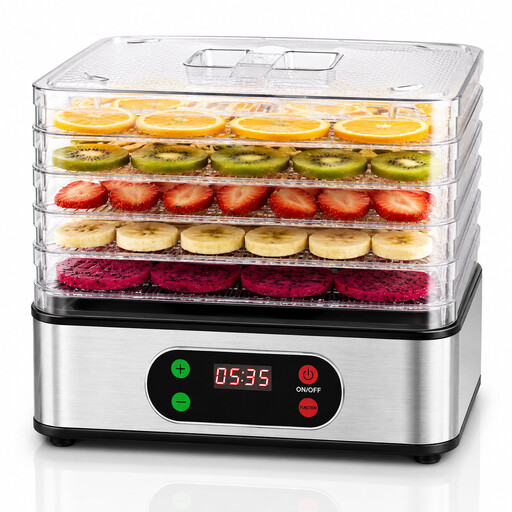
Food dehydrator with LED display, 35–70 °C and adjustable timer

Food dehydrator with LED display, 35–70 °C

Temperature selection and an adjustable running time are useful if you want to plan your preparation around a set schedule.

The title lists 35–70 °C, a timer from 0.5–72 hours in 30-minute increments and 350 W.

View at Joybuy
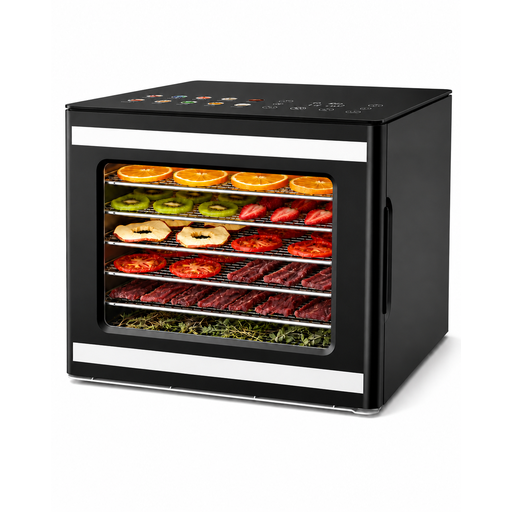
HavenWell food dehydrator with six removable stainless steel trays

HavenWell food dehydrator with 6 stainless steel trays

The removable trays may suit small to medium quantities. Check that the usable area is right for the size of your usual mushroom batch.

The title lists six removable stainless steel trays, a touch display and overheat protection. The product description specifies temperature control from 35–75 °C.

View at Joybuy

Havenwell food dehydrator with ten stainless steel trays and a 48-hour timer

Havenwell food dehydrator with 10 stainless steel trays

The ten trays are worth considering if you want to prepare larger quantities at once. Check the area against the size of your mushroom slices and the space they need.

The title lists variable temperature control, a 48-hour timer, ten programmes and 850 W.

View at Joybuy

Havenwell food dehydrator with eight drying trays and a 48-hour timer

Havenwell food dehydrator with 8 drying trays

If you want to use several levels, compare the number of trays with the area you actually need and the space required for air to circulate.

The title lists eight stainless steel drying trays, 35–85 °C, a 48-hour timer and 650 W.

View at Joybuy
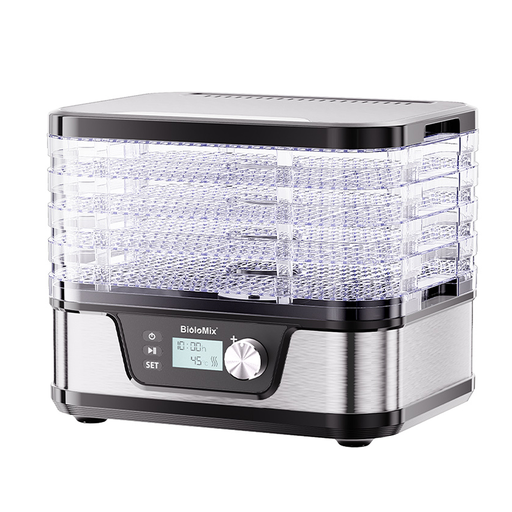
BioloMix BFD1300 with five trays and an adjustable timer

BioloMix BFD1300 with 5 trays

The five trays offer a useful option for drying on multiple levels. Make sure the mushroom slices are not too close together.

The title lists an adjustable 24-hour timer, 35–75 °C and 360° hot air circulation.

View at Joybuy

Frequently asked questions

Are mushrooms ready to store as soon as the timer ends?

No. The timer alone does not confirm that the mushrooms are sufficiently dry. The time needed depends on factors such as the size and thickness of the pieces. Check the batch and only pack the mushrooms once they are thoroughly dry and cool; as the German Federal Institute for Risk Assessment explains, insufficient drying or incorrect storage can encourage mould.

How should I prepare mushrooms for a food dehydrator?

Use fresh mushrooms that look sound, and arrange similarly sized pieces in a single layer. The Federal Centre for Nutrition advises against buying dry or slimy mushrooms with dark spots; keep the airways clear while drying.

How should I store dried mushrooms for future meals?

Let fully dried mushrooms cool before packing them. The Rommelsbacher dehydrator guide recommends clean, airtight jars or sealed portions, stored somewhere cool, dry and dark. Check your supplies from time to time.

Does drying make wild mushrooms safe to eat if I’m not sure what they are?

No. A food dehydrator cannot identify a mushroom species or make an uncertain identification reliable. The German Federal Institute for Risk Assessment warns that some mix-ups can be life-threatening, even for experienced foragers. Do not use any mushrooms you cannot identify with certainty as suitable to eat.

Which labels and materials matter for an electric food dehydrator?

The relevant EU product requirements apply to the appliance in question; for electrical appliances covered by the rules, this includes CE marking. The European Commission explains that CE marking is the manufacturer’s declaration that the product complies with the relevant regulations, not an independent product test. Parts that come into contact with food must meet the applicable requirements, including Regulation (EC) No 1935/2004. Check the information and care instructions for the specific model.