Which camera setup is right for you?

Capture mushroom details

If you want to show gills and fine surface textures in close-up, check the macro lens’s magnification ratio. At high magnifications, depth of field becomes shallow; Canon Academy describes this effect at magnifications approaching 1:1 and beyond.

Take spontaneous shots on walks

If you want to switch between mushrooms and landscapes without carrying or changing lenses, look for a dedicated close-up mode and a suitable field of view. OM SYSTEM says the TG-7’s Microscope mode can focus from 1 cm.

Head out in changeable weather

If you expect wet or muddy paths, check the protection ratings for the camera and any attached lens. Ricoh Imaging notes that its WG-8 protection tests do not rule out damage.

What should you look for when buying?

Key consideration What to check when buying Who it matters most to
Capture tiny details at a larger scale Check the magnification ratio and choose a suitable lens; don’t confuse the minimum focusing distance with the distance between the front of the lens and the subject. If you want to fill the frame with gills or surface textures, the magnification of the specific combination is what counts. This is the main consideration for around 33% of consumers.
Take spontaneous shots with minimal kit Compare the close-up mode, field of view and weight of the complete setup. If you want to switch between mushrooms and their surroundings on walks without changing lenses, being ready to shoot quickly matters. Around 27% of consumers put this consideration first.
Focus accurately in low light Check whether the camera can be positioned steadily close to the ground, and consider which stabilisation or lighting options suit the way you work. If you want to focus precisely on the forest floor in low light, shallow depth of field and camera movement can make shots more difficult. This is a priority for around 20% of consumers.
Be prepared for changeable weather Check the protection ratings and care instructions for every item you’ll actually use. If you take photos on wet or muddy paths, the protection ratings should apply to your entire setup. Around 20% of consumers put this consideration first.

Which misconceptions should you avoid?

  • “Macro” or 1 cm doesn’t automatically mean 1:1

    Focusing distance doesn’t tell you the magnification ratio. For example, Canon gives the Canon RF 35mm F1.8 Macro IS STM a magnification ratio of 1:2.

    For tiny mushroom details, compare the maximum magnification ratio stated for the specific camera and lens combination.

  • Budgeting for the camera body alone

    The stated 1:1 magnification for the mirrorless camera setups mentioned comes from the respective macro lens, not automatically from the camera body or standard kit.

    Compare complete, compatible setups and consider what you actually want to carry on a walk.

    A suitable macro lens and, depending on the shot, a tripod or lighting will also take up more space and require extra preparation.

  • Assuming the whole system has the same protection as the camera body

    Protection ratings may differ between the camera body and lens. OM SYSTEM gives the OM-5 Mark II body an IP53 rating and the separate 60mm macro lens an IPX1 rating.

    Check the ratings and care instructions for the exact camera and lens you’ll be using.

  • Overlooking nature reserve rules for your photos

    What you’re allowed to do in a nature reserve depends on the specific protection rules for that area.

    Check the signs and rules at your chosen location before leaving the path or setting down your equipment.

Which brands and systems are worth considering?

OM SYSTEM

The TG-7 is a compact option for spontaneous close-ups; the OM-5 Mark II can be paired with a separately selected macro lens to create a system you can build on.

  • OM SYSTEM says the TG-7 can focus from 1 cm in Microscope mode.
  • OM SYSTEM gives the M.Zuiko Digital ED 60mm F2.8 Macro a maximum magnification ratio of 1:1.
  • The IP53 rating for the camera body and IPX1 rating for the lens apply to different parts. These are manufacturer specifications, not the result of an independent performance comparison.

PENTAX / Ricoh Imaging

The WG-8 is a rugged compact camera for walks where the weather and close-up subjects are a consideration.

  • Ricoh Imaging lists a Digital Microscope mode for the WG-8, along with protection against water and dust.
  • Ricoh Imaging notes that its protection tests do not rule out damage. This doesn’t give it a blanket advantage over other cameras.

Nikon

A compatible Z-system camera body paired with a suitable NIKKOR Z MC lens is one way to photograph mushroom details and other travel subjects with an interchangeable-lens system.

  • Nikon gives the NIKKOR Z MC 50mm f/2.8 a magnification ratio of 1:1 and describes it as suitable for general subjects too.
  • The macro performance comes from the lens, not automatically from every Nikon body or standard kit.

Canon

EOS R cameras can be paired with RF macro lenses for close-ups and other travel subjects.

  • Canon gives the RF 35mm F1.8 Macro IS STM a magnification ratio of 1:2 and lists the EOS R50 as a compatible camera body.
  • The word “macro” doesn’t mean 1:1 for this lens. Check the lens and any included kit items separately.

Sony

The SEL30M35 is a macro option for a compatible Sony E-mount APS-C system.

  • Sony gives the SEL30M35 a maximum magnification ratio of 1:1 and a minimum focusing distance of 0,095 m.
  • The minimum focusing distance isn’t the clear space in front of the lens. Sony gives the distance between the front of the lens and the subject as 2,4 cm at maximum magnification; this can affect your shooting position and lighting.

Joybuy products for holiday photography on the go

This Joybuy selection includes an action camera for taking holiday photos on the go. Before buying, check whether its close-up capabilities are suitable for your mushroom subjects.
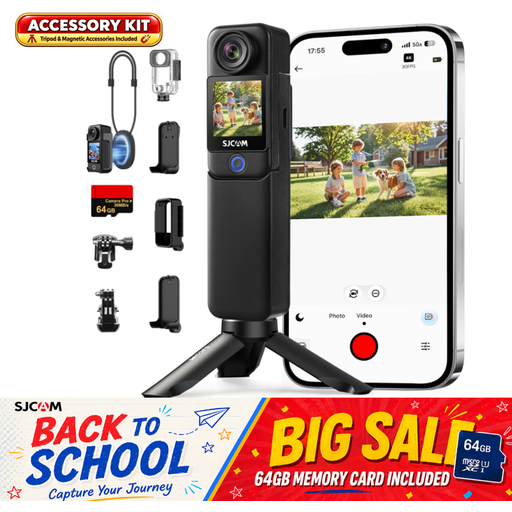
SJCAM C300 Action Camera 4K

SJCAM C300 Action Camera 4K

Described as an action camera for taking photos on the go; check whether its close-up capabilities are suitable for your mushroom subjects.

4K; stated battery life: 7 hours; 6-axis stabilisation; two touchscreens. Waterproofing to 30 m requires the supplied waterproof case to be fitted and sealed correctly.

View at Joybuy

Frequently asked questions about mushroom photography

Do I need an interchangeable-lens camera to photograph mushroom details?

No. For straightforward close-ups, you can consider a compact camera with a dedicated close-up mode. If you want to capture very small details at a specific magnification, compare the magnification ratio of a suitable macro lens; a focusing distance of 1 cm isn’t the same as 1:1.

How can I avoid blurry photos on the forest floor?

Keep the camera as steady as possible and check where the focus falls. At high magnifications, depth of field is shallow. A tripod helps prevent camera shake, but it won’t stop the mushroom or its surroundings from moving.

What extra costs and rights should I consider when buying?

With a mirrorless camera, you’ll need to budget for a lens suitable for your desired magnification and, depending on the shot, a tripod or lighting. For goods bought from business sellers in the EU, you’re entitled to a minimum two-year legal guarantee from the date you receive them; this is separate from any voluntary manufacturer’s warranty. Many online purchases come with a 14-day right to cancel, although some exceptions apply.

Can I leave the path wherever I like to take a mushroom photo in a German nature reserve?

No, there’s no general permission to do so. Section 23 of the BNatSchG refers to the specific protection rules for each area. Check the signs and regulations before leaving the path or setting down your equipment.

Do I have to pick a mushroom to photograph it?

No. Whenever possible, photograph it where it’s growing. Section 39 of the BNatSchG allows limited picking of wild mushrooms for personal use, subject to the conditions set out there. This doesn’t mean you have to pick mushrooms for photos, nor does it give you permission to ignore local access or conservation rules.