Hosts with a large tart tin
If you’re baking a round tart for guests, your tin needs to fit inside the oven. The Küchengötter recipe uses a tin with a diameter of 30 cm; Rommelsbacher specifies model-dependent size limits for its countertop ovens.


Choose your oven first by checking the diameter of your tart tin, then by deciding whether you can accommodate a built-in or countertop model. For the pastry base, consider not only fan-assisted cooking but also top and bottom heat, or separately selectable bottom heat. The Küchengötter mushroom tart recipe fries the mushrooms and reduces the liquid. The recipe and appliance details mentioned here are not a comparative test showing that one type of oven is superior.
If you’re baking a round tart for guests, your tin needs to fit inside the oven. The Küchengötter recipe uses a tin with a diameter of 30 cm; Rommelsbacher specifies model-dependent size limits for its countertop ovens.
If you’re keeping an eye on the base when baking a moist mushroom topping, check for top and bottom heat or separately selectable bottom heat as well as fan-assisted cooking. The NDR describes bottom heat as a way to finish baking the base more directly.
If you’re looking for a freestanding appliance, check the size of your tin, the space available on your worktop and the connection requirements for the specific model. Rommelsbacher publishes size limits for its countertop ovens; in Germany, work on fixed electrical installations is subject to the requirements of § 13 NAV.
A good fit if: You have a suitable space for a built-in appliance and are planning to use a larger tin or cook other dishes too. Compare the housing and appliance dimensions, as well as the usable interior space.
What to weigh up: The installation and connection need to suit your kitchen. Extra heating and cleaning functions are only worthwhile if you’ll use them.
A good fit if: You don’t want to use a built-in space and your tin is within the manufacturer’s stated size limit. Rommelsbacher specifies a maximum diameter of 29 cm for the BG 1550 and 31,5 cm for the BG 1805/E.
What to weigh up: The smaller oven limits the size and quantity you can cook. Also check the space it needs and the required clearance around it.
| Buying priority | What to check | Who is it especially relevant to? |
|---|---|---|
| Tart base and heating modes | Fan-assisted cooking and top and bottom heat; separately selectable bottom heat if available. | If I’m baking a moist mushroom topping, I want to choose a heating mode that suits the recipe and keep an eye on the base. This is a priority for around 33 % of consumers who consider the base and heating mode most important. |
| Tin size and quantity | The diameter of the tin, including its rim and handles; what’s included and how many guests you’re planning to serve. | If the tart needs to serve guests, I need a tin that really does fit inside the oven. Around 27 % of consumers prioritise tin size and quantity. |
| Built-in or freestanding | For a built-in oven: housing and appliance dimensions. For a countertop model: worktop space, clearance and connection requirements. | If there’s no built-in space available or the connection needs to be checked, the right installation and set-up are what matter. This applies to around 20 % of consumers. |
| Energy use and cleaning | Comparable energy-use information for the specific appliance and the cleaning method it uses. | If I use the oven regularly, I want to weigh up running costs and cleaning effort against one-off convenience features. Around 20 % of consumers put these longer-term considerations first. |
A recipe may call for a tin that’s too large for a particular countertop oven. The Küchengötter recipe specifies a diameter of 30 cm; Rommelsbacher states a maximum of 29 cm for the BG 1550.
Before considering the oven’s capacity in litres, compare the full diameter of your tin, including its rim and handles, with the model’s stated limit.
If the tin doesn’t fit, you may need a smaller one or an extra baking round.
These terms refer to different functions. A cleaning function is not the same as steam-assisted cooking, and neither is a requirement for making a mushroom tart.
Check what the specific model’s function does and whether you’d genuinely use it day to day.
Bosch now marks the HBG675BB1 as no longer available. So its place in a comparison table doesn’t tell you whether that exact model is currently on sale.
Check whether the exact model is available separately from checking its features and whether it’s suitable for your tin.
The BG 1550 and BG 1805/E countertop ovens are examples of freestanding models.
The BBIM12300X is a 60-cm built-in oven that Beko lists with a 72 l capacity and eight heating modes.
The HBG675BB1 is an example of a built-in oven with 4D hot air and bottom heat.
The BAR2 KH8V2 IN is a built-in oven with hot air and hydrolytic cleaning.
The BPS33102ZM is a built-in oven with pyrolytic cleaning and nine listed heating modes.
The models below include built-in and countertop ovens for fan-assisted baking and making a tart.
 No image available
A 60-cm built-in model with a fan function to consider for your planned tart.
It has a 70 l capacity and ten functions; the specifications also include 3 kW, AquaClean steam cleaning and an A energy efficiency rating.
Before buying, check that the housing dimensions and your tin size are right for your kitchen and tart tin.
 No image available
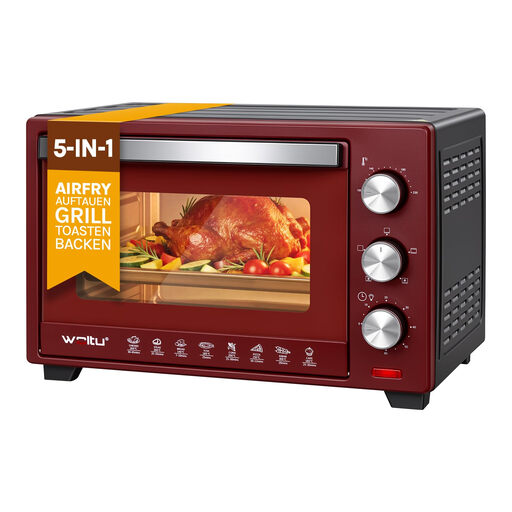
A countertop option for baking a tart, provided your tin and the space available are within the model’s dimensions.
It has a 28 l capacity and a stated temperature range of 100–230 °C, with top heat, bottom heat and a combined heating mode.
Check the size of your tin and the required clearance around the appliance.
 No image available
A built-in model for households looking for fan-assisted cooking and the option to cook on multiple levels.
It has a stated capacity of 71 l, 4D hot-air distribution and pyrolytic cleaning; according to the product description, you can cook on up to four levels at once.
The multi-level specification doesn’t confirm that your own tart tin or the accessories you need are included.
Rommelsbacher specifies that the BG 1550 takes baking tins up to 29 cm in diameter, so the 30-cm tin is over the stated limit. For the BG 1805/E, the manufacturer gives a maximum of 31,5 cm; also check the rim, handles and height of your actual tin.
No. The published Küchengötter mushroom tart recipe uses fan-assisted cooking. The recipe and the heating modes available on your specific appliance are what matter. The NDR distinguishes fan-assisted cooking, which uses a fan, from hot air, which also has an additional heating element in front of the fan.
The Küchengötter recipe fries the fresh mushrooms and reduces the liquid with the cream a little before adding the topping to the pastry. The recipe’s temperature and timings apply to this method of preparation and won’t necessarily work for every tin and oven.
It depends on whether the specific appliance can be connected to a suitable existing socket or whether work on the fixed electrical installation is needed. Under § 13 NAV, work to install, extend or alter this installation may only be carried out by an installation company registered in an installer directory, unless the work is done by the network operator.
No. Pyrolysis is a cleaning function, not a requirement for baking a mushroom tart. Compare the cleaning method on the specific model with your actual cleaning needs, and check its heating modes and size independently.