
Lieferung heute & morgen

Qualitätsgarantie

Willkommens-Angebote freischalten: KOSTENLOSE Lieferung | Bis zu 80 % RABATT | Kostenlose 30-Tage-JoyPlus-Testphase
App herunterladen
A musical activity table for babies and toddlers combines several play functions in a relatively small footprint. Piano keys, a drum, gears or turning knobs can invite little ones to grasp, press and explore. However, not every model suits every child or household.
An activity table may boast numerous play zones. What really matters, though, is whether the individual elements are within reach of small hands and whether your child can operate them independently. Too many buttons and sounds can also feel overwhelming. So look for clearly recognisable functions such as:
A play table with piano and drum is especially versatile when the functions aren't just decorative but are actually usable, either mechanically or electronically.
"From 6 months" doesn't mean that every six-month-old baby can already play safely at a table. Younger children often use an activity table on the floor at first, while toddlers who are standing need the table height and stability. So check whether the legs are removable or whether the table can be used as a flat play panel.
An activity table for 6–36 months should always be used with your child's individual development in mind. For children who pull themselves up or lean on furniture, stability and a non-slip setup are especially important.
Material details such as ABS or BPA-free can offer useful guidance. However, they don't replace checking the product information, warnings and workmanship. A CE mark is a legally required conformity marking, not an independent quality seal.
According to the product descriptions of the respective models, ABS, BPA-free materials, rounded edges and compliance with CE and EN71 requirements are mentioned. Even so, check the details on the product page before buying, and inspect the toy for loose or damaged parts after unpacking.
For a baby activity table model, the surface should be easy to clean. Smooth plastic surfaces can usually be wiped down without trouble. With painted or printed surfaces, look for cleaning instructions.
Key points to check:
Even a product labelled as Montessori toy or sensory toy isn't automatically suitable for every child. The term doesn't describe a uniformly protected product category. What matters is the specific features, the age recommendation and supervised use.
Compare the measurements with the intended play area. The model featured here measures approximately 30 × 30 × 31 cm according to the product description. What matters isn't just the height but also the footprint. A narrow table can tip over more easily when a child pulls or leans on it firmly.
Place the activity table on a level, non-slip surface and not directly next to stairs, windows or other climbing aids. A height-adjustable activity table can be practical if the construction locks the adjustment securely. If there's no specific information about height adjustment, don't assume this feature is available.
With electronic musical toys, batteries are often not included. That's the case with the musical activity tables mentioned here. So check:
A volume control allows you to adapt the sound to your home and time of day. However, it isn't proof of any specific health protection. Don't leave your child unsupervised with musical toys, and avoid prolonged high volume levels.
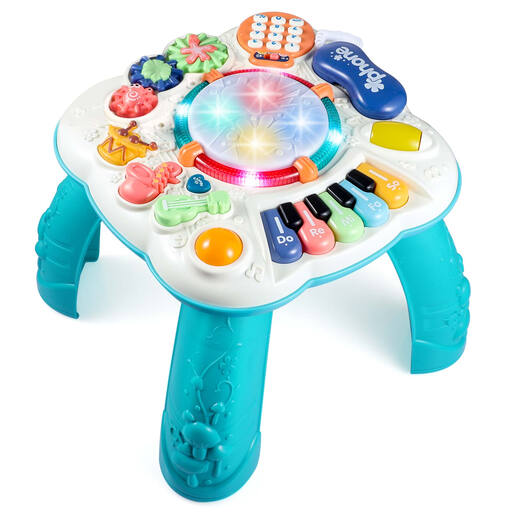
Why this product fits the profile: This compact model combines several functions in one table and, according to the description, can also be used as a flat play panel with the legs removed.
The product description mentions a volume control, a quiet mode and six play areas. This means you can check important everyday features before buying.
Compact dimensions of approximately 30 × 30 × 31 cm; piano, drum, gears and instrument keys all in one product.
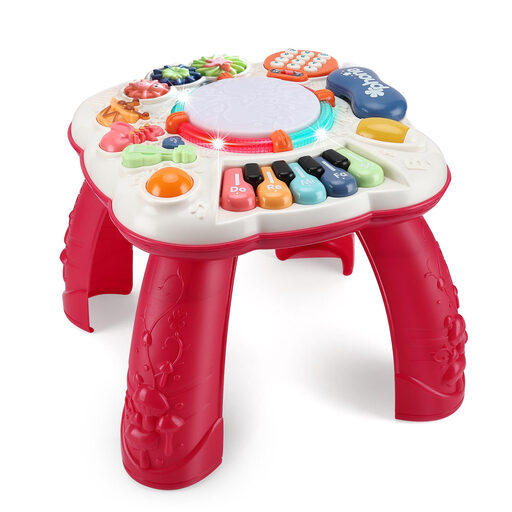
Why this product fits the profile: The red variant is aimed at buyers who want a clearly described set of features with multiple ways to play and flexible use.
The details mention material, dimensions, age range, removable legs and volume control. This concrete information makes it easier to compare with your own requirements.
Age recommendation 6–36 months; BPA-free ABS according to the product description and a combination of music, turning and role-play elements.
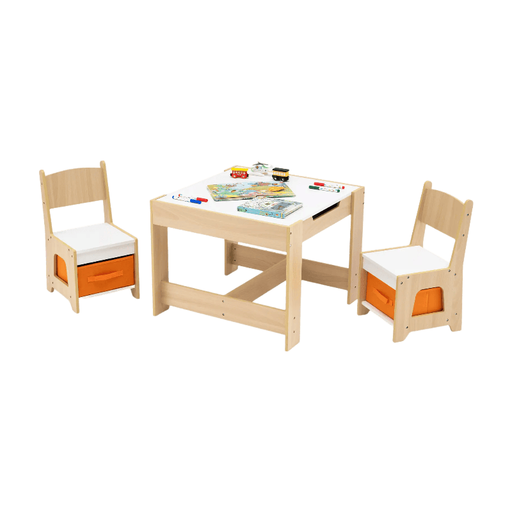
Why this product fits the profile: This set is designed for shared craft, reading and play activities and, according to the details, is suitable for children aged 3 years and over.
The clear age recommendation prevents it from being wrongly categorised as a baby toy. This set is better suited as an additional play and creative space for older toddlers.
Reversible tabletop with a whiteboard and chalkboard side; two seats and additional storage space according to the product description.
We've put together a full, regularly updated list of products that fully meet these strict selection criteria and the safety regulations in force in the EU.
When choosing a gift for a 1 to 3-year-old, don't just think about colour and the range of functions. Also check:
Musical toys for babies should be checked regularly for cracks, loose parts and faults. If you notice any visible damage, stop using the toy. Its lifespan depends on the material, how often it's used, storage and care; no general time frame can be given.
That depends on the specific product details and your child's stage of development. The musical models mentioned here are described as suitable for 6 to 36 months. For younger babies, using the table as a floor play panel can be more sensible than playing while standing. Always follow the manufacturer's instructions and warnings.
Choose a low volume setting and use the quiet mode if available. Your child shouldn't play for long periods right next to a loud sound source. A volume control is a practical feature, but it doesn't provide any medical protection.
With electronic activity tables, you'll usually need to buy batteries unless the table can be powered by a rechargeable battery or mains electricity. For the models mentioned, batteries are not included according to the product description. Check the required battery type and the battery compartment before you buy.