
Lieferung heute & morgen

Qualitätsgarantie

Willkommens-Angebote freischalten: KOSTENLOSE Lieferung | Bis zu 80 % RABATT | Kostenlose 30-Tage-JoyPlus-Testphase
App herunterladen
Musical baby toys combine sounds, movement and early cause-and-effect experiences. However, choosing the right one is not always easy for parents, grandparents and other family members: many products promote a wide range of functions, educational benefits and colourful light effects. The number of buttons is not what matters most. What matters is whether the toy suits the child’s age, surroundings and abilities.
A toy with a piano, telephone, cogs, lights and several melodies may seem versatile at first glance. For a younger baby, however, large buttons, simple sounds or moving elements may be more useful than complex controls. So check whether your child can reach and operate the functions independently.
The description “for babies and toddlers” is no substitute for a specific age recommendation. Small parts, battery compartments, cords or detachable accessories may be unsuitable for younger children. For example, an electronic keyboard with a microphone is intended for children aged 3 and over and should not be regarded as a baby toy.
Statements such as “BPA-free”, “rounded edges” or “CE” are important points to check, but they are not a blanket guarantee for every play situation. The CE mark indicates that the manufacturer has issued a legally required declaration of conformity. The EN 71 series of standards covers various areas of toy safety. Nevertheless, parents should inspect the product for cracks, loose parts and damaged battery compartments before purchase and regularly afterwards.
For baby toys from 6 months, easy-to-reach buttons, drum surfaces or large gripping elements are generally suitable. A sensory baby toy should offer different types of stimulation without overwhelming the child with constant lights and sounds.
From around one year of age, activity cubes and play tables can become more interesting. An activity cube for babies or a Montessori-inspired toy should primarily encourage grasping, turning, pressing and matching. However, Montessori baby toy is not a protected quality seal. So focus on the specific play activities described rather than the marketing term.
Look for:
With plush musical toys, a removable music mechanism is practical because the fabric can be cleaned separately. Electronic products should generally not be immersed in water.
Musical toys should not be held directly against the ear. Volume control or a quiet mode is particularly useful in flats, when travelling or during shared quiet times. Also check whether batteries are included, which type of battery is required and how easily an adult can open the battery cover.
Size matters too: a compact cube is more likely to fit on a shelf or in luggage, while a play table requires enough floor space and a stable surface.
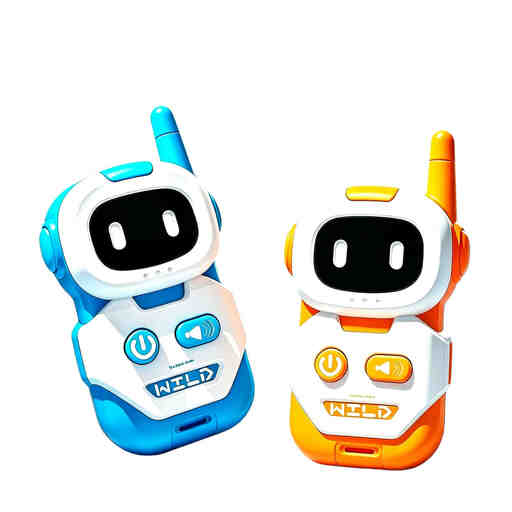
Why this product suits this profile: This compact musical toy combines drum surfaces, light effects, animal sounds, and shape and colour matching. According to the product information, it is suitable for ages 6 to 36 months; batteries are not included.
The play areas are clearly identifiable and are not limited to pre-installed melodies. The product information states that it uses ABS and BPA-free materials, with rounded edges and a non-slip base.
Four play areas in one device; shape and colour sorting adds a matching activity to the rattle and drum toy.
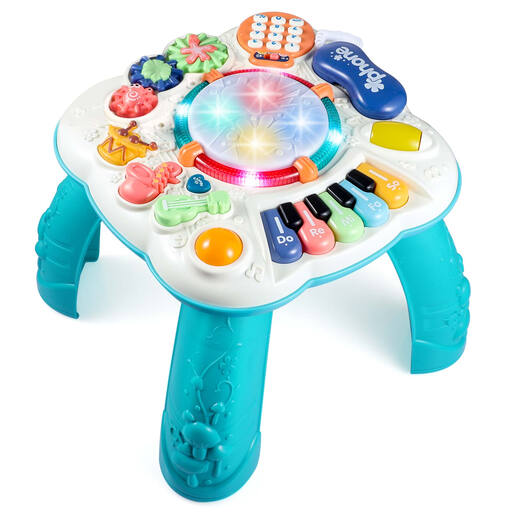
Why this product suits this profile: The play table offers six play areas, volume control and detachable legs. According to the product description, it can initially be used as a floor play panel and later as a table.
The dedicated volume control addresses the common problem of electronics with no volume adjustment. The 6 to 36-month age recommendation and the convertible design make it easier to adapt the toy to different stages of development.
Volume control and quiet mode; six clearly separate play areas with a piano, drum, cogs and pretend-play telephone.

Why this product suits this profile: The cube is designed for toddlers aged 1 to 3 and combines eight play modes, including a piano, guitar, telephone, cogs and a music box element. The carry handle makes it easy to transport.
The eight functions combine mechanical and musical activities. This means the play value is not based solely on light or sound effects. According to the product information, the housing and edges are made from ABS or rounded plastic.
Compact size of approximately 23 × 23 × 24 cm; several grasping, turning and pressing activities to engage hands and eyes.
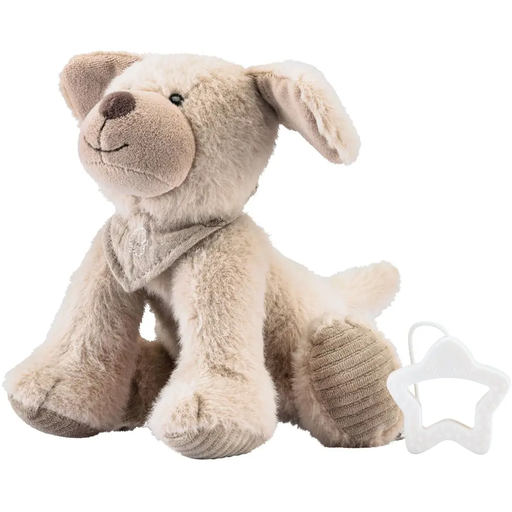
Why this product suits this profile: This soft musical toy is intended for children aged 1 and over. It makes a suitable gift for babies and toddlers when a fabric surface and simple operation are preferred.
According to the product information, the zip allows the music mechanism to be removed before washing. Important: the mechanism must not be accessible to small children and must be put back in place after cleaning.
Washable fabric when the music mechanism is removed; battery-free operation with the melody “Sandmann lieber Sandmann”.
Place electronic baby learning toys on a level surface and supervise your child’s first attempts at playing. With a play table, make sure the legs and connections are correctly engaged. Moving products such as a rolling baby toy require enough clear space to ensure that the child cannot reach cables, stairs or breakable objects.
Check the following before every use:
For older children aged 3 and over, musical toys for babies and toddlers with a stronger focus on instruments may also be suitable, such as a keyboard or junior drum kit. However, these products should not be given to younger babies if they contain small parts, drumsticks or cables.
We have put together a complete, regularly updated list of products that fully meet these strict selection criteria and the safety regulations applicable in the EU.
From 6 months, large, easy-to-reach controls such as drum surfaces, simple buttons and sturdy gripping elements are suitable. Check the specific age recommendation, ensure that the battery compartment is closed securely and that there are no small parts that could be swallowed. The toy should always be used under supervision.
The lifespan depends on the materials, electronics, batteries and how the toy is used. Models made from robust plastic can usually be cleaned with a damp cloth. Check the edges, buttons, seams and battery compartments regularly. If there are cracks, damaged cables or loose parts, the product should no longer be used.
Electronic musical toys require batteries, depending on the model. Running costs depend on the battery type, how long the toy is used and the volume. Rechargeable batteries can be practical for regular use, provided they are suitable for the battery compartment and comply with the manufacturer’s instructions. Plush music boxes without batteries, on the other hand, have no ongoing energy costs.