
Lieferung heute & morgen

Qualitätsgarantie

Willkommens-Angebote freischalten: KOSTENLOSE Lieferung | Bis zu 80 % RABATT | Kostenlose 30-Tage-JoyPlus-Testphase
App herunterladen
Musical learning toys for babies and toddlers combine buttons, sounds, lights and moving parts. For parents and grandparents, however, choosing the right one isn't always straightforward: many products boast Montessori terms, "early development" or an especially large number of features. What really matters isn't the number of melodies, but whether the toy suits the child's age, home environment and developmental stage.
A baby activity cube or musical baby play table can include numerous buttons, dials and sound effects. For younger children, however, a clear cause-and-effect relationship is important: the child presses, turns or taps and immediately sees what happens. Too many stimuli can make operation confusing and mean that individual features are hardly ever used.
Toys with lights and sounds can quickly become loud indoors. A volume control, a mute mode or at least an easily accessible on/off function are therefore practical criteria to look for. Particularly in flats with multiple neighbours, during quiet times or when travelling, a quieter play mode can make daily life much easier.
A baby piano toy for toddlers isn't automatically suitable for a six-month-old baby. Small accessories, detachable components or battery compartments must be appropriate for the child's age. Always read the manufacturer's age recommendation together with the safety warnings. For products with small parts, use under three years is often excluded or only permitted under direct supervision.
For learning toys for 6 to 36 months, large, easy-to-reach controls make sense. An activity table with detachable legs can first be used as a floor play mat and later as a standing table. For children from around one year old, a children's drum set with microphone, a keyboard or a compact activity cube may be more suitable.
Also look out for:
For plastic toys, product information often mentions ABS plastic and a BPA-free design. These details should be verifiable in the product listing or instruction manual. A CE marking is required for many toys sold in the EU market; however, it does not replace checking the actual build quality in everyday use. According to product information, some of the models below are designed to meet CE and EN71 requirements. Parents should also check that the product is undamaged and that no parts come loose.
For a portable musical nightlight and sound machine, different precautions apply: a sound machine is not automatically a toy. It should be placed out of the child's reach, on a stable surface and not directly next to the cot. Charging and cable instructions must be followed carefully.
Musical toys usually run on batteries, while portable devices are often charged via USB. Before buying, it's worth checking:
Many products in this selection are supplied without batteries. This should be taken into account when buying a gift for babies and toddlers.
Why this product fits the profile: This compact sensory toy combines drum surfaces, lights, animal sounds and shape and colour sorting. It is suitable for first grasping, pressing and tapping movements within the recommended age range of 6 to 36 months.
The large controls are designed for simple interaction. The product description mentions a non-slip base and rounded edges. Batteries are not included.
Four play areas in one device: drumming, lights, animal sounds and shape and colour recognition.
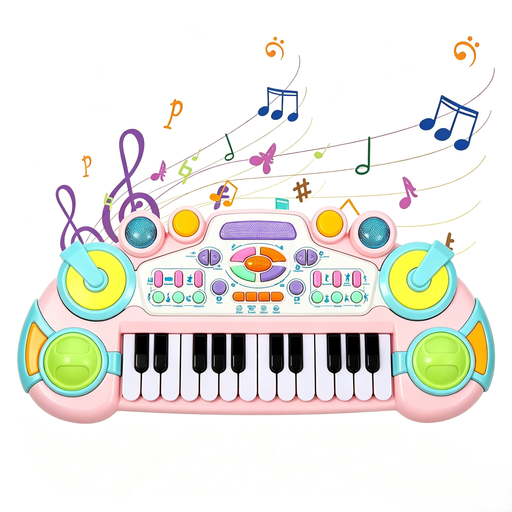
Why this product fits the profile: According to the product description, this keyboard features 24 keys, several sound modes, light functions and a volume control. This makes it a good fit for families looking for a versatile baby piano toy for longer-term use.
The volume can be adjusted; a mute mode is also included according to the supplier. This means the instrument can be used even in quieter home environments.
24 keys, sound effects, animal sounds and drum rhythms; suitable according to the product information for ages 1 to 5 years.

Why this product fits the profile: The cube is compact at 23 × 23 × 24 cm and has a carry handle. It suits families who want a motor skills toy for toddlers to use both at home and on the go.
Rather than relying solely on flashing effects, the cube combines pressing, turning, dialling and role-play. The age recommendation is 1 to 3 years.
Eight play modes with piano, guitar, telephone, gears and music; compact design with carry handle.
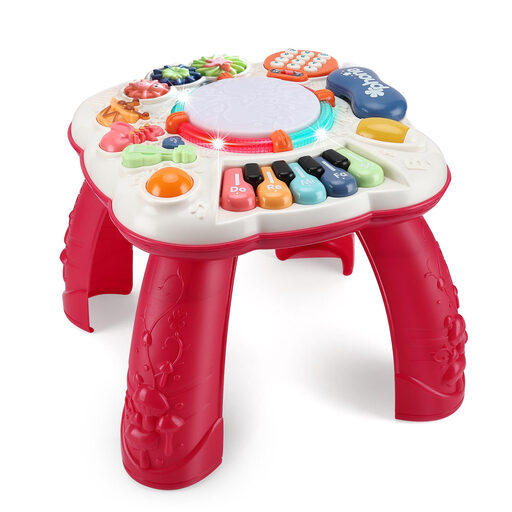
Why this product fits the profile: The table offers six play areas, including piano, drum, gears, telephone and instrument keys. Detachable legs allow it to be used as a floor play mat.
The two-in-one use reduces the problem of an unsuitable play height. According to the product information, volume control and a quiet mode are included.
Six different play zones, detachable legs and a recommended age range of 6 to 36 months.
We have put together a complete, regularly updated list of products that fully meet these strict selection criteria and the safety regulations in force in the EU.
A children's drum set with microphone is aimed primarily at children who want to actively sing, tap and coordinate their movements. Models with several drum surfaces, cymbals and a microphone need a bit more space. Look for a wide base, adjustable volume and a stable stand.
A baby piano toy is usually more space-saving and easier to fit into daily routines. Keys encourage grasping and pressing movements, while melodies and animal sounds provide acoustic feedback. For both types, the volume should be adjusted to suit the room, and the child should be supervised while playing.
That depends on the specific product. Some sensory toys are designed from around 6 months, while activity cubes and children's instruments are often recommended from 1 year. For products with small parts, cards or accessories, the age recommendation is particularly important.
The lifespan depends on the material, battery compartment, electronics and how it is handled. Clean plastic parts according to the manufacturer's instructions, avoid moisture with electronic devices and remove batteries if the toy is not going to be used for a long time. Damaged cables, swollen batteries or loose parts are reasons to stop using the product.
Battery-operated toys need new batteries regularly depending on use. A volume control, automatic shut-off or mute mode can reduce consumption. Portable sound machines with a rechargeable battery should be fully charged and operated according to the instructions. They are designed for quiet sound playback and are not intended as freely accessible toys for babies.