
Lieferung heute & morgen

Qualitätsgarantie

Willkommens-Angebote freischalten: KOSTENLOSE Lieferung | Bis zu 80 % RABATT | Kostenlose 30-Tage-JoyPlus-Testphase
App herunterladen
Musical learning toys for babies and toddlers combine sounds, colours, movement and early cause-and-effect experiences. Choosing the right one isn’t always easy for parents and gift buyers: many products advertise a wide range of play modes, while important details about volume, batteries and age suitability can be less prominent.
A toy with lights, melodies, animal sounds, buttons and shapes can offer plenty of variety. What matters, though, is whether a child can use the features independently. Too many flashing lights or constantly changing sounds can make a toy confusing to use. Look for clearly identifiable controls and play modes suited to your child’s age.
A children’s keyboard for toddlers isn’t automatically suitable for a six-month-old baby. Small detachable parts, an upright playing position or hard-to-reach buttons may not be suitable for younger children. The age recommendation on the product page, packaging and instructions should all match. If they differ, follow the stricter recommendation.
Musical toys can quickly become disruptive in everyday life, particularly in flats or at bedtime. A volume control or mute mode is therefore a practical feature to look for. Also check whether batteries are included. Several products in this selection require batteries that are sold separately.
For baby toys, smooth, rounded edges and a sturdy design are important features. The product details for the models featured here mention ABS plastic, BPA-free materials and rounded edges. Check these claims against the information on the relevant product page and in the instructions.
Also look for:
A CE mark indicates that the manufacturer must declare compliance with the relevant EU requirements. However, it isn’t an independent quality mark. The EN 71 series of standards is also relevant to toys. Check that the conformity information, warnings and manufacturer details are clearly provided.
A musical baby toy should have volume control if it will be used regularly indoors. This is particularly important for products with a microphone or amplifier. A mute mode can be useful during quieter periods, provided the toy still has a clear function without sound.
Buttons, drum pads, gears and shape sorters mainly encourage children to grasp, press, turn and match. These features can make a toy useful for developing fine motor skills, but they’re no substitute for spending time together with an adult.
A baby activity table needs enough floor space and should be placed on a level surface. An activity cube for babies is more compact and is better suited to the floor, travel or a smaller play area. Before you buy, check:
For babies from around six months, a flat play panel may be more suitable during tummy time than a table with legs. Once your child can stand confidently, an activity centre with a stand may be more engaging.
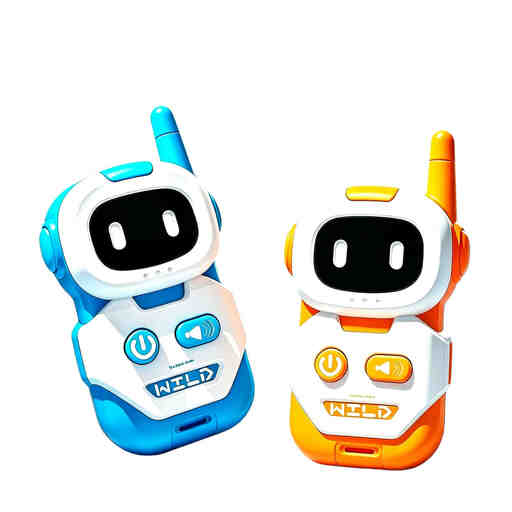
Why it suits this profile: This compact toy combines drum pads, lights, animal sounds, and five shapes and colours. It’s a good choice for families looking for several sensory features in a smaller toy.
The play areas take the form of clearly defined buttons and drum pads. The product details state that there are no loose parts, but batteries aren’t included.
Recommended for ages 6–36 months, made from ABS plastic according to the product description, with several ways to grasp, press and sort.
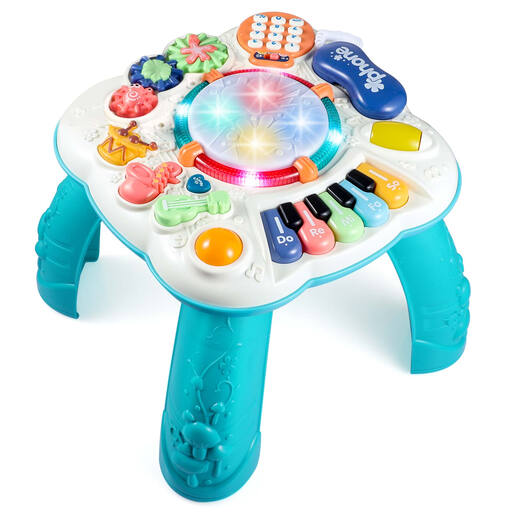
Why it suits this profile: The table has six play areas, including a children’s keyboard, bass drum, telephone, gears and instrument buttons. Its detachable legs let you use it as a flat play panel.
The product details mention volume control and a quiet mode, so you can adjust the sound for indoor use and different times of day.
Two ways to play, six activity zones, and BPA-free ABS plastic with rounded edges, according to the manufacturer.
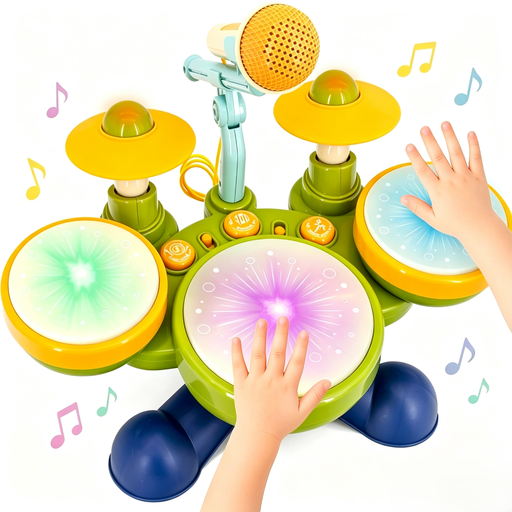
Why it suits this profile: Designed for toddlers aged around 1 to 3 who want to drum and sing, this set features three light-up drum pads, two movable cymbals and a microphone.
The volume can be adjusted according to the product description. The detachable stand also makes it easy to use on the floor and store away compactly.
For ages 1–3, with a microphone included and a four-point non-slip base, according to the supplier.

Why it suits this profile: This compact cube with a carry handle brings together a piano, guitar, telephone, gears and other activity panels. It’s ideal for trips, visits or smaller homes.
Its compact shape takes up less room than an activity table. Still, check the age guidance and battery access before you buy.
Measures approximately 23 × 23 × 24 cm according to the product details, with eight play modes and a carry handle for easy transport.
We’ve put together a complete, regularly updated list of products that meet these strict selection criteria and fully comply with the safety regulations in force in the EU.
It depends on the design and features. Some products are intended for babies from around six months, according to the supplier, while others are suitable from one year. For babies, look for large, firmly integrated controls and toys that can be used on the floor. An adult should supervise play and follow the manufacturer’s guidance.
There’s no single recommended setting for every product. Choose a moderate volume and avoid prolonged use close to your child’s ear. Models with volume control or a mute function are useful. If a toy makes unusually loud sounds, stop using it until you’ve found out why.
Lifespan depends on the materials, battery compartment, switches and how much the toy is used each day. Clean surfaces according to the instructions, remove the batteries if the toy won’t be used for a while, and check edges, covers and moving parts regularly. Don’t pass the toy on if it shows visible damage.