
Lieferung heute & morgen

Qualitätsgarantie

Willkommens-Angebote freischalten: KOSTENLOSE Lieferung | Bis zu 80 % RABATT | Kostenlose 30-Tage-JoyPlus-Testphase
App herunterladen
Musical learning toys for babies and toddlers should offer more than colourful buttons and repetitive melodies. For parents, grandparents and other family members, the key considerations are a suitable age rating, a practical volume level and a design that matches the child’s stage of development. However, baby musical toys, children’s pianos, baby drums and musical activity tables can differ considerably.
A toy with lots of buttons, lights and sounds may look appealing. For babies, however, an overloaded control panel can be confusing. What matters is whether the child receives a clear response to their action: pressing produces a sound, turning moves an element or tapping activates a light.
“From 6 months” does not mean that a baby should already use the product as a standing or table toy. At this age, floor-based toys, grasping elements and visual stimuli are generally more suitable. Once a child can sit or stand securely, a baby activity table or musical activity table may be more appropriate. The age recommendation does not replace adult supervision.
Terms such as “BPA-free”, “CE” and “EN71” are important information, but they are not a reason to stop supervising your child. CE is not an independent test mark; it indicates the manufacturer’s declaration of conformity. You should also check:
For toys from 6 months, choose products that can be reached while lying down, during tummy time or while sitting. A removable table leg or a flat play board can adapt the toy to different stages of development. For toddlers between one and three years old, a sturdy activity table, a multi-sided activity cube or a small children’s piano may be appealing.
From around the age of three, parents should also pay attention to warnings about small parts. This applies, for example, to interactive learning systems with cards or stickers: the manufacturer of the alilo Smarty Bunny explicitly warns about small parts and recommends use from the age of three.
Electronic baby musical toys should have volume control or a mute function. This makes them easier to use at home, during quiet times or when travelling. A moderate volume is sensible for everyday use; the toy should not be held directly against the ear.
You should also consider the power supply. Batteries are not included with several of the products in this selection. Before buying, it is worth checking the battery type, charging function, battery compartment and expected usage time. A USB-C connection is convenient, while replacing batteries during frequent play can lead to additional ongoing costs.
ABS plastic with rounded edges is used in many electronic learning toys. Information such as BPA-free should be clearly stated in the product description. For textile products, removable and washable parts are helpful in everyday family life.
A musical activity table must stand securely and should not slide around easily when being pressed or played like a drum. For use on the go, a compact baby activity cube with a carry handle takes up less space than a complete table. Wooden motor-skills toys can be a more minimalist alternative, but they should also be checked regularly for cracks, loose elements and dirt.
The following recommendations do not rank products in a blanket order. Instead, they group them according to specific everyday situations and verifiable product features.
Why this product suits this profile: This compact baby drum combines drum pads with shape and colour sorting. According to the product information, it is designed for ages 6 to 36 months, making it a versatile sensory toy for babies during the early play stage.
The controls are designed for pressing, tapping and inserting. The product information specifies BPA-free ABS, rounded edges and a non-slip base. Batteries are not included.
Four play areas, light effects, animal sounds and drum sounds; suitable for tummy time and early grasping movements.
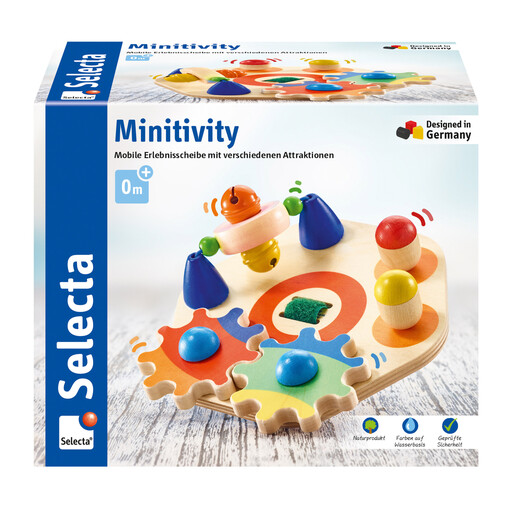
Why this product suits this profile: If you are deliberately choosing a minimalist Montessori toy without electronics, this product offers three play stations made from natural wood. It measures 14 cm and, according to the product information, is made in Germany.
It does not use batteries, lights or speakers. This removes battery costs and the worry of melodies playing continuously. Check the fastening before every use.
Three mechanical play stations with gears, moving elements and bells; attaches to a cot, playpen or pram frame.
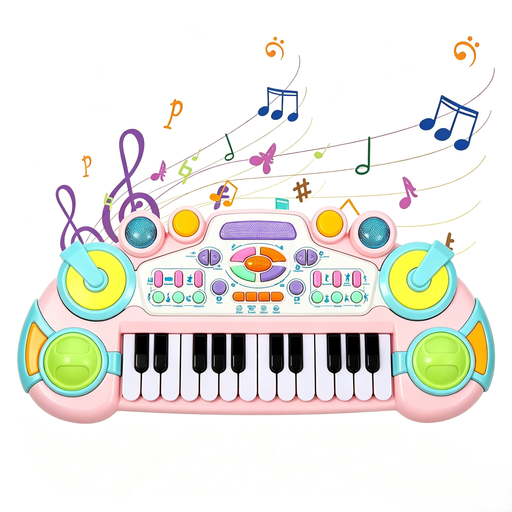
Why this product suits this profile: According to the product information, this children’s piano is designed for children aged 1 to 5 and features 24 keys, sound modes, volume control and a mute function. It is a good choice for families looking for an electronic instrument that can be used for longer.
The volume control and quiet mode help prevent unnecessary continuous noise. The device is supplied without batteries, so this should be taken into account before giving it as a present.
24 keys, several sound and rhythm options, plus soft-light and volume functions.
We have put together a complete, regularly updated list of products that fully meet these strict selection criteria and the safety regulations applicable in the EU.
From around six months, babies can use accessible play boards, soft balls with sounds or simple drum and grasping elements. Look for a stable base, rounded edges and no small parts. An activity table should only be set up once the child can sit or stand securely.
Their lifespan depends on the battery compartment, casing, button mechanism and frequency of daily use. It is not possible to give a general figure for how long a toy will last. Dry storage, careful cleaning in accordance with the manufacturer’s instructions and removing flat batteries can all help extend its life. Check for loose parts and damage before every play session.
That depends on the power supply and how often it is used. Models without a rechargeable battery generally require new batteries on a regular basis. Before buying, check whether batteries are included, which size is required and whether a silent mode is available. For frequent use, a rechargeable system or a mechanical motor-skills toy for toddlers may be more practical in the long term.