
Lieferung heute & morgen

Qualitätsgarantie

Willkommens-Angebote freischalten: KOSTENLOSE Lieferung | Bis zu 80 % RABATT | Kostenlose 30-Tage-JoyPlus-Testphase
App herunterladen
Musical toys can encourage babies to reach, press, shake and listen. But products vary considerably in their age recommendations, volume controls, cleaning requirements and small parts. If you choose based only on the number of melodies or light effects, you could end up with a toy that quickly becomes impractical.
As Joybuy Product Recommendation Officer, I look for clear, verifiable product information. That’s why I focus on age suitability, materials, ease of use and practicality in everyday life rather than marketing promises.
Descriptions such as ‘for babies and toddlers’ don’t tell you much. A toy suitable from birth must meet different requirements from an activity toy for children aged 3 and over. Small accessories, cards or removable modules may not be suitable for younger children.
Always check:
Lights, music, animal sounds and multiple buttons can be engaging. But if there’s no volume control, or the controls are too complicated for little hands, the toy may go unused. With light and sound toys, it’s also important to distinguish between brief responses to an action and melodies that play continuously.
Plush musical toys, rattles and activity toys often come into contact with hands, floors and mouths. A built-in music module can make cleaning more difficult. If a musical toy has a removable module, take it out before washing and store it safely out of babies’ reach afterwards.
Simple, lightweight products with easy-to-grip shapes and high-contrast surfaces are suitable for newborns. A musical toy or soft hanging toy can be useful for quieter moments. From around 3 months, rattles and teething rings may be suitable, provided the age recommendation for each product allows it.
From around 6 months, interactive products with buttons, drum pads or shape sorters can be engaging. An activity toy should have a manageable number of features so that children can explore cause and effect for themselves.
Look for:
A CE mark is not a quality seal; it indicates that the manufacturer declares the product conforms to applicable EU requirements. If a product is described as BPA-free, this should be stated in the product description or manufacturer’s information. If in doubt, follow the information on the packaging and in the instructions.
A musical toy with volume control is easier to adapt to different situations, such as a shared home or use on the go. Batteries aren’t always included with battery-powered products, so check whether they’re supplied and what type is required.
Removable music modules are practical for textile products. A wind-up musical toy doesn’t need batteries, but an adult must wind it up. Rechargeable electronic devices should only be charged with the cable provided for that purpose; charging should be kept out of the hands of young children.
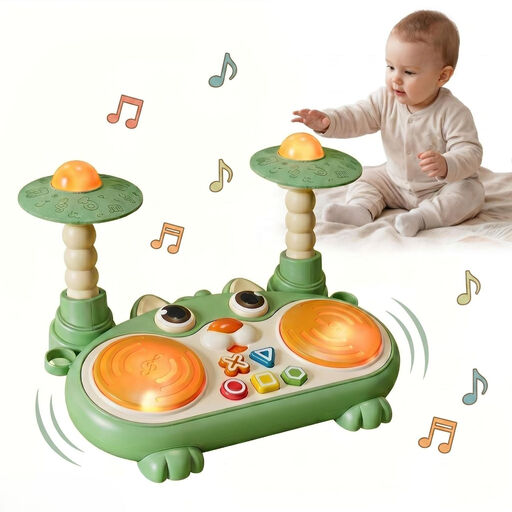
Why it suits this profile: This compact musical toy combines drum pads, lights, animal sounds, and five shapes and colours. According to the product information, it’s designed for children aged 6 to 36 months, making it a good fit for families looking for several ways to play in one toy.
Children can activate the features by pressing, tapping and fitting the shapes into place. This makes the toy easier to understand than one where most effects run automatically.
ABS casing, rounded edges, a non-slip base and several hands-on play areas. Batteries aren’t included, according to the product information.
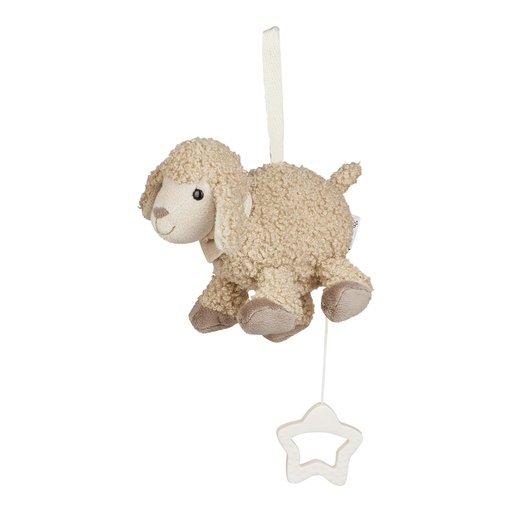
Why it suits this profile: According to the product information, this fabric musical toy is suitable from birth and can be attached to a pushchair, car seat or baby carrier using its ties. It’s a good option for families looking for a simple musical toy to use at home and on the go.
The music module can be removed using a safety zip. This means you can wash the plush cover according to the care instructions without washing the mechanical module.
A mechanical musical mechanism that needs no batteries, a machine-washable cover once the module has been removed, and a soft fabric surface.
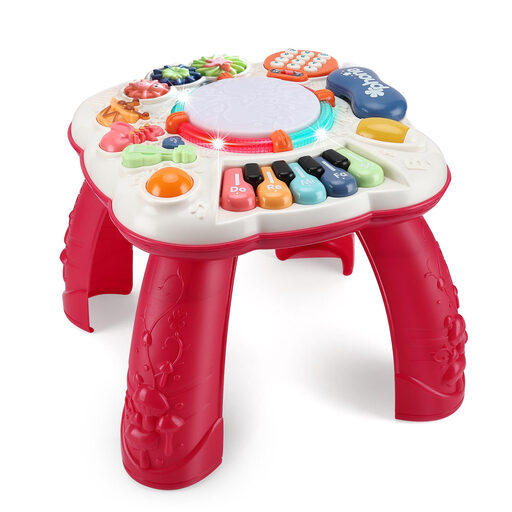
Why it suits this profile: The table has six play areas, including piano keys, a drum pad, gears and instrument sounds. The legs can be removed, so according to the product description, it can also be used as a floor play panel.
A built-in volume control and quiet mode address the common problem of sound levels that can’t be adjusted. Even so, always use the toy at a suitable volume.
Several hands-on play areas, a convertible design and, according to the description, BPA-free ABS material. Batteries aren’t included.
We’ve put together a comprehensive, regularly updated list of products that meet these strict selection criteria and the safety requirements in force across the EU.
A sensory toy doesn’t have to be electronic. A classic baby rattle, a teething ring with different textures or a fabric ball made from a range of materials can also encourage babies to grasp and explore. If you’re buying a newborn gift, simple, age-appropriate products with clear care instructions are often easier to manage than toys with lots of small parts.
Children aged 3 and over have different needs. Products such as learning pens, large card sets or some toy phones may contain small parts and aren’t suitable as baby toys. Don’t overlook the age recommendation in favour of what might seem like a wider range of features.
Only products specifically approved for use from birth are suitable. Soft musical toys or attached hanging toys may be an option, depending on the model. Make sure they’re securely attached, check them regularly for damage, and don’t use toys with loose ties or detachable parts in a baby’s cot.
There’s no single volume recommendation that applies to every product. If possible, choose a model with volume control and avoid placing it close to your baby’s ears. If the melodies are very loud or play continuously, pause the toy or use it further away.
How long a toy lasts depends on its materials, battery compartment, care and how often it’s played with. Fabric musical toys with removable modules can remain practical for longer if cleaned correctly. Store electronic learning toys somewhere dry, avoid dropping them, and only charge them or use suitable batteries as directed in the instructions.