
Lieferung heute & morgen

Qualitätsgarantie

Willkommens-Angebote freischalten: KOSTENLOSE Lieferung | Bis zu 80 % RABATT | Kostenlose 30-Tage-JoyPlus-Testphase
App herunterladen
Musical toys for children range from classic baby music boxes to children’s keyboards with a host of sound effects. But with so much choice, deciding what to buy can be tricky. A toy may have plenty of keys, lights or tunes and still be a poor fit for your child’s age, your home or the way they like to play.
Three common buying mistakes are particularly likely to lead to disappointment:
For baby musical toys and musical instruments for toddlers, the age guidance should match your child’s stage of development. For example, soft music boxes without an accessible musical mechanism may be suitable for babies from birth. For products with cards, clip-on parts or buttons, check whether they contain small parts.
One example is the alilo Pocket Bunny: the product information says it is for children aged 3 and over, even though the product name may appeal to younger children too. As it may contain small parts, it should not be given to children under 3. The age guidance in the safety documentation takes precedence.
The CE mark is a legally required conformity marking, not an independent quality seal. For plastic or wooden toys, parents should also look for rounded edges, secure joints and clear manufacturer information. The EN 71 series of standards sets out requirements for toy safety, but does not replace checking that a specific toy is suitable for the way it will be used.
For a Montessori wooden musical toy, smooth surfaces, securely fitted parts and clear care instructions are particularly important. With electronic products, check the battery compartment and charging cable, and consider the risk of overheating.
A children’s keyboard, piano or drum kit should ideally have a volume control. Keep acoustically loud toys at a sensible distance from your child’s ears and limit playtime. Battery-powered products have ongoing running costs; for rechargeable devices, check the charging time and cable, and make sure charging takes place under adult supervision.
With a baby music box, the musical mechanism should be removable before washing. This makes it easier to care for, but also means that only an adult should handle the zip or safety fastening.
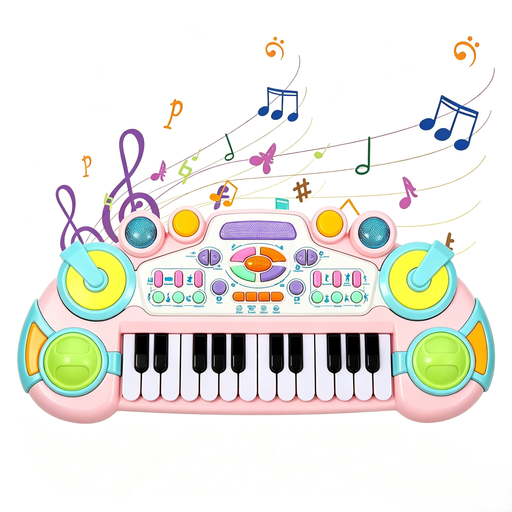
Why it suits this type of buyer: This compact electronic piano is listed for children aged 1 to 5 and has keys, animal sounds, drum sounds and a volume control. It’s an accessible introduction to musical learning toys at home.
The volume can be adjusted, making it easier to manage in a flat. Even so, check the batteries and what’s included before buying.
24 keys, several sound modes and a stated ABS construction with rounded edges.
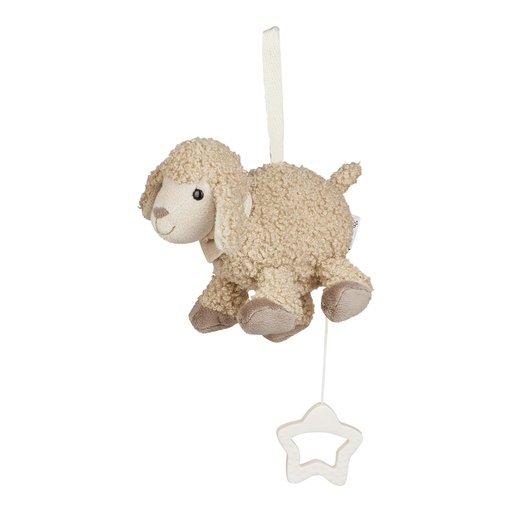
Why it suits this type of buyer: This mechanical music box is listed as suitable from birth, requires no batteries and can be attached to a pushchair, car seat or baby carrier using its ribbons.
The removable musical mechanism makes machine washing easier. It must be taken out before washing and fitted back correctly afterwards.
Mechanical operation with no batteries and a removable musical module; the listed tune is ‘Brahms’ Lullaby’.
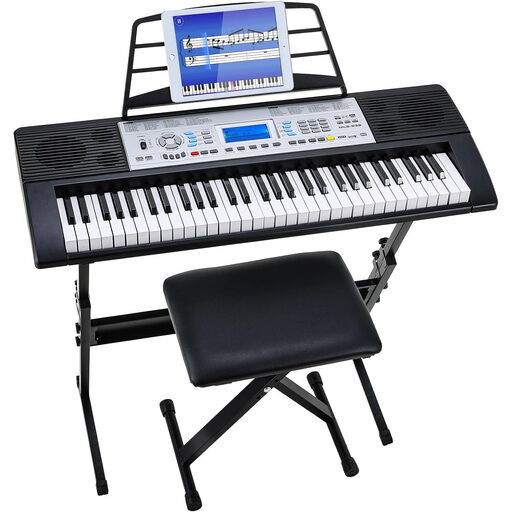
Why it suits this type of buyer: This set is designed for beginners and children who want to play the keyboard regularly. A stand and stool are included, but it needs plenty of space and should be used under adult supervision.
The three-stage learning function and LCD display make it easier to use than a toy focused purely on sound effects. The stand must be assembled securely.
61 keys, 500 built-in sounds and rhythms, and two speakers, according to the product description.
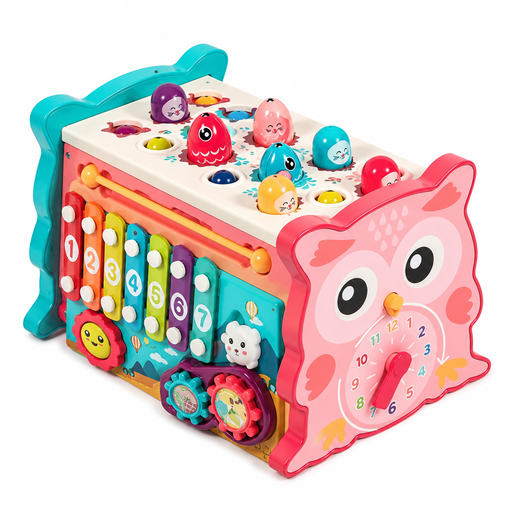
Why it suits this type of buyer: This wooden toy combines a xylophone, hammer game, fishing game and gears. It’s listed for children aged 1 to 3 and makes a versatile learning toy for children from 1 year.
It offers several types of play without batteries or a charger. As it contains small parts, children should use it only under supervision.
Made from solid wood according to the product information, with a water-based finish and four different ways to play.
We’ve put together a complete, regularly updated list of products that meet these strict selection criteria and fully comply with the safety regulations in force in the EU.
From 1 year, simple xylophones, sturdy musical activity boards, rattles and activity cubes are all worth considering. Look for large, securely fitted parts, rounded edges and controls that are easy to understand. Toys with small parts should only be used under close supervision.
There’s no general volume recommendation without measuring the specific product. Look for a volume control, don’t hold the toy directly to your child’s ear and limit playtime. Models with a quiet or mute setting are more practical for flats.
Its lifespan depends on the mechanism, how often it’s used and how well it’s cared for. A removable musical module helps protect it from moisture during washing. For battery-powered baby musical toys, remove the batteries if the toy won’t be used for a long time. Mechanical music boxes don’t need batteries, but can be damaged by being wound too tightly or knocked.