
Lieferung heute & morgen

Qualitätsgarantie

Willkommens-Angebote freischalten: KOSTENLOSE Lieferung | Bis zu 80 % RABATT | Kostenlose 30-Tage-JoyPlus-Testphase
App herunterladen
Musical toys for babies and toddlers combine sounds, movement and simple cause-and-effect experiences. Choosing the right one isn’t always straightforward for parents, grandparents and other family members. Many products are marketed as “educational toys”, “Montessori” or “supporting early development”, without clearly explaining what they actually do.
Three common buying pitfalls are worth watching out for:
The manufacturer’s age recommendation is a useful starting point, but it doesn’t replace observing your child. Toys with easy-to-grasp, lightweight parts are often suitable for babies from 6 months, as are toys designed for tummy time or sitting up. An activity centre with detachable legs may last longer if it can first be used as a flat play panel and later as a table.
Musical toys for toddlers from around 1 year may include buttons, drum pads and rotating parts. Toys with small shapes, rings or detachable parts should be offered in line with the warnings and only under supervision.
Look for:
The product details for the electronic toys listed below include, among other things, ABS plastic, BPA-free materials and compliance with CE and EN71 requirements. This information comes from the individual product descriptions. Before buying and again when your item arrives, check it against the packaging and instructions.
Volume control is useful for family life, especially in flats, during quiet times or when travelling. However, it isn’t medical protection. Don’t hold the toy directly against your child’s ear, and supervise them while they play.
Also check whether batteries are included. They aren’t supplied with several of the models featured here. Cleaning instructions also vary considerably: some products should only be wiped with a damp cloth, while other silicone toys are described by the manufacturer as dishwasher-safe.
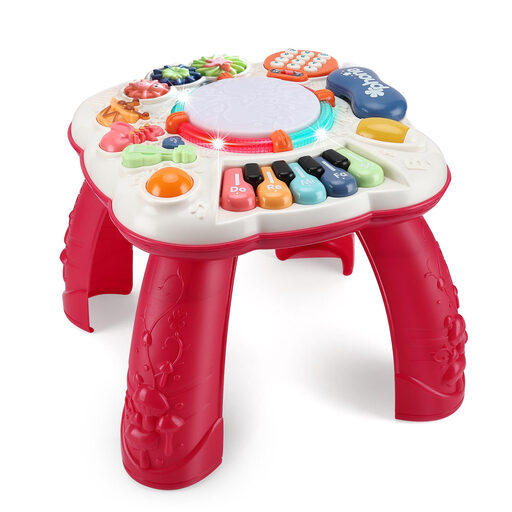
Why it suits this profile: This table combines piano keys, a drum pad, gears and a toy phone. Its detachable legs mean it can first be used as a floor play panel and later as a standing table.
The 6–36 months age range and the different ways to use it are clearly described. According to the product details, it also has volume control and a quiet mode.
Six play areas, detachable legs and a stated age range of 6 to 36 months.
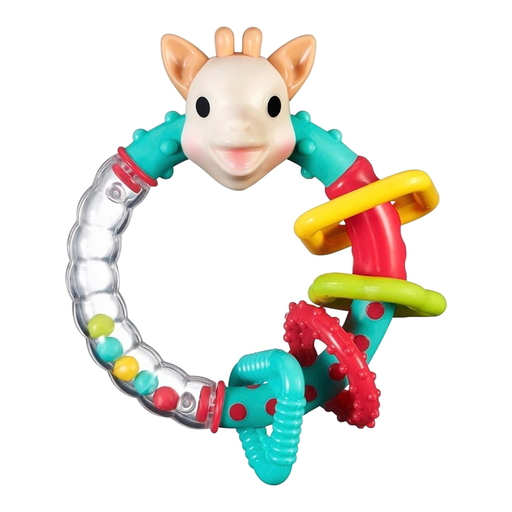
Why it suits this profile: This rattle is listed as suitable for babies from 3 months. It combines grasping, rattling and a variety of textures in a compact design.
There are no electronic sounds or batteries. The care instructions are clear: wipe clean with a damp cloth only; do not put it in the dishwasher.
Combines a rattle and teether, with four movable rings and a stated size of approximately 9 cm.
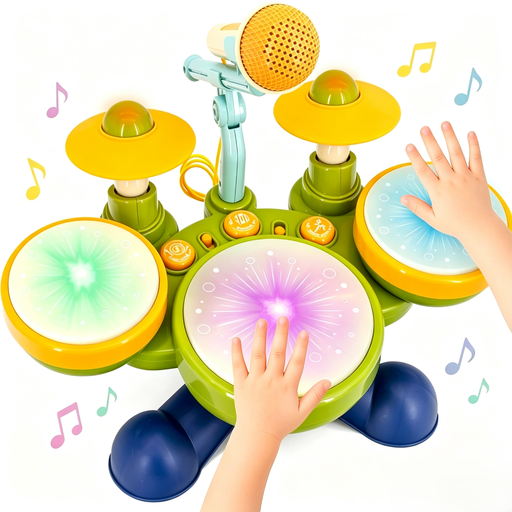
Why it suits this profile: Designed for toddlers aged 1 to 3, this set features illuminated drum pads, raised cymbals, a microphone and several sound modes.
The product description says the volume can be adjusted. The stand is detachable, so the toy can also be used as a flat floor play panel.
A microphone, three illuminated drum pads, two cymbals and a detachable stand; batteries are not included, according to the product details.
We’ve put together a complete, regularly updated list of products that meet these strict selection criteria and fully comply with the safety regulations in force in the EU.
For a birthday present for a toddler, look for products with several ways to play, as long as they’re suitable for the child’s age. A toy piano with a volume control may appeal to children aged 1 to 5, while an activity cube offers compact entertainment for journeys or restaurant visits.
As a Christmas present for a baby, lightweight grasping toys, rattles or a musical tummy-time toy are often easier to manage than a large instrument. For any gift, check the age recommendation, batteries, cleaning instructions and supervision requirements.
It depends on the design. Some grasping toys are listed as suitable from 3 months, while musical toys from 6 months are often designed for tummy time or sitting up. Drums, pianos and activity centres are often suitable from 1 year, depending on the model. Always follow the age recommendation and safety instructions from the relevant manufacturer.
Choose a low, comfortable setting and keep the toy away from your child’s ear. Volume control or a quiet mode makes it easier to use in everyday life. Stop using the product if it makes unusually loud noises, has damaged speakers or has no volume control.
How long a toy lasts depends on its materials, construction and how it’s played with. Models with adjustable or detachable parts may hold a child’s interest for longer. Regularly check the battery compartment, edges, feet and moving parts. Remove any damaged or loose components straight away.