
Lieferung heute & morgen

Qualitätsgarantie

Willkommens-Angebote freischalten: KOSTENLOSE Lieferung | Bis zu 80 % RABATT | Kostenlose 30-Tage-JoyPlus-Testphase
App herunterladen
Musical toys can encourage babies and toddlers to reach, press, drum and listen. But products vary considerably in their age recommendations, volume controls, stability and features. If you focus only on lots of buttons, flashing lights or a long list of built-in tunes, you could overlook important buying considerations.
Three common pitfalls can lead to disappointing purchases:
The age recommendation is a useful starting point, but it doesn’t replace adult supervision. For babies from around six months, larger, easy-to-reach controls, simple cause-and-effect activities and a stable base are usually suitable. A musical learning toy for ages 1 to 3 can combine several play areas, spinning features or buttons.
Products that adapt to different play positions are particularly practical. A baby activity table with removable legs, for example, can first be used as a flat floor toy and later as a standing table. With a children's drum kit, a removable stand can make it easier to play on the floor.
Look for:
The volume should suit the size of the room and the situation. A moderate setting is sensible for longer play sessions or in a busy household. This isn’t a medical safety measure, but a practical way to keep everyday noise in check.
For BPA-free children's toys, check the material information for the specific product. According to the product details, the products featured here are made from BPA-free ABS plastic and have rounded edges. The product details also state that they comply with CE and EN71. You should be able to verify this information on the product page and packaging.
It’s also important to check for:
Montessori sensory toy is not a standardised certification. It usually describes a design that encourages children to grasp, sort, turn and explore independently. So focus on the actual features and age suitability, rather than the label alone.
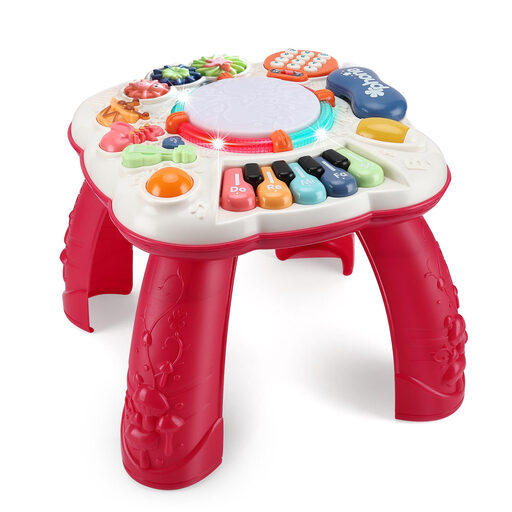
Why it suits this profile: This activity table brings several play areas together in one product and, according to the product details, is designed for ages 6 to 36 months. Its removable legs let you use it as a flat floor play panel or as a table.
The product details list a volume control and a quiet mode, so you can adjust the sound to suit different everyday situations.
Six play areas, removable legs, BPA-free ABS plastic according to the product details, and rounded edges.
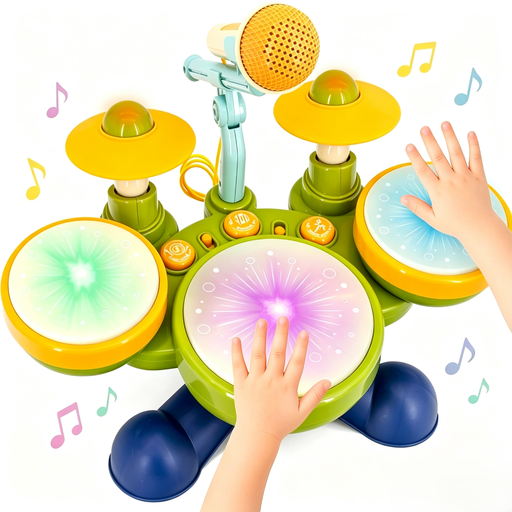
Why it suits this profile: According to the product details, this set is designed for children aged 1 to 3 and combines drum pads, two liftable cymbals, a microphone and several sound functions.
The product description says the volume can be adjusted. The removable stand also lets you use it as a flat floor toy.
A microphone, height-adjustable cymbals, a removable stand and, according to the product details, BPA-free ABS plastic with a non-slip base.

Why it suits this profile: According to the product details, this compact cube is suitable for ages 1 to 3. Its carry handle and different sides—with a piano, guitar, telephone function and cogs—also make it handy for taking out and about.
The features are arranged around a compact cube, rather than requiring a large play area. According to the product details, its surfaces are made from BPA-free ABS and have rounded edges.
Eight play modes, a carry handle, several manual controls and compact dimensions of 23 × 23 × 24 cm according to the product details.
We’ve put together a complete, regularly updated list of products that meet these strict selection criteria and fully comply with the safety regulations in force in the EU.
It depends on the product. According to the product details, some models are suitable from six months, while others are intended for children aged one or three and over. Also check the size of any detachable parts, the stability of the toy and whether supervised use is recommended.
There’s no one-size-fits-all volume level for every product. It’s best to choose a toy with an easy-to-adjust setting, and avoid using it continuously right next to your child’s ear. Parents should also plan breaks when using electronic toys and adjust the volume to suit the room.
Lifespan depends on the build quality, batteries, cleaning and how often the toy is used. A sturdy casing, rounded edges and a stable base are useful things to look for. If you’re buying a gift for a baby or toddler, also check whether the toy will continue to offer suitable features as the child grows.