
Lieferung heute & morgen

Qualitätsgarantie

Willkommens-Angebote freischalten: KOSTENLOSE Lieferung | Bis zu 80 % RABATT | Kostenlose 30-Tage-JoyPlus-Testphase
App herunterladen
Musical toys can encourage babies and toddlers to grasp, press, shake or tap. At the same time, musical boxes, toy pianos, children’s drum kits and interactive baby toys can vary considerably in their recommended age, volume, care requirements and need for supervision. If you choose based only on colourful lights or a long list of features, you could overlook important details.
A toy with lots of melodies, animal sounds and buttons may seem versatile at first glance. But too much stimulation can be confusing for a one-year-old. What matters is whether the toy is easy to use, with a few clearly positioned controls, and suits the child’s stage of development.
Simple cause-and-effect experiences are often useful in a musical learning toy: the child presses a button and hears a sound, or moves a part and triggers a noise. Clear, intuitive controls are often more practical than a long list of modes.
‘From 0 months’ doesn’t mean ‘suitable for unsupervised play’. For example, the music mechanism in a baby musical box must remain securely enclosed inside the fabric body. Products with small parts, battery compartments or projectiles should be kept out of the hands of children below the stated age limit.
The age range ‘1 to 5 years’ should also be considered carefully. A toy piano may be suitable for a toddler, while a three-year-old and a five-year-old may be interested in different features.
Electronic musical toys can seem much louder in a small room than they do in a shop. A volume control or mute mode is therefore an important factor to consider. Parents should also check whether batteries are included, what size is needed and whether the toy can be recharged via USB.
Before buying, check:
For fabric products such as a baby musical box, the music mechanism should be removable for cleaning. After washing, the fabric must be completely dry before you put the module back in.
For plastic toys, details such as ABS, BPA-free or rounded edges are useful product information. However, they don’t replace checking the specific warnings. The CE marking indicates that the manufacturer declares the product meets the applicable EU requirements. A stated EN 71 compliance refers to requirements for toy safety.
The product information for the plastic products below states that they meet CE and EN 71 requirements. This should be understood as information provided by the manufacturer or seller, not as a general assessment of quality.
The following features are useful at home, when travelling and during play together:
Mechanical musical boxes don’t need batteries. Electronic products, on the other hand, need batteries or regular charging. Remember to factor these ongoing costs into your choice.

Why this product suits this need: This compact cube combines several ways to play, including a piano, guitar, gears and a phone feature, for children aged 1 to 3.
The age recommendation, carry handle and compact design make it easy to choose for home or travel. The features are accessed directly using switches, buttons and movable parts.
Eight play modes, ABS plastic according to the product information, rounded edges and a size of approximately 23 × 23 × 24 cm.
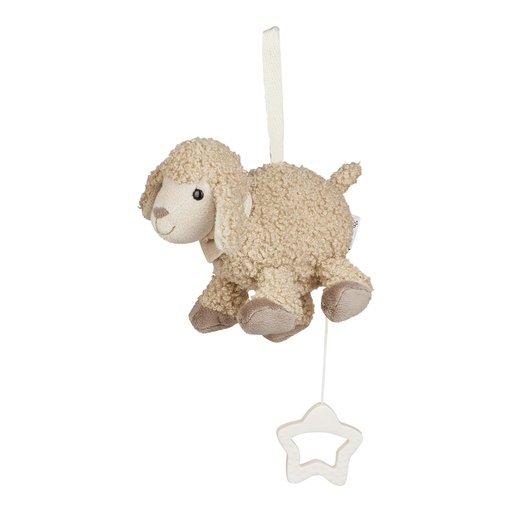
Why this product suits this need: This fabric musical box is suitable from birth and is a good choice for families looking for a washable soft toy that doesn’t need batteries.
The music module can be removed before washing using a safety zip. Keep it out of babies’ reach and make sure it is securely replaced afterwards.
A mechanical music mechanism that needs no batteries, fastening straps for outings and a plush body that is machine washable at 40 °C according to the product information.
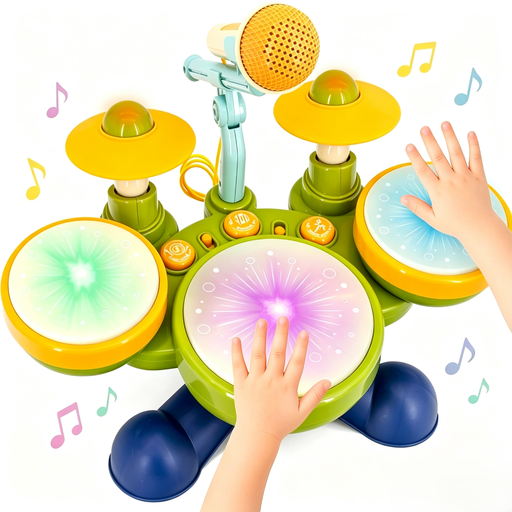
Why this product suits this need: According to the product information, this drum kit is designed for children aged 1 to 3. It has drum pads, cymbals, a microphone and several sound modes for making music together.
A volume control lets you adjust the sound to suit your home and the time of day. The removable stand can convert the toy for floor play.
Three illuminated drum pads, two lift-up cymbals, a microphone and BPA-free ABS plastic with rounded edges, according to the seller.
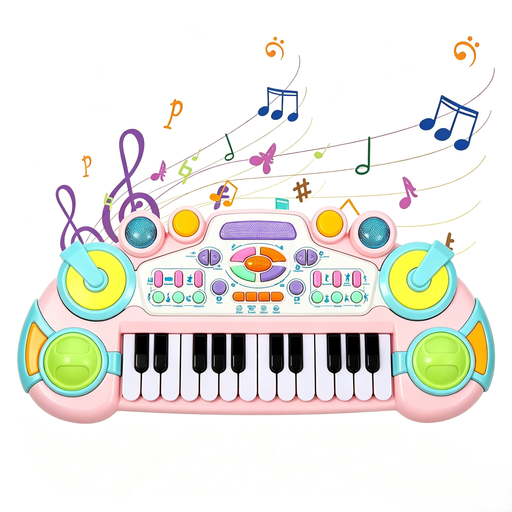
Why this product suits this need: This electronic toy piano has 24 keys, lights, animal sounds and a volume control, and is designed for children aged 1 to 5.
The volume control and mute function mean you’re not stuck with a fixed volume. Information about the batteries and the absence of a microphone helps you plan how the toy will be used.
24 keys, several sound modes, soft lighting and BPA-free ABS plastic with rounded edges, according to the product information.
We’ve put together a complete, regularly updated list of products that meet these strict selection criteria and the safety regulations in force in the EU.
For babies from birth, soft musical boxes or fabric musical toys with a securely enclosed music module are the main options. The module must not be accessible. Check fastening straps, zips and seams regularly. Always follow the manufacturer’s warnings whenever the toy is used.
There’s no single recommended volume that applies to every product. Models with a volume control or mute function are useful. Start with the volume set low and don’t hold the toy directly next to your child’s ear. It’s a good idea to take breaks during longer play sessions.
How long they last depends on the materials, battery compartment, switches, care and how often they’re played with. Battery-powered products should be stored in a dry place and not cleaned with water. With a musical box, a removable music module makes it easier to care for the plush toy. Before buying, it’s also worth checking the type of replacement batteries needed, charging accessories and available care instructions.