
Lieferung heute & morgen

Qualitätsgarantie

Willkommens-Angebote freischalten: KOSTENLOSE Lieferung | Bis zu 80 % RABATT | Kostenlose 30-Tage-JoyPlus-Testphase
App herunterladen
Musical toys for babies and toddlers combine sounds, movement and visual stimulation. But choosing the right one isn’t always easy for parents, grandparents and other family members: product pages often promise learning benefits, versatile features and long-lasting play. What matters most, though, is not the marketing claims but the age recommendation, build quality, volume control and what the toy is actually designed for.
A musical activity table or baby activity cube might combine piano keys, a drum, cogs, a toy phone and animal sounds. That may sound versatile, but it could also overwhelm a younger child. For babies aged 6 months and over, a few easy-to-reach features are often more useful than a complex control panel.
Check whether your child can reach the buttons, surfaces or shapes independently. A toy for tummy time should be flat and stable enough not to tip over. A table with removable legs may be more practical than a model designed only for use while standing.
Toys with lights and music can help demonstrate cause and effect: a child presses a button and hears a sound or sees a light-up surface. But this doesn’t automatically lead to measurable learning progress. Terms such as ‘Montessori toy’ or ‘early development toy’ often describe a concept, but they’re no substitute for specific product information.
Check what your child can actually do with the toy: press, turn, grasp, sort or tap. These features are easier to assess than broad claims about developmental benefits.
Electronic musical toys for babies often need batteries, which may not be included. The volume should also be adjustable or at least moderate. A children’s drum kit with a microphone can quickly become too loud in a flat if there’s no volume control.
It’s just as important that surfaces can be cleaned with a slightly damp cloth. Small openings, hard-to-reach corners and loose accessories add to the cleaning workload and can be impractical for everyday use.
The age recommendation is a key factor when choosing a toy. A product for 6 to 18 months should meet different needs from a children’s drum kit for 1 to 4 years. Check the following:
A product description stating that a toy is suitable for ages 6 to 36 months doesn’t automatically mean it’s equally suitable for every stage of development. How it will actually be used remains the key consideration.
The plastic products featured here are described as being made from ABS plastic and BPA-free. This information should be included in the product details. Rounded, burr-free edges and a sturdy construction are also important for toys that help develop motor skills.
The CE marking indicates conformity with the relevant EU requirements. EN 71 refers to the European series of standards for toy safety. However, a safety marking is no substitute for a visual check: inspect the toy before each use for cracks, loose parts or damaged battery compartments. For the products below, information about materials and standards is based on the individual product descriptions.
The following features are particularly useful in baby drums and musical activity tables:
Electronic features use more battery power. If a toy has lots of tunes, lights and sensors, factor in the ongoing cost and frequency of battery changes.
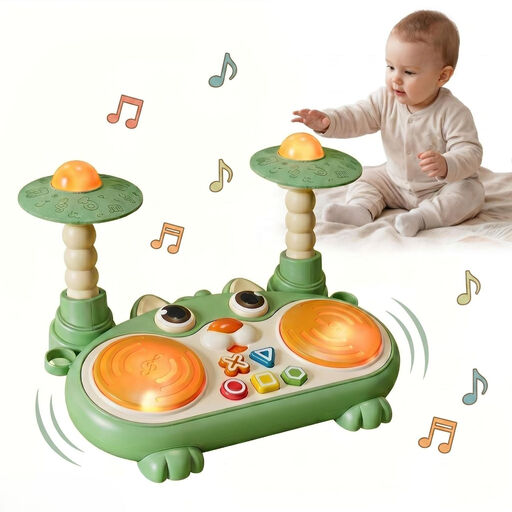
Why this product suits this profile: This baby drum combines drum pads, shape sorting, animal sounds and light effects in one compact design. It’s a good option for families looking for a variety of ways to play in a single toy.
The four play modes described are clearly listed. This makes it easier to check before buying whether the shapes, colours, music and drumming will suit your child.
According to the product information, it’s made from ABS, is BPA-free, has rounded edges and a non-slip base. Batteries are not included.
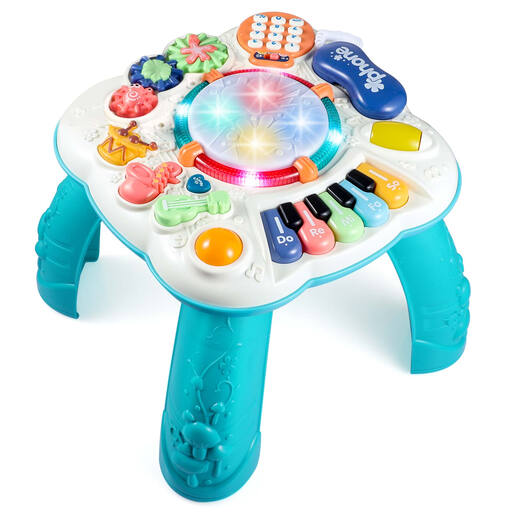
Why this product suits this profile: This musical activity table is a good choice for families who prefer a stationary learning toy with a range of grasping and pressing activities.
According to the description, the removable legs also let you use it as a flat play surface. This could make it a more practical purchase across several stages of development.
Six play zones, volume control and, according to the supplier, ABS plastic in a BPA-free design.
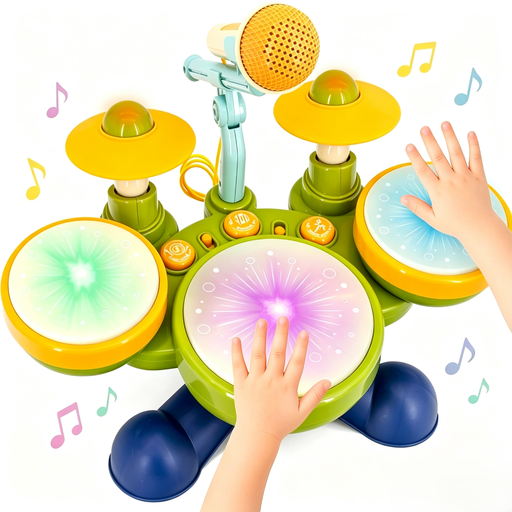
Why this product suits this profile: This children’s drum kit is aimed at families who want to focus on active music-making, drumming and singing. The removable stand makes it easy to use in different ways.
The volume control described addresses a common drawback of electronic drum kits. Even so, check the actual volume before buying and supervise your child while they play.
Three light-up drum pads, two adjustable cymbals, a microphone and a removable stand, according to the product description.
We’ve put together a complete, regularly updated list of products that meet these strict selection criteria and fully comply with the safety regulations in force in the EU.
It depends on the design. According to the manufacturer, some products are suitable from 6 months, while others are intended for children aged 12 months and over or up to 4 or 5 years. Check the age recommendation, the size of the controls and any supervision guidance. Never leave a baby unsupervised with a toy that has damaged or loose parts.
It’s not possible to give a reliable general volume limit without measuring the specific product. Models with a volume control, mute function or clearly limited sound output are recommended. Don’t hold electronic toys directly next to your child’s ear, and stop play if they show signs of discomfort.
How long a toy lasts depends on its materials, how it’s used and your child’s development. A baby activity cube with turning, sorting and pressing activities may remain engaging for several months. A musical activity table with removable legs or a drum kit with a removable stand can be adjusted to suit different play positions. Check the battery compartment, cables, feet and casing regularly for damage.