
Lieferung heute & morgen

Qualitätsgarantie

Willkommens-Angebote freischalten: KOSTENLOSE Lieferung | Bis zu 80 % RABATT | Kostenlose 30-Tage-JoyPlus-Testphase
App herunterladen
Musical learning toys for babies and toddlers combine sounds, colours, movement and simple cause-and-effect experiences. However, choosing the right product is not always straightforward for parents, grandparents and other family members. Many products advertise a wide range of features, while leaving out important details about volume, age suitability or small parts.
This buying guide explains what matters when choosing musical toys for babies, sensory toys and musical instruments. The selection is based on clear, understandable product information and different everyday situations in UK households.
A toy with lights, music, buttons and moving parts may appear versatile. However, the key question is whether a baby can actually reach and use these functions. A children’s piano with lots of keys may be unsuitable for a six-month-old, while a simple drum toy may be easier to reach during tummy time.
So look out for:
Toys with lights and music can quickly become too loud in a home. A volume control, quiet mode or mute function is therefore particularly useful. Without one, it can be difficult to adjust the noise level in everyday situations – for example during a midday nap or in a home with poor sound insulation.
Volume control does not replace responsible use. The toy should not be held directly against the ear, and regular breaks should be taken during longer play sessions.
Descriptions such as “non-toxic”, “safe” or “educational” are not, on their own, enough to base a purchase on. Instead, check the specific information provided about the material, edges, components and markings. For example, the products listed here specify ABS plastic and BPA-free materials. The information on CE and EN71 compliance comes from the respective product descriptions and should be checked against the specific listing before purchase.
Small, detachable parts are also particularly relevant for toys intended for children under three. Age recommendations and warning notices should not be ignored in favour of an assumed longer period of use.
For learning toys from 6 months, choose large, easy-to-grip surfaces, simple buttons and sturdy feet. An activity cube or play board should be designed so that the child is not reliant on small parts.
From around one year old, children can more often combine several actions: pressing, turning, drumming, pulling or imitating. A children’s drum kit or activity centre with different play zones can then encourage varied movements. Between three and five years old, more complex options such as a children’s piano, microphone or interactive language and reading games may be suitable.
Look out for:
ABS is a commonly used plastic for toys. However, the material specification alone does not prove that a product has undergone a complete safety assessment. The manufacturer’s information, product markings and compliance with the recommended age range are what matter.
With battery-powered musical toys for babies, batteries often need to be purchased separately. Check the battery type, battery compartment and, where applicable, whether a mains or USB connection is available. Rechargeable models may be more practical with regular use. An automatic shut-off function and energy-saving quiet mode can also be useful in everyday life.
Musical toys can encourage children to experiment, imitate and sing together. They do not replace supervision and cannot guarantee a particular developmental outcome. With motor skills toys, the specific actions are especially important: gripping, pressing, turning, placing and controlled striking can engage different movement patterns. The term “Montessori-inspired” describes a design concept and does not automatically mean official Montessori certification.
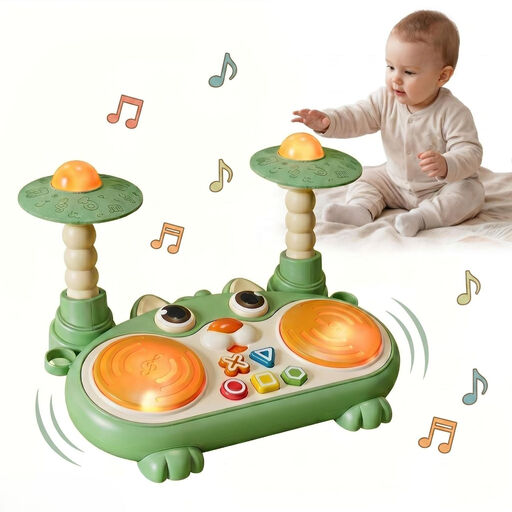
Why this product suits this profile: This frog toy combines drum surfaces, lights, animal sounds and shape and colour matching in a compact device designed for the stated age range of 6 to 36 months.
The functions are clearly listed in the description. This makes it possible to check in advance whether the child can press the shapes, drum and trigger sounds. Batteries are not included.
ABS plastic, BPA-free material specification, rounded edges and a non-slip base according to the product description.
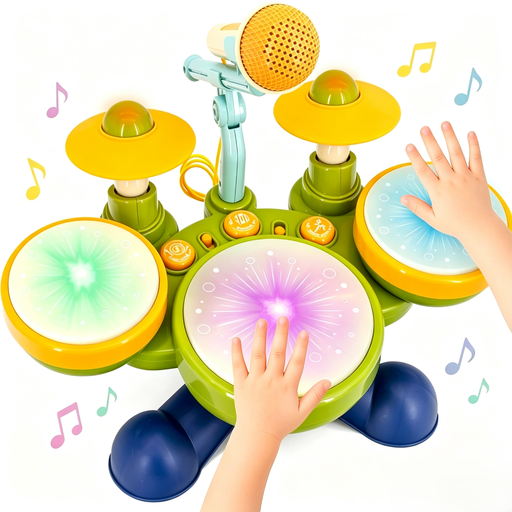
Why this product suits this profile: For families looking for a larger instrument for active play, this set offers three illuminated drum surfaces, cymbals, a microphone and an adjustable volume control.
The volume control allows you to adjust the sound to suit the room and time of day. The detachable stand can make the instrument more flexible for floor-based play.
Adjustable cymbal height, detachable stand and microphone according to the product information; batteries are not included.
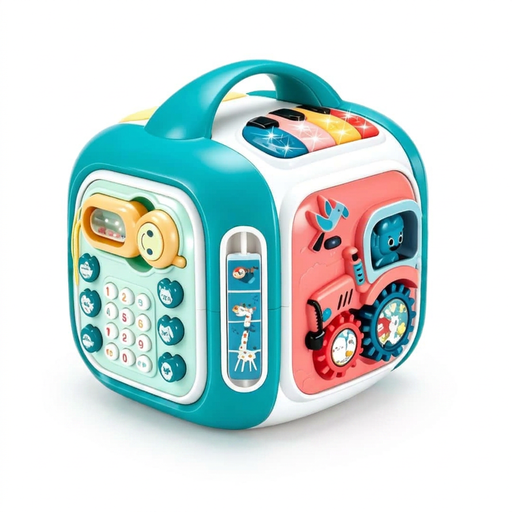
Why this product suits this profile: Designed for toddlers aged 1 to 3, this activity cube combines a piano, guitar, telephone, gears and other controls on a compact surface.
The different play sides offer alternatives when a child does not want to make music alone. Its compact shape also makes it suitable for travel and changing play areas.
Eight stated play modes, carry handle and BPA-free ABS plastic with rounded edges according to the product description.
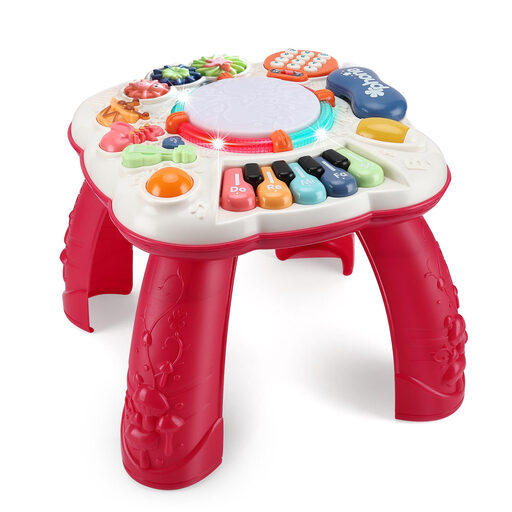
Why this product suits this profile: According to the product information, the activity table can initially be used without its legs as a floor play board and later as a standing play table.
The 2-in-1 design can prevent the toy from becoming impractical too soon as the child’s posture changes. A volume control and quiet mode are useful in the home.
Six stated play areas, detachable legs, volume control and mute function according to the product description.
We have put together a complete, regularly updated list of products that fully meet these strict selection criteria and the safety regulations applicable in the EU.
This depends on the specific product. According to the product information, some drum and activity toys are intended for children from 6 months. Other products, such as an interactive reading pen set, carry a warning for children under three. The age recommendation, small-parts warning and supervision advice for the individual product should always be followed.
It is not possible to give a reliable general volume level without measurements for the specific model. A low setting, sufficient distance from the ear and regular breaks are recommended. A volume control or mute function makes it easier to adapt the toy to your home, but does not replace responsible use.
Their lifespan depends on the material, construction, intensity of use and care. Before each use, check the battery compartment, feet, buttons and moving parts. Clean electronic toys only as recommended by the manufacturer, and do not use them if the casing is damaged or components are loose. This helps reduce the risk of a toy that was initially suitable becoming unsafe due to wear and tear.