
Lieferung heute & morgen

Qualitätsgarantie

Willkommens-Angebote freischalten: KOSTENLOSE Lieferung | Bis zu 80 % RABATT | Kostenlose 30-Tage-JoyPlus-Testphase
App herunterladen
Musical toys for toddlers can help develop a sense of rhythm, hand-eye coordination and independent exploration. At the same time, electronic instruments, activity centres and classic children's drum kits differ significantly in volume, stability, ease of cleaning and age suitability.
If you choose based purely on the number of melodies or flashing features, you risk overlooking important details. Three common buying mistakes are particularly frequent:
For babies from around six months, flat play panels or simple sensory elements that can be reached while lying down are suitable. A baby activity centre with removable legs can later be used as a standing play table. The key point is that the child can sit, grasp or stand safely, and doesn't have to climb to reach the toy.
From around one year, learning toys for 1-year-olds, children's pianos and compact drums become appropriate. A children's drum kit should have a stable base and be designed so that it doesn't slide easily during normal drumming. For children aged three and over, a classic junior drum kit with a seat, pedal and drumsticks can be appealing.
With electronic musical toys, volume controls, a mute function and easily accessible buttons are practical features. A moderate setting is more pleasant for family life than constantly loud sound effects. Parents should also avoid letting children use the toy directly next to their ears, and should plan breaks during longer play sessions.
A microphone with amplification can be fun for role play, but it also increases the noise level. For flats, shared spaces or quiet times, a model with volume control and mute function is usually easier to manage.
According to the respective product details, several of the models presented here are made from ABS plastic, described as BPA-free and feature rounded edges. You should check these details in the current product description before purchasing. However, the material alone doesn't guarantee overall safety in use.
Also pay attention to:
The CE marking indicates declared conformity with applicable EU requirements, but it is not an independent quality seal and does not replace adult supervision. With classic drum sets, particular attention should be paid to warnings about small parts and use near the ears.

Why this product fits the profile: The compact cube combines several types of play in a small footprint, making it ideal for families looking for a versatile musical learning toy without a large piece of furniture.
The different controls are spread across eight play modes. This means the offering isn't limited solely to loud drum beats or individual melodies.
According to product details, includes piano, guitar, telephone function, gears and music; compact size of approximately 23 × 23 × 24 cm.
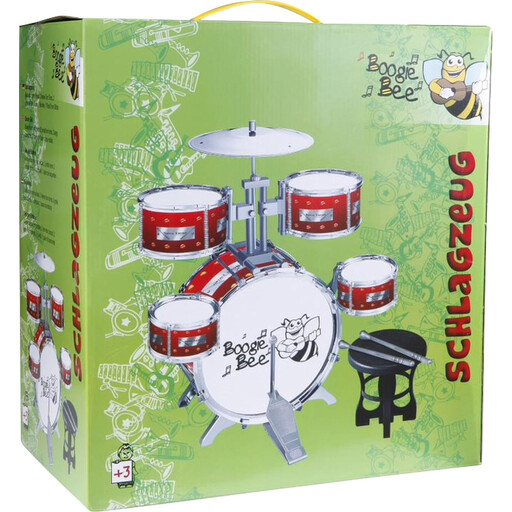
Why this product fits the profile: For those seeking a traditional instrument without batteries, this junior set includes a seat, pedal and several drum parts for more structured music-making.
The set works without electronic sound effects or batteries. The volume cannot be adjusted with a control, so maintaining a sufficient distance from the ears remains important.
According to the product description, seven pieces including bass drum, pedal, toms, hi-hat, drumsticks and stool; recommended from three years.
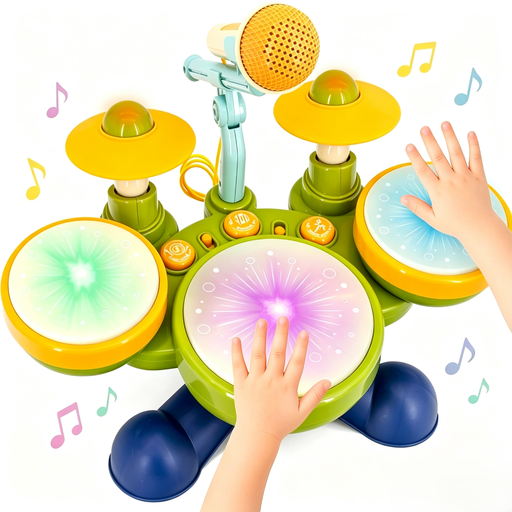
Why this product fits the profile: For children aged around one to three who enjoy singing, drumming and trying out different sound modes, this toy combines several interactions.
The product details mention a volume control and a removable stand. This makes it easier to adapt to the room and playing position.
According to the description, three illuminated drum pads, two liftable cymbals, microphone and several melodies; batteries are not included.
We have compiled a complete, regularly updated list of products that fully meet these strict selection criteria and the safety regulations in force in the EU.
With toys featuring lights and music, parents should check whether the light intensity and melodies can be switched off. For travel or restaurant visits, a portable model with a handle is more practical than a large drum kit. A children's piano suits families who want to offer individual keys and note sequences; a drum set appeals more to children who enjoy rhythmic and physical play.
As a gift for toddlers, you should also consider packaging size, batteries, what's included in the box and assembly effort. A seemingly cheap purchase can lead to extra costs for batteries or missing accessories. For frequent use, an easy-to-wipe surface and a design without hard-to-reach crevices are worthwhile.
That depends on the construction. Some sensory drum toys and activity centres are recommended from around six months according to product details, while more complex instruments or classic drum kits are usually offered from one or three years respectively. The age recommendation should be matched to the child's motor skills and the intended playing position.
A generally suitable setting depends on distance, room and play duration. Choose the lowest volume possible, avoid direct proximity to the ear and prefer models with a volume control or mute function. If unusually loud noises occur, the toy should not be used further until the cause has been identified.
There is no one-size-fits-all answer. Several play modes, changeable playing positions and different difficulty levels can extend the period of use. At the same time, features should match the child's developmental stage. A simple instrument that allows independent pressing, hitting or turning can be more useful in everyday life than a model with many rarely used effects.