
Lieferung heute & morgen

Qualitätsgarantie

Willkommens-Angebote freischalten: KOSTENLOSE Lieferung | Bis zu 80 % RABATT | Kostenlose 30-Tage-JoyPlus-Testphase
App herunterladen
A My Flair rug can visually divide a room, make walkways more comfortable and bring different furnishings together. However, your choice should not be based solely on colour or the product photo. With rugs in particular, unclear size specifications, unsuitable materials and underestimated care requirements often lead to disappointing purchases.
A rug for the living room should neither look too small nor block doors, wardrobe fronts or radiators. For a rectangular rug, it is advisable to mark out the desired area first using masking tape or sheets of newspaper. This makes it easier to check whether, for example, the front legs of your furniture can stand on the rug.
For a hallway, narrow runners such as a 250 × 80 cm or 300 × 80 cm model are often more suitable than a square design. By contrast, a round rug measuring 100 × 100 cm or 150 × 150 cm can highlight a seating area, a small table or an open zone in the bedroom.
Jute has a natural appearance and a textured surface. A jute rug such as the “Natural Bengal” or “Juna Essence” models suits Scandinavian, rustic and nature-inspired interiors. However, these fibres should not be confused with a soft deep pile. In areas where spills or coarse dirt are common, the care instructions should be followed particularly carefully.
A polypropylene shaggy rug feels noticeably more sumptuous thanks to its 4 cm material height. However, longer fibres can collect more crumbs and dust. In households with children or pets, regular vacuuming and a suitable location are important selection criteria.
A handwoven Chindi rug can have an individual look due to variations in material and colour. With handmade products, precisely these differences are part of their appearance. If you expect an absolutely even surface, it is better to choose a plain or clearly structured model. The “Ashraf” and “Ameer” models are also available in different sizes, so their effect ranges from a small hallway format to a larger living area.
Before buying, you should have at least the following dimensions in mind:
The product information should also clearly distinguish between length and width. For the products listed here, the depth is approximately 1 cm or 4 cm, depending on the version.
Weight provides a rough indication of the amount of material used, but it does not replace an assessment of the workmanship and underside. The “Natural Bengal”, measuring 250 × 200 cm, is specified, for example, as weighing 2,700 g/m² and having a net weight of 14 kg. This can help keep the rug securely in place, but it also makes it heavier to turn over or clean.
Jute models have a naturally toned appearance. A natural-coloured rug can be combined with wood, white, beige and muted shades of green. A grey or dark grey rug is less likely to show everyday marks and works well with many modern furnishings. The exact colour perception may vary depending on the room lighting and your screen.
For rooms with underfloor heating, it is not just the material that matters, but also the product’s explicit suitability information. According to the product details, the models in the “My Shaggy” series are described as suitable for underfloor heating. This feature should not automatically be assumed for other rugs.
A non-slip underlay is also advisable, particularly on smooth tiles, laminate or parquet flooring. It can help keep the rug stable and reduce the risk of tripping. The underlay must be suitable for the size of the rug and must not unreasonably restrict the heat output from the underfloor heating.
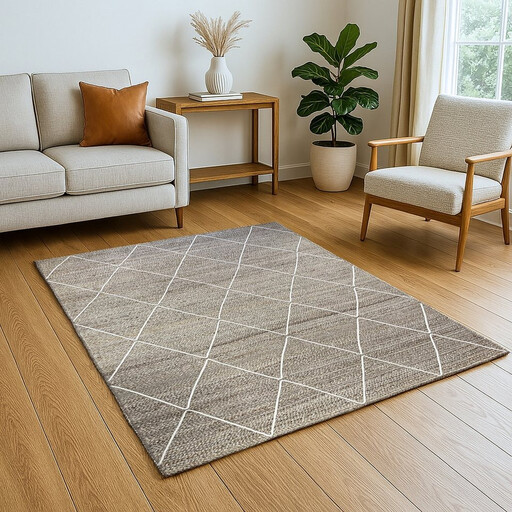
Why this product suits this profile: The 150 × 100 cm format is suitable as a rug for bedrooms, small living areas or a compact seating space. The jute surface with its geometric cotton pattern combines a natural look with a clean shape.
The clearly stated dimensions reduce the risk of buying a rug that is too large for a small room. The jute material specification makes it easier to understand what to expect from the surface.
Jute, geometric pattern, 1 cm depth and 4 kg net weight according to the product details.
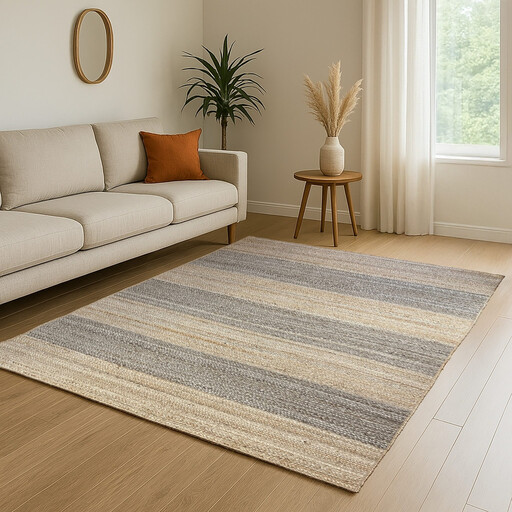
Why this product suits this profile: The large format is suitable for a spacious living room when you want one continuous surface beneath the sofa and table. The two-tone jute look and zigzag weave create a distinctive accent.
The area can be measured precisely before purchase. The stated material and 14 kg weight provide concrete reference points instead of relying solely on the product image.
250 × 200 cm, jute, 1 cm depth and a material weight of 2,700 g/m² according to the product details.
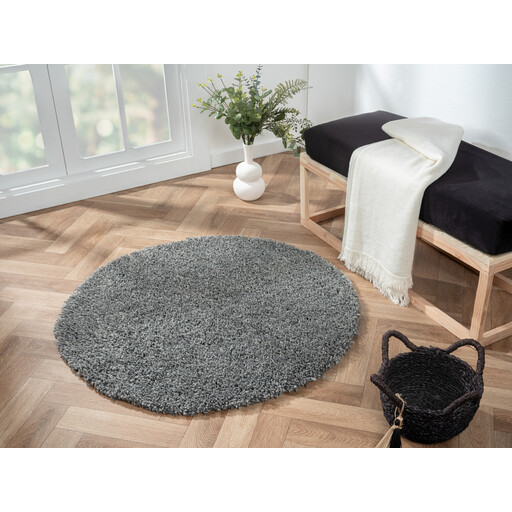
Why this product suits this profile: The round polypropylene shaggy rug is suitable for children’s rooms, teenagers’ rooms or cosy reading corners. According to the product details, it is suitable for rooms with underfloor heating.
Its suitability for underfloor heating is explicitly stated. Even so, you should allow for the 4 cm depth around doors and furniture.
Round shape, dark grey colour, polypropylene, 150 × 150 cm and 4 kg net weight according to the product details.
We have compiled a complete, regularly updated list of products that fully meet these strict selection criteria and the safety regulations applicable in the EU.
With jute rugs, loose dirt should be removed regularly using a suitable vacuum setting. Moisture should be avoided wherever possible unless the manufacturer’s care instructions specify otherwise. Handwoven Chindi rugs can be cared for by shaking them out and vacuuming gently; the irregular structure should not be subjected to unnecessary strain.
A shaggy rug usually requires more attention because of its deeper surface. Do not leave furniture with sharp edges standing on the pile permanently, and check that the rug lies flat after laying it out. If the rug is delivered as bulky freight, it may be sensible to measure access through doors, the stairwell and the hallway in advance.
That depends on the particular model. The product details for “My Shaggy” state that it is suitable for underfloor heating. For jute and Chindi rugs, check the relevant product page and also make sure you use a suitable, heat-permeable underlay.
For a larger living room, options such as 200 × 140 cm or 250 × 200 cm may be suitable. The key factors are the footprint of the sofa, table and armchairs, as well as the distance from doors. Before buying, mark out the desired area on the floor to check the proportions.
Regular vacuuming suitable for the material, removing stains promptly and using an appropriate non-slip underlay can reduce everyday wear. Rugs should also be turned occasionally so that walking areas do not always form in the same places.