
Lieferung heute & morgen

Qualitätsgarantie

Willkommens-Angebote freischalten: KOSTENLOSE Lieferung | Bis zu 80 % RABATT | Kostenlose 30-Tage-JoyPlus-Testphase
App herunterladen
A motion-activated LED night light can automatically illuminate paths, cupboard interiors and worktops, so you don’t have to fumble for a switch. For UK homes, brightness and design aren’t the only things to consider. The fitting, sensor performance, charging connection and suitability for the room all matter.
Many products look similar at first glance. Look more closely, though, and you’ll find significant differences in battery capacity, detection range and controls.
A high number of LEDs doesn’t automatically mean even illumination. For LED cupboard lighting or an LED under-cabinet light with a motion sensor, the length of the light also matters. A short lamp may be enough for a shelf, while a 30- or 40-centimetre model can cover a larger area more evenly.
For a nighttime trip to the bathroom, a soft, warm-white night light is often more comfortable than a very bright task light. Check whether the light offers several brightness levels or a dimming function.
A PIR motion sensor light responds to movement within a specific angle and distance. Without these details, it’s difficult to tell whether the light will switch on reliably under a kitchen cupboard or in a hallway.
It’s also important to check whether the sensor has separate day and night modes. Some models only activate the sensor when ambient light is low, while others switch on whenever they detect movement. This affects both power consumption and how practical the light is for everyday use.
‘No drilling’ usually means fitting the light with a magnet, adhesive strips or a metal plate. This is convenient, but the surface needs to be clean, dry and reasonably smooth. Adhesion may be poor on rough plaster, damp tiles or dusty cupboard surfaces.
If you’re choosing a magnetic LED light, check whether you have a magnetic surface or whether a self-adhesive metal plate is included.
Check the detection angle, range and automatic switch-off time. Depending on the product, the models featured here list a range of, for example, 3 to 5 metres or a detection angle of 120 degrees. These are manufacturer or product specifications, not a guarantee of performance in every installation.
A short switch-off time is often enough for a cupboard or hallway. For stairs or longer routes, a longer activation period may be more practical. A continuous-light mode is a useful extra if you also want to use the light as a regular task light.
A rechargeable night light saves you from having to buy batteries regularly. Check:
Actual run time depends on the brightness setting, how often the sensor is triggered and the condition of the battery. Claims such as ‘up to 80 hours’ should therefore be understood as maximum figures under specific conditions.
Neutral or cool white light is often a good choice for kitchens and cupboards, as it can make outlines and objects easier to see. For bedrooms, nurseries or nighttime routes, a warm-white night light of around 2,800 to 3,200 Kelvin is often preferred.
Several colour temperatures, such as 3,000, 4,500 and 6,500 Kelvin, give you more flexibility. Three or five dimming levels are useful if you want to use the same LED sensor light during both the day and at night.

Why it suits this profile: This two-pack is ideal for small cupboards, shelves or a short stretch of hallway. With 21 LEDs per light, three colour temperatures and USB charging, it keeps things simple.
The product details clearly state the dimensions, PIR range of 3 to 5 metres, battery capacity and adhesive fitting method.
Two lights, an 800-mAh battery in each light, three light colours and fitting without drilling.
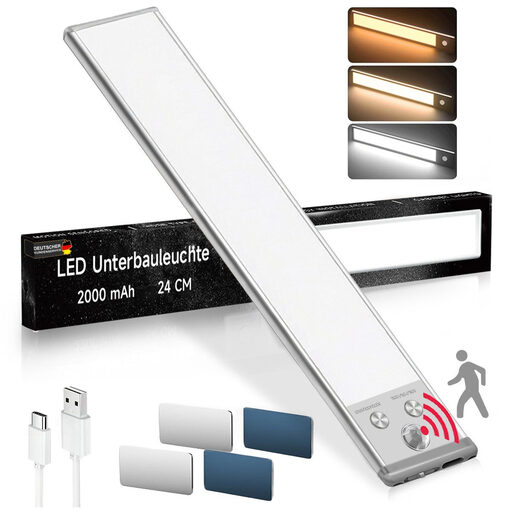
Why it suits this profile: With three colour temperatures and three brightness levels, this light is a versatile choice for the kitchen, wardrobe, bedroom or stairs.
The product details specify the sensor area, 120-degree angle, 3-metre range and 20-second switch-off time.
88 LEDs, a 2,200-mAh battery, USB-C connection, aluminium housing and magnetic fitting with adhesive plates.

Why it suits this profile: This set is designed for bedrooms, nurseries, hallways or bathrooms where you need several brightness levels in a compact design.
The product details list five dimming levels, three colour temperatures, a sensor range of 3 to 5 metres and a threshold of no more than 20 lux.
500-mAh battery, USB charging, 30 lumens, five dimming levels and two operating modes.
We’ve put together a complete, regularly updated list of products that meet these strict selection criteria and fully comply with the safety regulations in force in the EU.
Clean the surface before fitting the light, then check that it is securely in place. Lithium-battery models should only be charged with a compatible USB charger. If the light is visibly damaged, gets unusually hot or has a swollen battery, stop using it.
For bathrooms, bear in mind that many cordless lights are designed for dry indoor spaces only. Check the stated IP rating and keep the product away from direct water and high humidity. A plug-in light isn’t automatically suitable for areas exposed to splashes either.
The surface should be dry, clean and as smooth as possible. Magnetic models attach directly to metal surfaces or can be fitted using the adhesive plate supplied. It’s a good idea to test the light briefly in the intended position before fixing it in place permanently.
Run time depends on battery capacity, brightness and how often the sensor is triggered. Manufacturer claims such as ‘up to 10 hours’ or ‘up to 80 hours’ refer to specific operating conditions. If you use the light frequently, a larger model with a 2,200-mAh battery may need charging less often than a compact light with 500 mAh.
In sensor mode, the light only comes on when it detects movement and, depending on the model, only when ambient light is low. This can mean lower power consumption than leaving a light on continuously. Actual usage will still depend on the sensor range, switch-off time, brightness and how often the sensor is triggered each day.