
Lieferung heute & morgen

Qualitätsgarantie
App herunterladen
Kategorien
Nail art pens are specialised drawing tools designed for applying fine details and complex patterns onto nail surfaces. Unlike conventional nail polish brushes, whose bristle structure limits control during intricate work, these pens feature firm, fine tips that enable high precision. They typically operate using a pigmented, acrylic-based ink that ensures a controlled flow and forms a solid, opaque layer upon drying. This makes them a fundamental tool for creating detailed lines, lettering, and dot patterns in nail design.
The selection of suitable nail design pens depends on specific technical parameters that define the intended application and desired result. An objective evaluation of the following criteria is essential for making an informed decision.
The tip is the critical component for precision. Standard tips typically range in diameter from 0.5 mm to 0.7 mm.
The ink's composition determines its opacity, drying behaviour, and ability to create three-dimensional effects.
The durability of the materials used is crucial for the longevity of a nail design. Water-resistant nail pens become resistant to water and smudging after they have fully dried. This prevents the design from smearing before the protective top coat is applied. A short drying time of just a few minutes is advantageous for speeding up the workflow and preventing accidental damage.
A nail art pen set offers a curated selection of colours. For beginners or for basic designs, a set with 12 essential colours (including black, white, and primary colours) may be sufficient. For advanced users and professional nail technicians, sets with 24 or more colours, including metallic and neon shades, allow for a significantly broader creative range.
The following selection is based on an analysis of the products' technical specifications and intended applications.
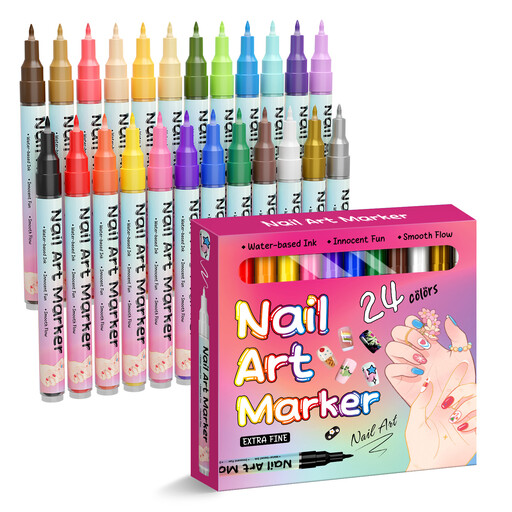
Why We Recommend This Product This set stands out with its extensive colour palette of 24 different shades, including both basic and special-effect colours. The consistent use of a 0.5 mm tip across all pens ensures uniform and high precision for detailed work. The formulation is explicitly designed to create 3D textures through layered application.
Pros
Who It's For This set is aimed at experienced users and professional nail technicians who require a wide range of colours for complex and varied designs. It is also suitable for ambitious DIY enthusiasts looking to expand their creative options.
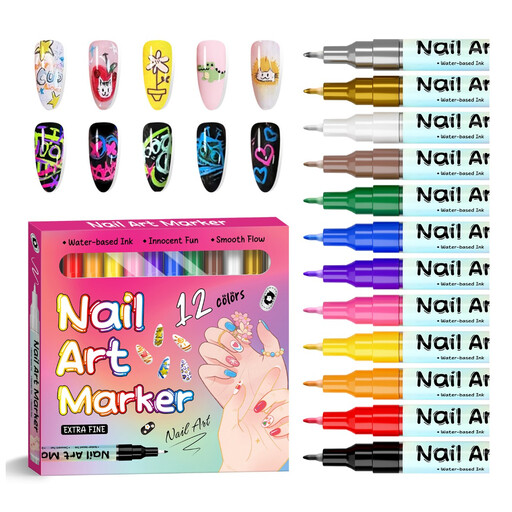
Why We Recommend This Product This set focuses on 12 essential colours, providing a solid foundation for a wide variety of nail designs. It features the same precise 0.5 mm tip as the larger set, enabling professional-quality line work. The quick-drying and water-resistant acrylic formula makes it an efficient tool for DIY nail design accessories.
Pros
Who It's For This set is ideal for beginners in nail design and for users seeking a compact, functional selection of the most commonly used colours. It represents a cost-effective solution for home use.
Product conformity information according to the manufacturer NINGBO COSEEDA IMP & EXP LTD., Room3-2-2,No.288 Guanghua Road,High-Tech Zone,Ningbo,Zhejiang, China. EU Responsible Person: Jingdong Retail Germany GmbH, Kasseler Straße 7, 35418 Buseck, Germany.
Beyond specialised pens, the field of nail design includes a variety of other instruments. Tools such as dotting tools with spherical tips for creating perfect dots, fine brushes for colouring larger areas, or applicators for rhinestones and foils complement any kit. For a comprehensive selection of accessories and materials to expand your technical capabilities, you can find relevant products in our Art Supplies category.
Nail art pens are applied over a fully dried base (either a base coat or colour polish). Before use, shake the pen and press the tip several times on a test surface to activate the ink flow. After drawing the design, the ink must air-dry completely. Finally, the artwork is sealed with a top coat to protect it from abrasion.
A special top coat is not strictly necessary, but a "non-smudge" top coat is recommended. It is crucial to apply the top coat only after the pen's design is completely dry. Applying it too soon or using a top coat with an aggressive solvent can dissolve the design. Apply the top coat with a quick, floating brush stroke to minimise contact.