
Lieferung heute & morgen

Qualitätsgarantie

Willkommens-Angebote freischalten: KOSTENLOSE Lieferung | Bis zu 80 % RABATT | Kostenlose 30-Tage-JoyPlus-Testphase
App herunterladen
A narrow bathroom shelf can make practical use of unused gaps. In small rented flats, cloakrooms or narrow utility rooms, however, width is not the only factor that matters. Depth, load capacity, moisture protection and whether the shelf will stay in the same place or need to be moved easily are equally important.
If you focus only on product images or terms such as “space-saving”, you can easily overlook important details. Three common buying pitfalls are particularly relevant:
Measure the available recess at several points. Walls are not always completely parallel. Also take skirting boards, pipes, door leaves and the distance to the toilet or shower into account.
A recess bathroom shelf should not only fit into the gap; you should also be able to pull it out or clean it comfortably. A recess trolley with castors also requires sufficient clear floor space in front of the furniture.
As a guide:
Always check the complete dimensions in the order Width × Depth × Height. A narrow front can still take up a lot of space if the unit is very deep.
The maximum load capacity does not automatically apply to every shelf. Wherever possible, place heavier supplies at the bottom. Open compartments make items easy to access, while drawers or baskets help organise smaller items and keep them out of sight.
For bathroom storage, consider what you actually need to store:
E1 MDF or E1 chipboard refers to the formaldehyde emission class of the wood-based material. This classification is an objective material specification, but it does not indicate complete water resistance. The rule for bathroom furniture is therefore: wipe away splashes promptly, avoid standing water and dry the surface after cleaning.
A narrow bathroom cabinet with feet can create clearance from the floor. For a bathroom trolley, the castors should be securely attached and, where available, lockable. Aggressive cleaners and abrasive products can damage coatings.
The following models differ in storage space, mobility, layout and assembly. Before ordering, check the current product details and the installation conditions in your home.
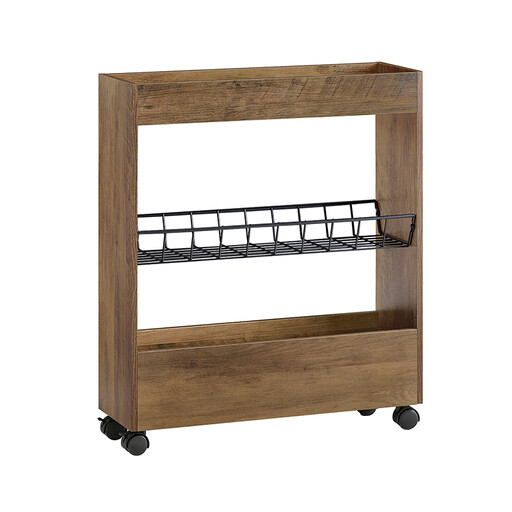
Why this product suits this profile: The open shelf has three levels and, thanks to its four castors, can be moved flexibly between the kitchen, bathroom or utility room. The stated dimensions are approximately 20 × 70 × 60 cm (W × D × H).
The open design keeps the compartments clearly visible. Two castors have brakes; nevertheless, the shelf should stand on a level floor and be protected from prolonged exposure to moisture.
Three open levels, four castors and a stated total load capacity of up to 40 kg.
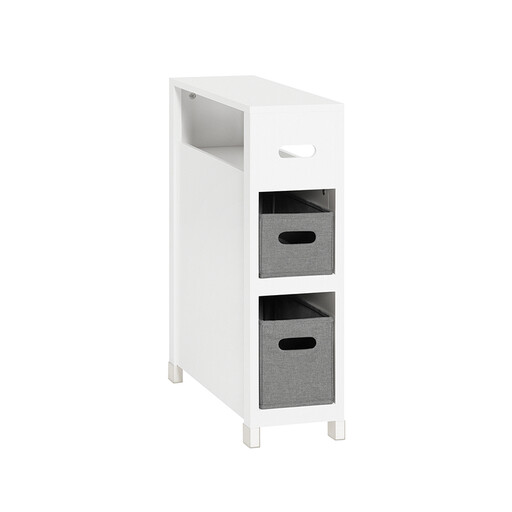
Why this product suits this profile: Two removable baskets and an open compartment organise toilet paper, toiletries or kitchen supplies. According to the product details, the dimensions are approximately 20 × 70 × 60 cm.
The layout prevents small items from being left loose in a deep compartment. A raised base creates clearance from the floor; direct contact with water should nevertheless be avoided.
Two removable baskets, an additional compartment and a separate rear compartment for a toilet brush.
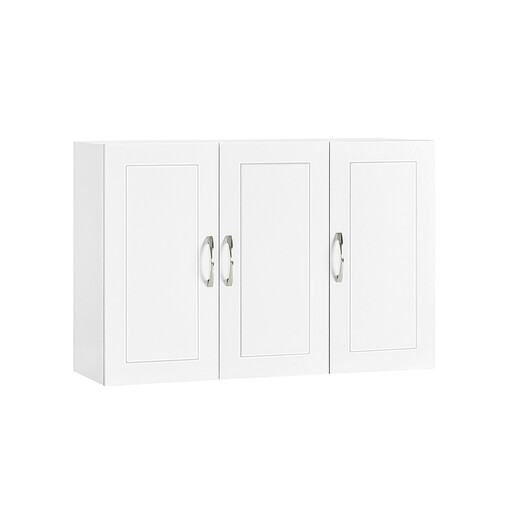
Why this product suits this profile: This wall cabinet is suitable for anyone who needs storage above worktops or washbasins. The dimensions are 90 × 30 × 60 cm.
The adjustable shelf can be adapted to bottles, glasses or towels of different heights. The supplied anti-tip fitting should be properly secured to a suitable wall.
Adjustable internal shelf, doors and a stated total load capacity of up to 36 kg.
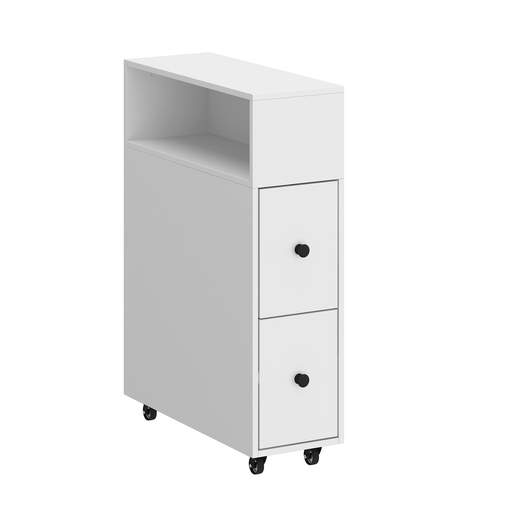
Why this product suits this profile: According to the product details, the mobile trolley is approximately 4.8 cm wide, making it suitable for particularly narrow gaps. Before buying, check the dimension diagram and the available clearance for pulling it out carefully.
An open compartment and two drawers keep frequently used items separate. The safety instructions require a level position and evenly distributed loading; both drawers should not be pulled out at the same time when heavily loaded.
Four castors, an open compartment and two drawers for the kitchen, bathroom or utility room.
We have put together a complete, regularly updated list of products that fully meet these strict selection criteria and the safety regulations applicable in the EU.
Before assembling or positioning the furniture, check the tiles, wall clearances and any existing pipes. A bathroom trolley needs a level floor so that the castors are loaded evenly. For a wall cabinet, the wall’s load-bearing capacity is crucial; use wall plugs and screws that are suitable for the substrate.
For a longer service life:
That depends on the available recess and how you intend to use it. For toilet paper or a few toiletries, 10 to 15 cm may be enough. For several compartments, towels or bottles, around 20 cm is often more practical. The key point is to leave sufficient clearance beside the furniture.
A trolley can be useful if you want to move cleaning products or toiletries around easily. Look for castors with brakes, a stable base and a dry location. For areas regularly exposed to splashes, the material and care instructions for the specific product are especially important.
There is no standard service life. It depends on the material, load, assembly, humidity and care. If furniture is kept permanently damp, overloaded or loaded unevenly, its coatings, edges and fittings may deteriorate more quickly. You should therefore observe the load capacity and remove water promptly.