
Lieferung heute & morgen

Qualitätsgarantie

Willkommens-Angebote freischalten: KOSTENLOSE Lieferung | Bis zu 80 % RABATT | Kostenlose 30-Tage-JoyPlus-Testphase
App herunterladen
Living spaces are becoming increasingly compact, presenting a growing challenge for staying organised. Narrow hallways, small bathrooms, and unused nooks can be particularly problematic: where can you store shoes, towels, or everyday items without sacrificing valuable floor space? Narrow cabinets are a smart solution. They leverage vertical space while minimising their footprint on the floor.
This article serves as your practical guide. We'll introduce various models and provide you with objective criteria to help you find the perfect storage solution for your compact spaces.
Before making a decision, consider three fundamental aspects to ensure the piece of furniture serves its purpose and fits safely into your living space.
Depth is the most crucial factor. Measure your available space precisely—width, height, and especially the maximum depth the cabinet can have without obstructing pathways. A typical niche cabinet or slim hallway furniture often has a depth of less than 25 cm. Also, consider the swing clearance for doors or flaps. For instance, a tip-out shoe cabinet requires less forward space to open than a cabinet with traditional hinged doors.
Consider what you plan to store. For shoes, a narrow shoe cabinet with tilted compartments is ideal, as it keeps shoes stored efficiently and out of sight. For the bathroom, a tall bathroom cabinet with adjustable shelves is more practical for accommodating bottles of various heights and towels. The interior layout determines how flexibly and efficiently you can use the storage space.
Most space-saving furniture is made from MDF (Medium-Density Fibreboard) panels, often with an E1 classification, which indicates low formaldehyde content. Look for a water-resistant surface finish, especially for a tall bathroom cabinet. Due to their tall and narrow design, these cabinets have a higher tendency to tip over. An included anti-tip kit for wall mounting is therefore an essential safety feature and should always be used.
Here is a selection of models that are well-suited for tight spaces due to their specific dimensions and features.
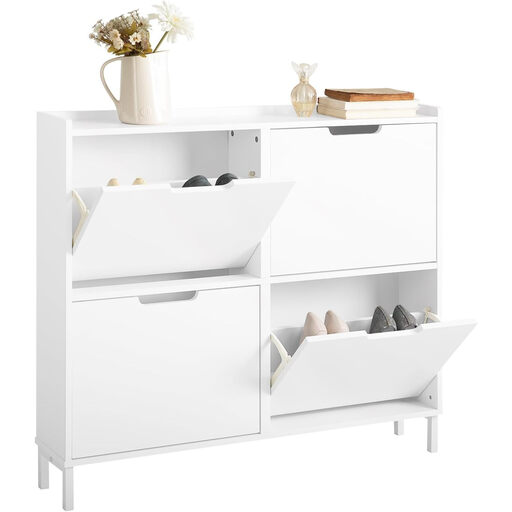
What makes it stand out: With a depth of just 19 cm, this tip-out shoe cabinet is an extremely space-saving solution. It leverages its width to offer high capacity without protruding into the room.
Pros:
Who it's for: Individuals looking to store a large number of shoes neatly and out of sight in a narrow entryway.
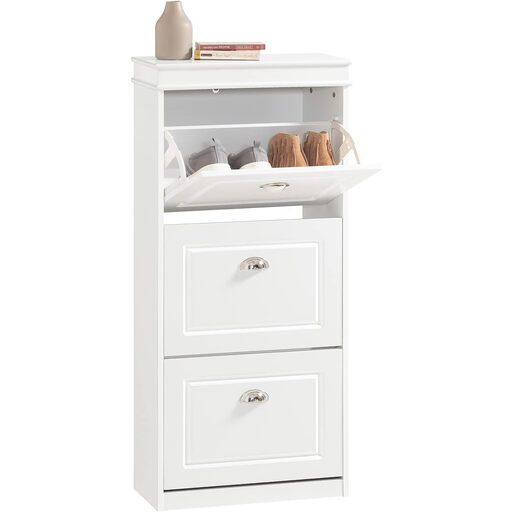
What makes it stand out: With a 24 cm depth, this model offers an excellent balance between a slim design and generous storage. It efficiently uses its height to provide ample capacity on a small footprint.
Pros:
Who it's for: Households looking for a compact yet spacious storage solution for the hallway and who value certified materials.
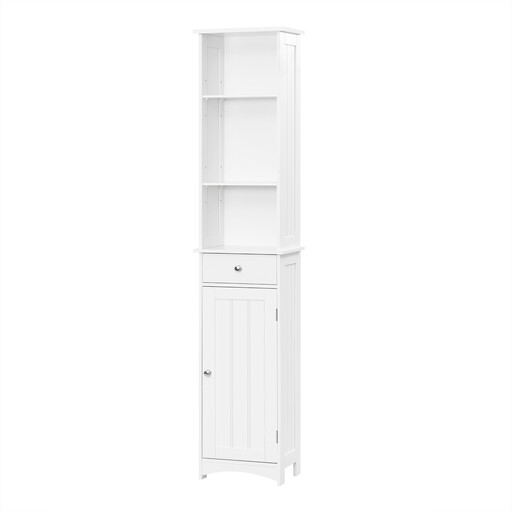
What makes it stand out: With its 33 x 23 cm dimensions, this tall bathroom cabinet is specifically designed to utilise corners or narrow wall sections in the bathroom.
Pros:
Who it's for: Anyone needing an elegant and space-saving storage option for towels, cosmetics, and cleaning supplies in the bathroom.
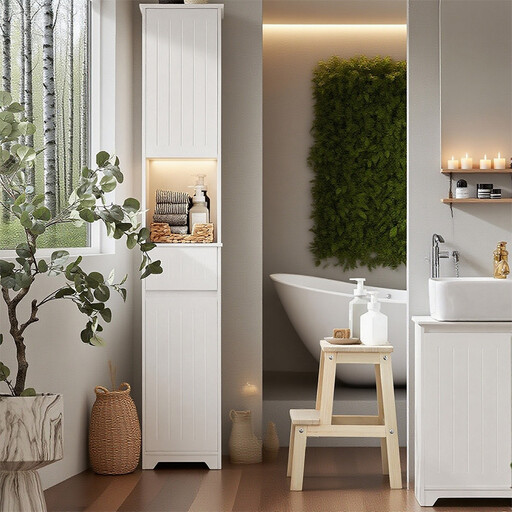
What makes it stand out: With a footprint of just 30 x 30 cm and a height of 170 cm, this cabinet is a classic solution for small bathrooms. It combines open and closed compartments.
Pros:
Who it's for: Those who prefer a mix of open and concealed storage in a tall, narrow bathroom cabinet.
The models featured here cover common needs, but the selection of designs and materials is vast. If you're looking for a different colour, material, or a specific size, you may find the perfect piece in our broader collection.
? Explore our entire selection of white wooden cabinets here
The depth varies depending on its intended use. Ultra-slim tip-out shoe cabinets can be as shallow as 17 to 20 cm. General-purpose narrow cabinets for hallways or bathrooms are often between 20 and 35 cm deep. It is crucial to measure your available space accurately before buying.
Tall and narrow furniture should always be anchored to the wall to prevent tipping. Most manufacturers include an anti-tip kit (usually a bracket or a strap) for this purpose. Follow the manufacturer's assembly instructions and use wall plugs and screws that are appropriate for your wall type (e.g., concrete, drywall).
No, their applications are highly versatile. A tall bathroom cabinet can utilise the space above a toilet, a narrow cabinet in the bedroom can hold accessories, and in the kitchen or living room, a niche cabinet can fill unused gaps and create additional storage.