
Lieferung heute & morgen

Qualitätsgarantie

Willkommens-Angebote freischalten: KOSTENLOSE Lieferung | Bis zu 80 % RABATT | Kostenlose 30-Tage-JoyPlus-Testphase
App herunterladen
A narrow console table can hold keys, post and decorative items in the hallway, provide extra storage behind the sofa or make practical use of an empty wall in the living room. However, if you want this piece of furniture to remain genuinely useful day to day, you should look beyond colour and design.
Common buying mistakes tend to fall into three typical traps:
Before buying, measure the intended location. It is not just the product dimensions that matter; you should also take doors, radiators, skirting boards and the available movement space in the hallway into account.
For a hallway console table or entrance table, models measuring around 30 cm deep are often easy to accommodate. Even so, there should be enough space between the edge of the table and the opposite wall or furniture for people to pass comfortably. Measure the area with doors open, and remember that decorations such as lamps or baskets may extend beyond the edge of the table.
A long console table measuring 140 or 160 cm provides plenty of display space for photo frames, vases or a table lamp. In smaller rooms, a model 100 to 105 cm wide may look more balanced. The key is to choose proportions that suit the wall and ensure the table is not positioned too close to door frames or walkways.
As a sofa table behind the sofa, the height should work with the backrest. A tabletop that is significantly higher than the sofa can be impractical and alter the view across the room. In the hallway, a height of 80 to 90 cm is suitable for many uses, such as putting down keys or displaying decorative items.
A wooden console table may be made from solid wood, MDF or coated chipboard. Terms such as ‘wood effect’ do not automatically mean solid wood. Always check the material information in the product specification.
For coated wood-based materials, cleaning with a soft, slightly damp or dry cloth is recommended. Direct contact with water, abrasive cleaners and prolonged exposure to moisture can damage the surface.
A console table with a shelf is suitable for baskets, books or frequently used items. A console table with storage helps keep smaller items such as bags, keys or post out of sight. Open shelves provide quick access, but leave their contents fully visible. Consider whether you need open compartments or prefer a tidier appearance.
Always compare the load capacity with how you plan to use the table. A tabletop holding a lamp, books and decorative items will normally remain well below the manufacturer’s maximum stated load. Even so, heavy items should be distributed evenly.
Also look for:
The following details are based on the respective product descriptions and should be checked again on the product page before purchase.
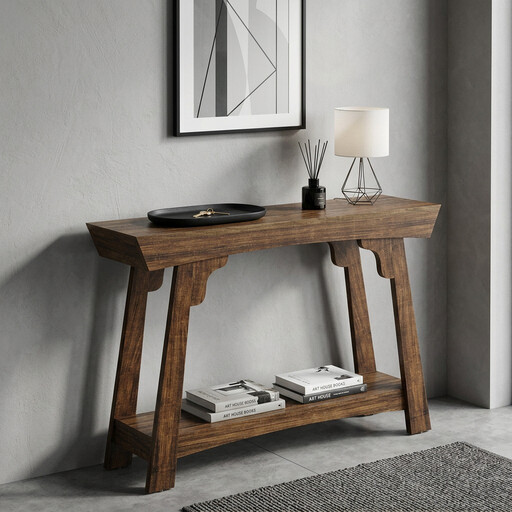
Why this product fits the profile: Measuring 105 cm wide and 30 cm deep, it is suitable for a compact hallway, entrance area or niche behind the sofa. Two tiers provide additional space for baskets and everyday items.
The compact dimensions reduce the risk of unnecessarily narrowing the walkway in a small hallway. Adjustable feet help level the table on slightly uneven floors.
Two storage tiers, a 4.5 cm thick tabletop and a stated maximum load capacity of 50 kg.
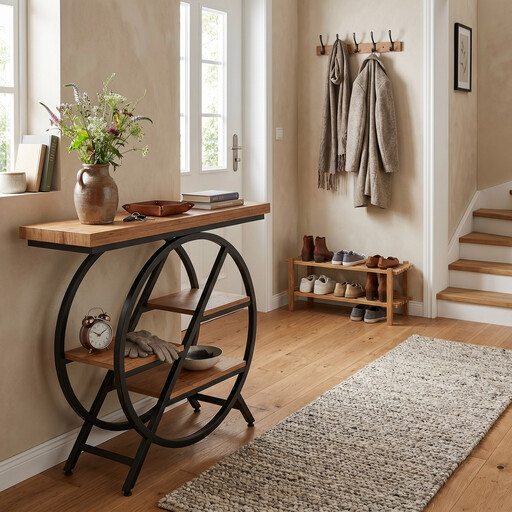
Why this product fits the profile: The four tiers combine a compact footprint with organised storage. This model is suited to shoppers who value a clearly described construction and high stated load capacity as well as good looks.
The product description specifies a sturdy metal frame, adjustable foot pads and a thickened tabletop. This makes key buying criteria clear and transparent.
Dimensions of 100 × 30 × 81 cm, four storage tiers and a maximum load capacity of 158 kg according to the product information.
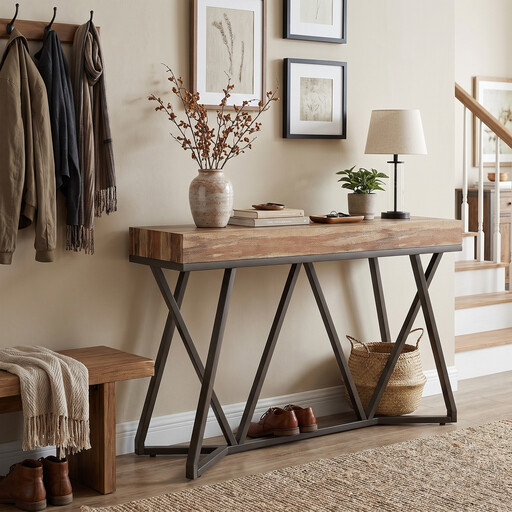
Why this product fits the profile: The 140 cm-long surface is suitable for a wider entrance area or as a sofa table behind the sofa. The combination of a wood-effect finish and black metal frame complements industrial-style and modern interiors.
The depth remains limited to 30 cm, while the metal frame and adjustable feet support stability. The stated load limit of 90 kg should nevertheless be observed.
140 × 30 × 90 cm, MDF tabletop with a wood-effect finish, metal frame and illustrated assembly instructions.
We have put together a complete, regularly updated list of products that fully meet these strict selection criteria and the safety regulations applicable in the EU.
Most models are delivered flat-packed. Before assembly, check that all components, screws and labelled parts are included. Begin by assembling the table loosely, and only tighten the connections once the frame has been correctly aligned. You should then:
A wall-mounted table or freestanding hallway table should not be used as a seat. For the wood-based materials mentioned above, cleaning usually requires no more than a dry or slightly damp cloth, followed by drying the surface.
A depth of around 30 cm is practical for many narrow hallways and entrance areas. The available walkway width remains the deciding factor. Measure the entire passageway, taking doors and protruding decorations into account.
Yes, provided the length and height suit the sofa. A model measuring 30 cm deep can create space behind the sofa for lamps, books or decorative items. With a freestanding table, you should also check whether anti-tip protection is provided.
This depends on the model and its construction. In the product data mentioned above, the stated capacities range from 50 to 158 kg, for example. These are maximum figures and should not be exceeded. Heavy items should be placed on a sturdy surface designed for this purpose and distributed evenly.