
Lieferung heute & morgen

Qualitätsgarantie

Willkommens-Angebote freischalten: KOSTENLOSE Lieferung | Bis zu 80 % RABATT | Kostenlose 30-Tage-JoyPlus-Testphase
App herunterladen
As a Joybuy Product Recommendation Officer, I see every day how thoughtful furniture choices can significantly impact your quality of life at home. A common concern is the functional and stylish design of narrow or previously unused areas. Long hallways, the empty space behind a sofa, or a small entryway can be a challenge for many. A narrow console table can be the perfect solution. This article serves as a practical guide to help you find a model that fits your spatial needs and aesthetic preferences.
Selecting the right piece of furniture depends on several objective factors. The following points will help you pinpoint your requirements.
The term "narrow" is relative. Measure the intended space precisely. A typical narrow console table has a depth between 25 cm and 35 cm. This is sufficient for decorations or a key bowl without blocking the walkway. The length is just as crucial. A long console table of 150 cm or more is excellent as a sofa table behind the couch to create a visual separation in the room and provide additional surface area. For a compact entryway, a shorter table is often the more practical choice. The height should align with other furniture or windowsill heights, typically ranging from 75 cm to 85 cm.
The material determines not only the look but also the durability and maintenance. A wooden console table or one with a wood-effect finish radiates warmth and pairs well with styles like farmhouse or vintage. Models made from engineered wood (MDF) often offer excellent value for money and are available in a wide variety of surface designs. Pay attention to the description of the surface treatment to assess its resistance to scratches and moisture.
Consider the primary purpose the table will serve. Will it be purely a wall table for decorative purposes? Or do you need additional storage? A console table with a shelf offers a second tier where baskets, books, or boxes can be placed. This is particularly useful in hallways for neatly storing shoes or other everyday items. In contrast, a simple hallway table without an extra shelf appears more airy and minimalist.
Based on the criteria mentioned, we have curated a selection of models that are suited for different needs due to their specific features.
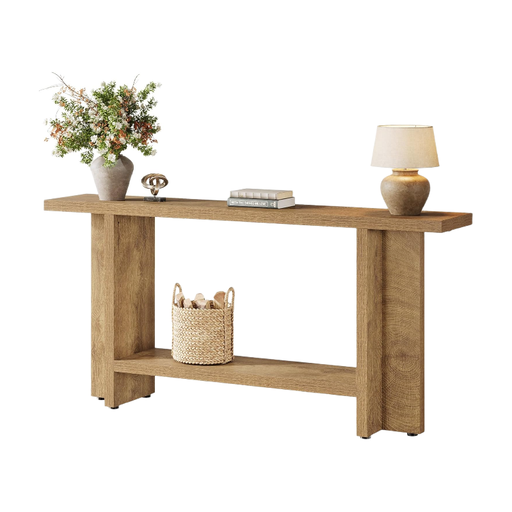
Why it stands out This model combines an impressive length with a slim depth and an additional shelf. The T-shaped leg design ensures stability and gives the table a touch of farmhouse charm.
Pros
Who is it for? Ideal for those looking for a long but narrow hallway table or a table for the space behind a large sofa, who also value maximum storage.

Why it stands out With a length of 160 cm, this table offers an exceptionally generous surface. Its minimalist design, featuring a thick tabletop and a weighted base, ensures clean lines and excellent stability.
Pros
Who is it for? Perfect for anyone needing maximum display space behind a couch or in a long foyer and who prefers a simple, sturdy design without a lower shelf.
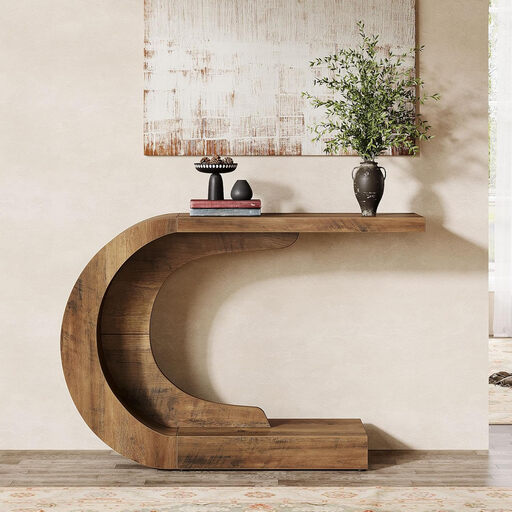
Why it stands out The striking C-shaped design makes this table an eye-catcher. With a length of 110 cm and a depth of 35 cm, it is more compact and fits well in smaller entryways or as a side table in the living room.
Pros
Who is it for? A great fit for users who want to make a design statement and need a functional table for a smaller hallway, a niche, or as a complementary piece in the living room.
If you haven't found the right model for your needs among these suggestions, it's worth taking a look at other designs. In our collection for klassische skandinavische innenarchitektur m?bel, you will find more furniture pieces that combine functionality with a clean design language.
A console table is considered narrow when its depth is typically between 25 cm and 35 cm. This dimension allows the table to be placed in tight hallways or behind sofas without obstructing the flow of traffic, while still providing enough surface area for everyday items or decorations.
An entryway table is often used for both practical and decorative purposes. Typical items include:
As a rule, a console table is not a full-fledged substitute for a desk. The shallow depth of about 30 cm often doesn't provide enough space for a laptop, a keyboard, and adequate arm support. Furthermore, legroom under the tabletop is frequently restricted by structural elements like lower shelves or crossbars. However, it can serve as a temporary workspace for short tasks on a laptop.