
Lieferung heute & morgen

Qualitätsgarantie

Willkommens-Angebote freischalten: KOSTENLOSE Lieferung | Bis zu 80 % RABATT | Kostenlose 30-Tage-JoyPlus-Testphase
App herunterladen
By a Joybuy Product Recommendation Officer, August 28, 2026
Finding the right piece of furniture for a narrow hallway, an unused niche, or a small bathroom can be a challenge. A slim shelving unit often seems like the obvious solution, but the market is flooded with products whose weaknesses only become apparent after purchase. Before you invest, it's crucial to understand the common pitfalls that can quickly turn a clever storage solution into a regrettable buy.
Many buyers focus on aesthetics and overlook critical design features. Three common problems are:
A thoughtful selection process that goes beyond just design ensures your new furniture will make your daily life easier for years to come.
To find a durable and functional narrow shelving unit, you should check three core parameters. These will help you objectively evaluate a product's quality and tailor it to your specific needs.
The most important feature of a space-saving shelf is a shallow depth, typically under 35 cm. But the narrower and taller a shelf is, the more critical its stability becomes.
The material determines not only the look but also the durability and suitable location for your shelf.
Think carefully about what you want to store. Should the contents be visible or kept hidden?
Here are some recommendations tailored to specific living situations and requirements.
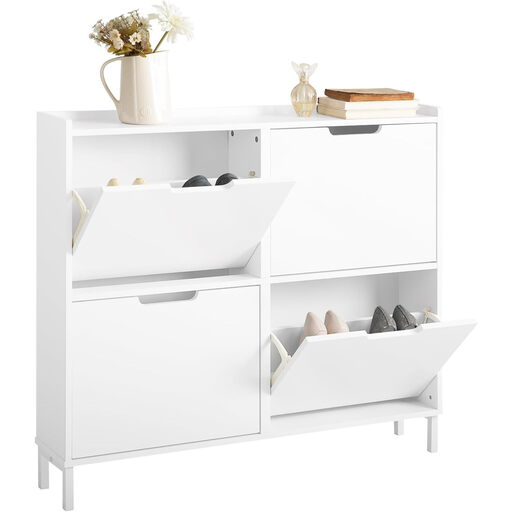
Why This Fits Their Persona: Ideal for those looking to create order in a narrow hallway. The closed flip drawers hide shoes and ensure a tidy look, while the top shelf provides space for keys and everyday items.
With a depth of just 19 cm, it's extremely space-saving. The included anti-tip kit directly addresses the stability problem common with tall, narrow furniture.
Dust-free storage thanks to closed drawers; high capacity on a minimal footprint.
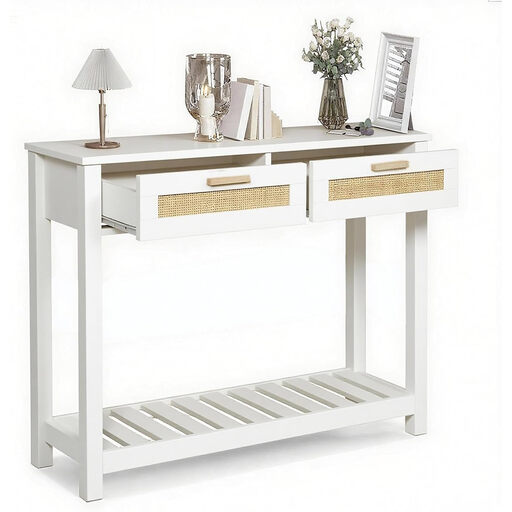
Why This Fits Their Persona: Perfect for anyone seeking a functional piece of furniture that also serves as a decorative element in the living room or hallway. The combination of a white finish and rattan drawers is both modern and timeless.
This piece avoids the trap of purely functional but unattractive designs. It offers flexible use with drawers and an open shelf, and is secure thanks to its anti-tip device.
Combines closed and open storage; the rattan design ensures good ventilation for the drawers.
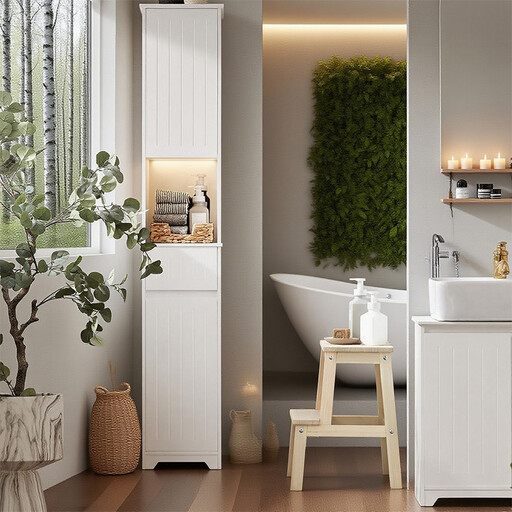
Why This Fits Their Persona: For users who need a pragmatic and durable storage solution for a small or humid bathroom. This tall cabinet makes optimal use of the room's vertical space.
The moisture-resistant MDF material (E1) prevents swelling from water vapour. The adjustable shelves bypass the trap of an inflexible compartment layout.
Optimal use of vertical space; customisable storage for towels and toiletries of various sizes.
We have compiled a complete, up-to-date list of products that fully meet these strict selection criteria and UK safety requirements.
Most tall, narrow shelves come with an anti-tip kit. This usually consists of a bracket or a strap that is screwed to the top of the shelf and to the wall. For wall mounting, use anchors and screws that are appropriate for your wall type (e.g., plasterboard, concrete, brick). The installation is straightforward and described in the product's instructions.
There is no official standard, but in practice, shelves with a depth of 35 cm or less are considered narrow. Particularly space-saving models, such as special shoe cabinets or niche shelves, can have a depth of even less than 20 cm. Measure your available space accurately and plan for a little clearance for air circulation behind the furniture.
Yes, absolutely. A narrow shoe rack with open compartments is also excellent for storing books, folded towels, storage baskets, or even kitchen supplies in a pantry. Models with adjustable or removable shelves are particularly flexible and can be adapted to accommodate different items.