
Lieferung heute & morgen

Qualitätsgarantie

Willkommens-Angebote freischalten: KOSTENLOSE Lieferung | Bis zu 80 % RABATT | Kostenlose 30-Tage-JoyPlus-Testphase
App herunterladen
A narrow hallway presents a common challenge for many households: where to put your shoes without blocking the walkway or creating clutter? A well-chosen, narrow shoe cabinet can be the perfect solution. It makes optimal use of limited space, ensuring your entryway remains tidy and inviting.
This guide introduces various models and provides you with the criteria to help you choose the right shoe storage for your entryway. The goal is to find a solution for your home that is both functional and aesthetically pleasing.
Before making a decision, a few considerations are helpful. The following points can serve as a guide to finding a model that meets your space and functional requirements.
The most critical factor is the available space. Precisely measure the intended spot in your hallway—width, height, and especially depth. A space-saving shoe cabinet is characterised by its shallow depth, often between 17 and 30 cm.
The material influences not only durability but also aesthetics. Models made from MDF (Medium-Density Fibreboard) with a coated surface are low-maintenance and available in many designs. A white shoe cabinet, for example, blends seamlessly into most interior styles and can make small rooms appear brighter and more spacious. A modern shoe cabinet often combines clean lines with metallic accents, becoming a subtle statement piece in your hallway.
Consider how many pairs of shoes you need to store and what types of shoes you own (flat trainers, tall boots, children's shoes). Models with adjustable or removable shelves offer the flexibility needed to adapt the interior to different shoe sizes and shapes. Some cabinets also provide extra drawers or a top surface for keys, mail, and other small items.
Here is a selection of narrow shoe cabinets that are suited for different needs and spatial situations due to their specific features.
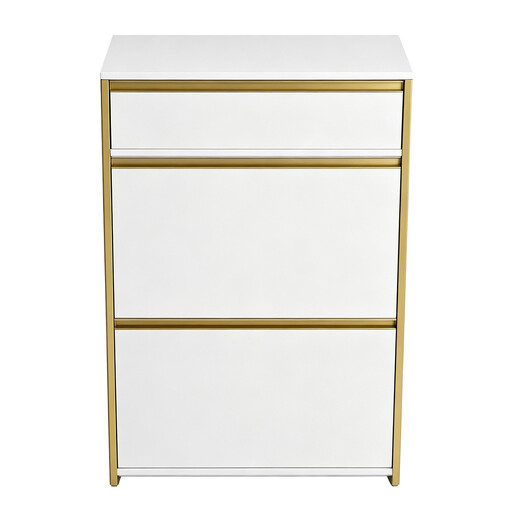
What Makes It Stand Out This narrow hallway cabinet combines shoe storage with an additional drawer and a top surface. The white design with gold handles and feet gives it a modern yet elegant touch. The interior shelves are adjustable, allowing for flexible use for different types of shoes or other items.
Advantages
Who It's For For those looking for a multifunctional storage solution that not only stores shoes but also serves as a decorative element and provides extra storage in the entryway or living room.
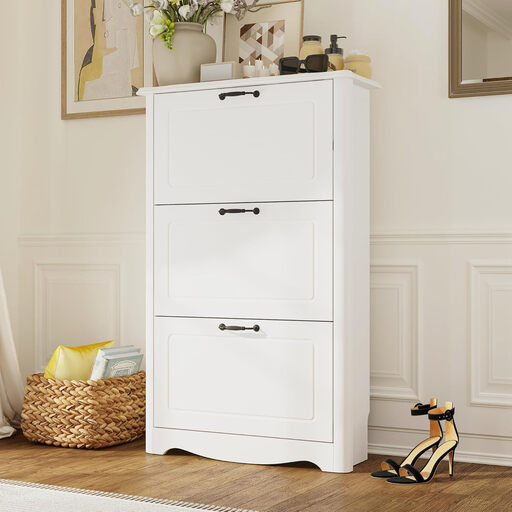
What Makes It Stand Out This tip-out cabinet from Caldion is designed for maximum space efficiency with its three spacious tilting compartments. The simple white design with subtle metal handles complements many modern interiors. The dividers inside the compartments are adjustable, allowing the space to be adapted to different shoe sizes.
Advantages
Who It's For Ideal for narrow hallways and small flats where high-capacity shoe storage is needed on a minimal footprint.
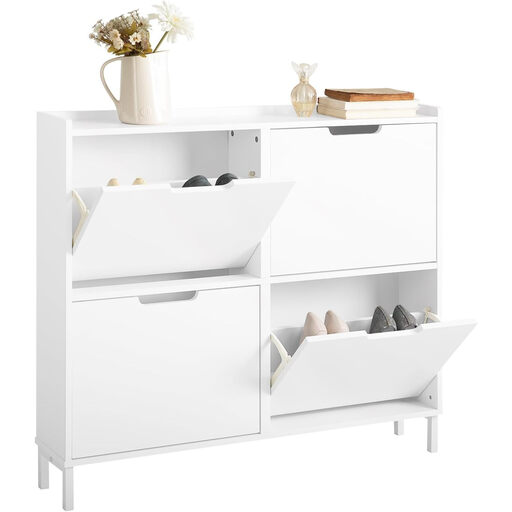
What Makes It Stand Out With an exceptionally shallow depth of just 19 cm, this model from SoBuy is a solution for extremely tight spaces. The four tip-out drawers provide organised and dust-free storage. The top surface can be used for decoration or everyday items. According to the manufacturer, the model is modular and can be combined with other furniture pieces from the brand.
Advantages
Who It's For For anyone living in very cramped conditions who needs to maximise vertical space while using a minimal floor footprint.
The models featured here are just a sample of the available possibilities. If you're looking for even more flexible or different types of storage solutions, folding racks could be an interesting alternative. They are often lightweight, mobile, and can be easily stored away when not in use.
Discover our selection of folding racks for flexible storage solutions
A narrow shoe cabinet typically has a depth between 17 cm and 30 cm. Models designed as tip-out cabinets, with depths of under 25 cm, are among the slimmest options on the market and are particularly well-suited for narrow walkways.
The capacity depends heavily on the size of the cabinet and the type of shoes. Compact models often hold 8 to 12 pairs of standard-sized shoes. Larger, narrow cabinets can accommodate 16 to 24 pairs. The product descriptions usually provide specific details on capacity.
The main difference lies in their mechanism. A shoe rack has open shelves or doors, behind which shoes are placed standing or lying flat. A tip-out cabinet features tilting compartments where shoes are stored at an angle. This design allows for a very shallow cabinet depth, making it the ideal solution for narrow hallways.