
Lieferung heute & morgen

Qualitätsgarantie

Willkommens-Angebote freischalten: KOSTENLOSE Lieferung | Bis zu 80 % RABATT | Kostenlose 30-Tage-JoyPlus-Testphase
App herunterladen
A narrow shoe cabinet should keep your shoes tidy, take up as little floor space as possible and suit your existing hallway. In a small flat or cramped entrance, every centimetre counts. Product photos and general marketing claims, however, don’t always help you make the right choice.
Three common pitfalls are worth watching out for:
If you’re buying a shoe cabinet for your hallway or entrance, start by measuring the available alcove. As well as the cabinet’s depth, you’ll need to allow room for doors, drawers and people walking past.
A shoe cabinet with a depth of 24 cm can work well in many narrow hallways. Before buying, though, check that the compartments can open fully and that skirting boards won’t affect installation. Make sure the cabinet’s external dimensions fit the space available.
A shoe cabinet with tilt-out compartments makes good use of height and keeps most shoes out of sight. Shoes are usually placed at an angle in this type of cabinet. This saves depth, but the height of each compartment may limit the types of shoes that will fit.
A shoe cabinet with doors provides enclosed storage and can help protect shoes from dust. Check the following:
If you’re looking for a shoe cabinet for 12 to 25 pairs of shoes, treat the manufacturer’s capacity as a guide. In family homes, it may help to sort shoes by type and keep frequently worn pairs within easy reach.
A shoe cabinet made from MDF is constructed from engineered wood panels with a smooth, even surface. On coated or painted models, check the edges, screw connections and quality of the back panel. A label such as MDF E1 refers to a defined emissions class for the engineered wood; it isn’t a general quality rating for the entire piece of furniture.
You should also check:
Tall furniture should be secured to the wall as directed in the assembly instructions before use. Do not exceed the stated load limit.
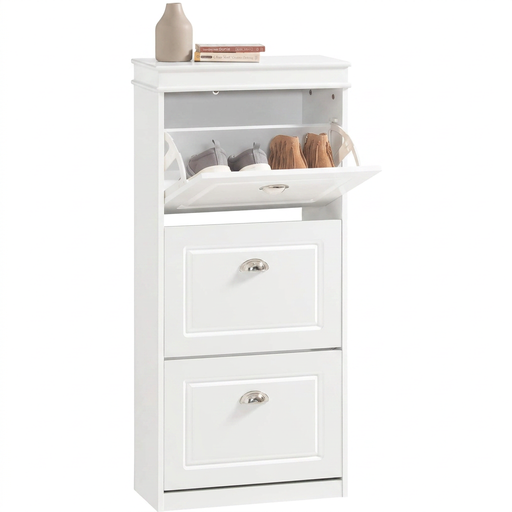
Why this product suits this profile: Its compact design works well in small hallways, flats and bedrooms. At 53 cm wide, 117 cm high and 24 cm deep, the cabinet makes use of vertical space rather than taking up a large area of floor.
Its 24 cm depth is clearly stated. It also comes with an anti-tip device for wall mounting. Check that the compartment layout suits your shoe sizes before buying.
MDF construction, three tilt-out compartments, a white painted finish and a footprint of 53 × 24 cm. Assembly is required.
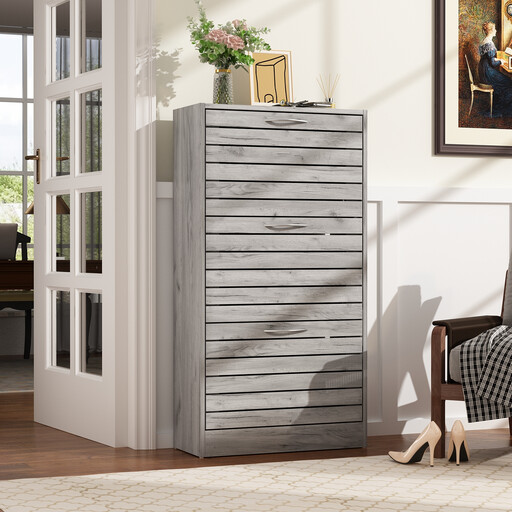
Why this product suits this profile: This grey model combines enclosed storage with a clean, understated look. It works in a hallway, bedroom or living room, and its dimensions of 54 × 24 × 107 cm make it suitable for smaller spaces.
The product description specifies three tilt-out compartments and six storage sections. This makes it easier to gauge the available capacity than a pair count with no further details.
MDF construction, three tilt-out compartments, six internal sections and a depth of 24 cm. Assembly instructions are included.
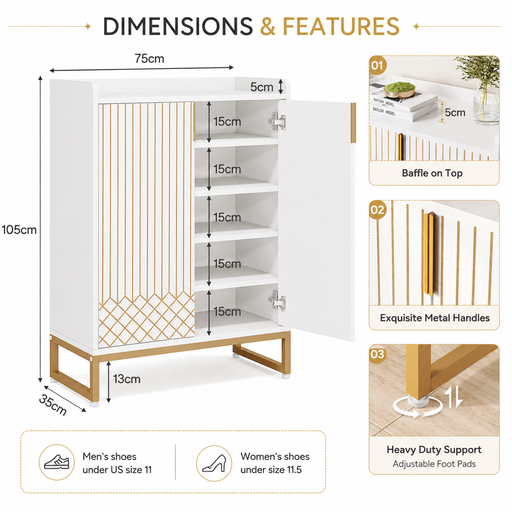
Why this product suits this profile: Its five tiers and stated capacity of around 22 to 25 pairs make it a good choice for households with a larger shoe collection. The open bottom shelf can be used for shoes you wear often.
Capacity is given as a range rather than a one-size-fits-all figure. Even so, compare your shoe sizes with the compartment heights before buying.
Enclosed storage behind doors, five storage tiers, metal legs and a separate open shelf. Assembly by two people is recommended.
We’ve put together a complete, regularly updated list of products that meet these strict selection criteria and fully comply with the safety regulations in force in the EU.
Before assembly, check the wall, skirting board and space needed for the doors or compartments to open. With a tall shoe cabinet with tilt-out compartments, the anti-tip device isn’t an optional extra; it’s an important part of using the cabinet as intended. Check the screws after assembly and tighten them if needed.
For painted or coated surfaces, a slightly damp cloth is usually all you need. Don’t leave water standing on the edges. Store shoes when they’re as dry as possible, to avoid putting unnecessary strain on the internal surfaces and engineered wood.
Models around 24 cm deep can be a good choice for narrow hallways. However, it’s not just the cabinet body that matters: you also need to allow room for open compartments or doors. Measure the space you’ll need to use the cabinet.
It depends on the compartment height, shoe size and shoe shape. Models with several compartments may hold around 12 pairs, while larger cabinets with five tiers are advertised as holding 22 to 25 pairs. Boots and shoes with wide soles will reduce the actual capacity.
Follow the assembly instructions and secure the cabinet to a suitable wall using the anti-tip device provided. Choose wall plugs and screws to suit the wall material. You should also follow the stated load limit and instructions for use.