
Lieferung heute & morgen

Qualitätsgarantie

Willkommens-Angebote freischalten: KOSTENLOSE Lieferung | Bis zu 80 % RABATT | Kostenlose 30-Tage-JoyPlus-Testphase
App herunterladen
A narrow hallway presents a common challenge for many households: where do you put the shoes without blocking the walkway or creating a messy tripping hazard? A narrow shoe rack seems like the logical solution. However, the market is flooded with products that look promising online but prove unsuitable in practice. Before you make a decision, it's crucial to understand the typical weaknesses that often only become apparent after the purchase.
As your Joybuy Product Recommendation Officer, I'm here to help you separate the wheat from the chaff. In this guide, we'll focus on the three most common mistakes when buying space-saving shoe storage and show you which objective criteria truly matter.
To avoid the problems mentioned above, you should focus on three verifiable features. These will help you find a functional and durable solution for your entryway.
For a space-saving shoe rack, depth is the most important metric. Measure the available space in your hallway accurately and plan for at least 60-70 cm of clear walking space.
The choice between an open freestanding shoe rack and a closed small shoe cabinet depends on your priorities.
Pay attention to the manufacturer's specifications for the maximum load capacity per tier. A reliable figure is often between 3 to 5 kg. This gives an indication of the construction's stability.
Here are three models tailored to different needs and spatial situations that meet the criteria mentioned.
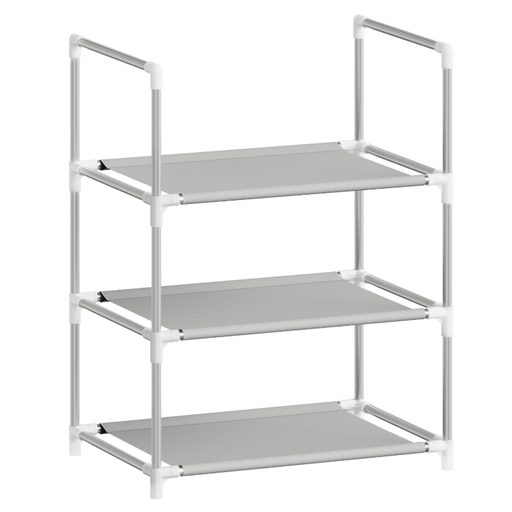
Why This Fits Their Persona: Ideal for individuals or as a secondary rack in a bedroom. It provides a basic, straightforward solution to shoe clutter in a minimal footprint, without breaking the bank.
The metal tube construction offers better baseline stability than all-plastic models. The open design ensures good ventilation for shoes.
Very compact dimensions (41x28x55 cm). According to the manufacturer, tool-free assembly is possible thanks to a plug-in system. The load capacity per tier is stated as 5 kg.
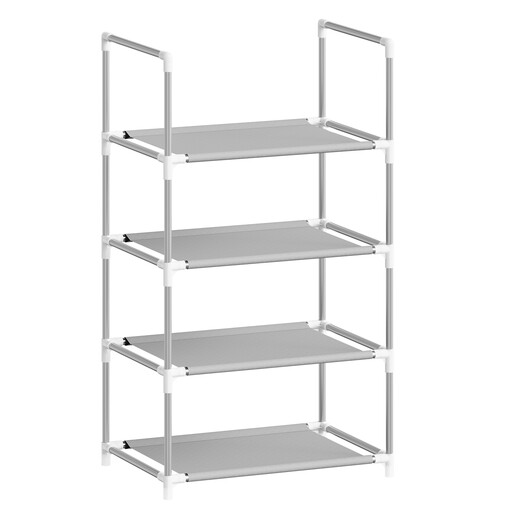
Why This Fits Their Persona: This model utilises vertical space to create more storage on the same footprint. It's a great choice for couples or small families who need a flexible solution for various shoe types.
It directly addresses the "inflexible storage space" pitfall. According to the manufacturer, individual tiers can be removed to make room for taller boots or ankle boots.
Good capacity-to-size ratio with four tiers. The flexible shelf design allows for storing different types of shoes.
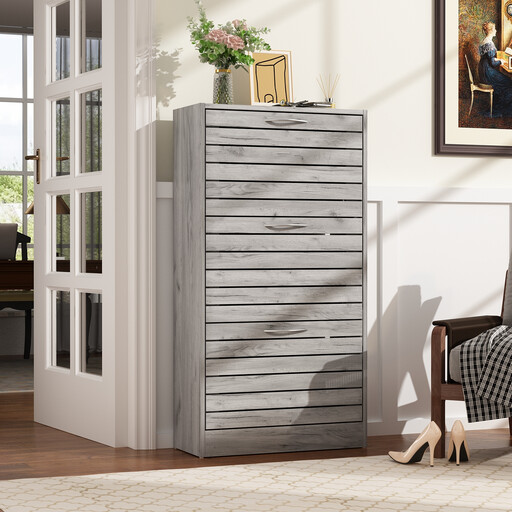
Why This Fits Their Persona: For anyone who prefers a tidy, furniture-like solution. This tip-out cabinet hides shoes behind a closed front, integrating seamlessly into the hallway as a modern piece of furniture.
With a depth of only 24 cm, this model is an excellent solution for the "misleading depth measurements" pitfall. It is extremely space-saving and ideal for very narrow passageways.
The closed front ensures a clean, minimalist look. The MDF board material promises a solid and durable construction.
We've compiled a complete, up-to-date list of products that meet these strict selection criteria.
For a narrow hallway, a depth of under 30 cm is recommended. Models like tip-out shoe cabinets with a depth of under 25 cm are optimal as they barely protrude into the room. Be sure to measure the available space before buying, taking into account the swing radius of any doors.
This depends on your personal preferences. An open rack offers better ventilation and quick access but can look messy. A closed shoe cabinet provides a tidy appearance and protects shoes from dust but offers less air circulation. Weigh what is more important to you: order and aesthetics or functionality and ventilation.
This varies greatly depending on the model and material. Always check the manufacturer's specification for "maximum load capacity per tier." A typical value for simple racks made of metal tubes and non-woven fabric is about 3 to 5 kg per shelf. This corresponds to roughly two to three pairs of men's shoes or several pairs of lighter women's shoes.