
Lieferung heute & morgen

Qualitätsgarantie
App herunterladen
Kategorien
An organized entryway is the foundation of an orderly home. In urban apartments especially, hallways and corridors are often narrow, making shoe storage in the hallway a challenge. A narrow shoe rack is designed to make optimal use of vertical space without compromising the width of the walkway. The solution lies in shelving systems that combine a shallow depth with sufficient height and stability.
This article analyzes the technical criteria for selecting a suitable narrow shoe rack and presents specific models designed for functionality and spatial efficiency.
Selecting a suitable rack is based on objective parameters. The following criteria are relevant for making an informed decision.
The choice of material directly impacts the rack's stability, durability, and weight.
Dimensions are the crucial factor for space-saving shoe storage.
A tall, narrow shoe stand requires special attention to stability. Models with an anti-tip kit, which allows for securing it to the wall, offer additional safety, especially in households with children or pets. The maximum load capacity per tier, typically around 5 kg, should be respected to prevent overloading.
Based on the technical criteria above, we present three models that are well-suited for tight spaces due to their specific dimensions and design features.
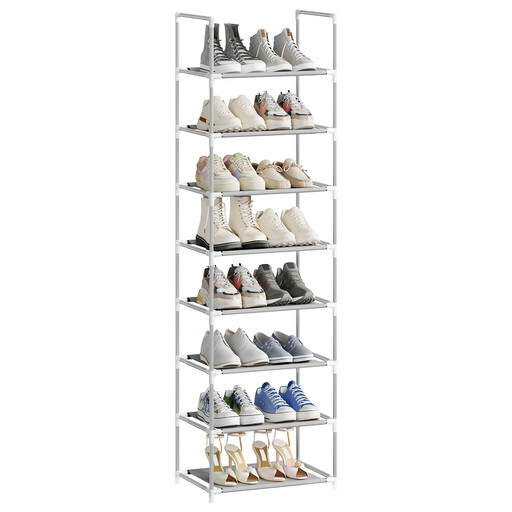
Why we recommend this product: This model maximizes storage capacity on a minimal footprint of 41 x 28 cm. With a height of 140 cm, it efficiently utilizes vertical space, providing room for up to 16 pairs of shoes. The ability to split the rack into two smaller units adds extra flexibility.
Advantages:
Best Suited For: Individuals and families with a large number of shoes who need to maximize storage space in a very narrow hallway or alcove.
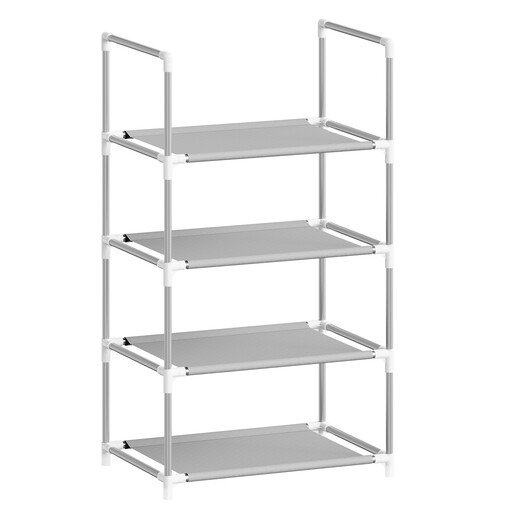
Why we recommend this product: At 72 cm high, this model is a balanced solution. It offers space for up to 8 pairs of shoes on four tiers and, thanks to its moderate height, fits well under coat racks or in smaller alcoves. The 41 x 28 cm footprint is identical to the taller model.
Advantages:
Best Suited For: Couples, individuals, or flatmates with a moderate number of shoes who are looking for a discreet and flexible storage solution for their entryway.
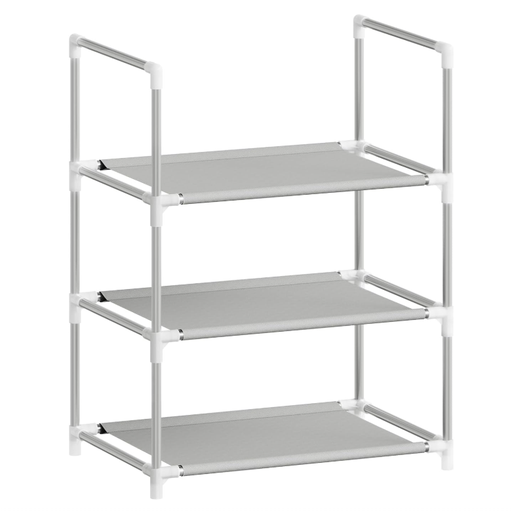
Why we recommend this product: At 55 cm, this is the shortest model and is perfectly suited for very limited spaces, such as right next to the front door or inside a small wardrobe. It holds up to 6 pairs of shoes and serves as a functional, minimalist storage unit.
Advantages:
Best Suited For: Individuals or as a secondary rack for quick access to everyday shoes. Ideal for renters who need a simple, affordable, and non-permanent solution.
If the models presented do not exactly meet your requirements in terms of dimensions or capacity, exploring a broader product range may be worthwhile. The Compact Shelving category includes a variety of storage solutions designed for spatial efficiency and flexible use. There you will find shelving systems with different materials, widths, and heights.
1. How much space does a narrow shoe rack require? A typical narrow shoe rack has a width of 40 to 60 cm and a depth of under 30 cm. Precisely measure the available space in your hall or entryway to ensure a walkway of at least 80 cm remains, which corresponds to standard recommendations for traffic areas.
2. Can a modular shoe rack be used for other items? Yes, the design is versatile. With a maximum load capacity of about 5 kg per tier, these racks are also suitable for storing lightweight items such as bags, hats, scarves, small storage boxes, or decorative objects. The removable tiers also allow for storing taller items.
3. How do you clean a shoe rack made of metal and non-woven fabric? Cleaning is straightforward. The metal frame and laminated non-woven fabric shelves can be wiped down with a slightly damp cloth. Avoid using harsh cleaning agents or abrasive sponges to prevent damage to the surfaces.