
Lieferung heute & morgen

Qualitätsgarantie

Willkommens-Angebote freischalten: KOSTENLOSE Lieferung | Bis zu 80 % RABATT | Kostenlose 30-Tage-JoyPlus-Testphase
App herunterladen
By the Joybuy Product Recommendation Officer
A narrow hallway or a small entryway presents a common challenge: where to put your shoes without creating tripping hazards or making the space look cluttered? A disorganised entrance can negatively impact the overall impression of your home. The search for suitable hallway shoe storage often leads to the realisation that standard furniture simply takes up too much space.
This article serves as your guide. As the Joybuy Product Recommendation Officer, I've made it my mission to sift through market information and present you with practical options. The goal is to help you find a space-saving shoe rack that is both functional and a perfect fit for your living situation. We'll explore various types, from open shelves to closed cabinets, to provide you with an informed basis for your decision.
Before you make a decision, there are a few fundamental aspects to consider. The right choice depends on your available space, the number of shoes you own, and your aesthetic preferences.
Narrow shoe storage solutions come in various designs, each with specific pros and cons:
The material affects not only the look but also the durability and stability of the rack.
Measure your intended space precisely: width, height, and especially depth are crucial. Also, consider the swing clearance for doors or drawers. Think about how many pairs of shoes you need to store and what type they are. Tall boots require more space than flat sneakers. Some racks offer adjustable or removable shelves to flexibly accommodate different shoe heights.
Here is a selection of different models designed for tight spaces. Each product meets different requirements for capacity, design, and functionality.
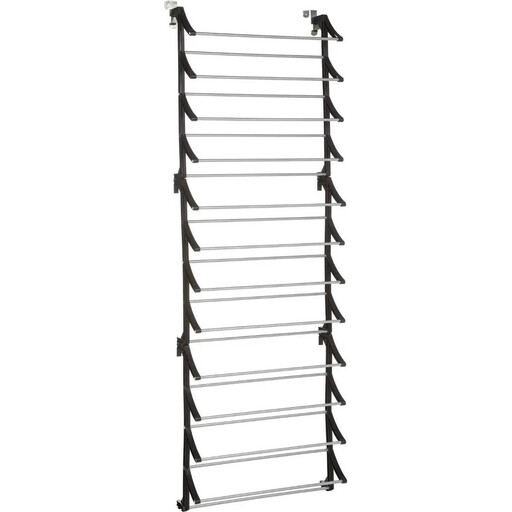
Why It Stands Out: This rack utilises vertical space on your door, offering an exceptionally high storage density for up to 36 pairs of shoes within the smallest footprint.
Advantages:
Who It's For: For people in rental apartments or rooms with very limited space who want to neatly store a large number of shoes without drilling into walls.
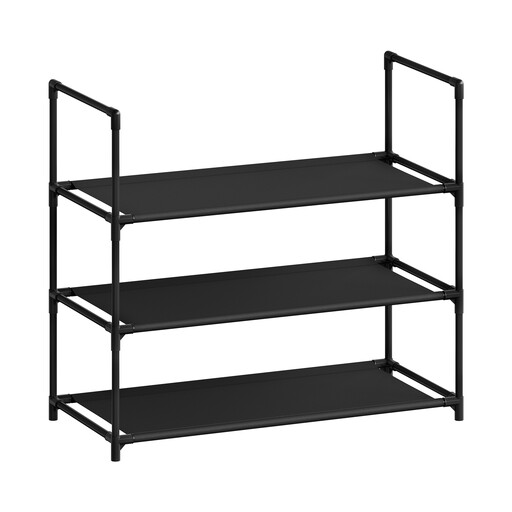
Why It Stands Out: A minimalist and versatile freestanding rack that impresses with its simple, tool-free assembly and light weight.
Advantages:
Who It's For: For users looking for a quick, straightforward, and affordable solution for a manageable number of shoes who prefer a simple, open design.
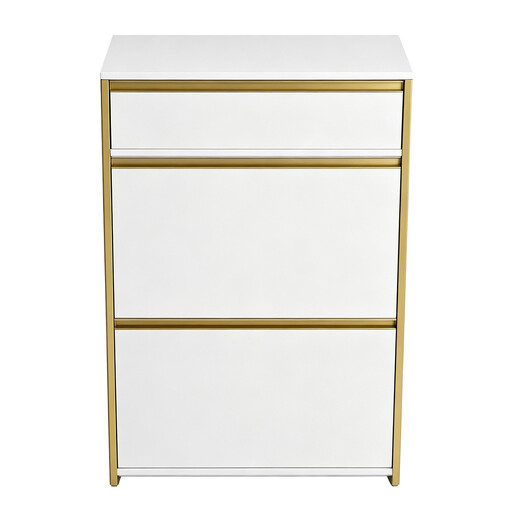
Why It Stands Out: This model combines closed shoe storage with extra space in the form of a drawer and a top shelf, all wrapped in a modern design.
Advantages:
Who It's For: For those seeking an aesthetic and durable solution that not only hides shoes but also serves as a fully-fledged piece of hallway furniture with additional storage.
Now that your entryway is perfectly organised, you might also find inspiration for your leisure activities. Discover our selection of padded long cycling tights for your next ride.
1. How deep should a narrow shoe rack be? A shoe rack is considered narrow if its depth is under 30 cm. Particularly space-saving models like tip-out cabinets or over-the-door racks are often only 17 to 25 cm deep. Be sure to measure the narrowest point in your hallway before buying and plan for enough room to move around.
2. What is a tip-out shoe cabinet? A slim tip-out shoe cabinet is a special type of shoe cabinet designed for extremely narrow corridors. Instead of shelves, it features pivoting compartments (tip-out drawers) where shoes are stored at a slight angle or vertically. This achieves a minimal structural depth while keeping shoes hidden and protected from dust.
3. How many shoes fit in a narrow shoe rack? Capacity varies greatly by model. A small, three-tier rack like the one from WOLTU holds about 9 pairs of shoes. A closed cabinet like the HaluPeit model offers space for about 12 pairs. In contrast, over-the-door hanging systems, like the one from 5five, can accommodate up to 36 pairs. Therefore, the capacity is directly related to the rack's design and height.