Anyone building a growing archive
You keep lecture files across several semesters and plan for both the storage space you need and future growth.


Choose a NAS hard drive for a growing lecture archive based on your existing collection, expected growth and the usable capacity of your specific NAS configuration. For regular writes, consider NAS-rated CMR drives. Before buying, check the full model number, compatibility with your NAS and the entire transfer path. Drive data rates do not guarantee network speeds, and Germany’s Federal Office for Information Security (BSI) does not consider RAID mirroring to be a backup.
You keep lecture files across several semesters and plan for both the storage space you need and future growth.
You regularly copy recordings between your computer and NAS, and want to avoid mistaking drive specifications for the speed of the entire connection.
You want to be able to recover recordings after accidental deletion or a NAS failure. The BSI distinguishes RAID mirroring from a backup.
For a lecture archive with frequent file transfers, rated capacity and drive data rates are not the only things that matter. NAS compatibility, a separate backup and controlled access can also affect your choice.
| What matters | What to check when buying | Who will find this especially important |
|---|---|---|
| Usable storage space | Work out your existing collection and expected growth; check the usable capacity of your NAS configuration and allow space for a separate backup. | I want to plan for recordings from several semesters and future files, rather than assume that the rated capacity of a single HDD is the same as the archive space available. Around 25% of consumers put their existing archive and future growth first. |
| Frequent file transfers | Consider the connections on your computer, network and NAS together; compare drive data rates only for the exact model. | If I regularly copy recordings between my computer and NAS, I want to account for potential bottlenecks along the entire transfer path. Around 25% of consumers prioritise the speed of frequent transfers. |
| Recovery | Plan for an independent backup destination and a recovery process you can test. | After accidental deletion or a NAS failure, I need a recoverable copy, not just a mirrored drive. Around 20% of consumers put recovery first. |
| NAS compatibility | Check the NAS model and full HDD model number against the compatibility list; check the format and interface. | If I’m buying for a particular NAS, I want to make sure that exact drive model is supported. Around 15% of consumers prioritise compatibility with their existing NAS. |
| Controlled access | Before sharing, clarify who is responsible, who is authorised to access the files and which institutional requirements apply. | If recordings contain identifiable people, I want to check access and the requirements for the specific purpose before sharing them; the drive alone won’t take care of that. Around 15% of consumers put access protection first. |
With mirroring, changes are copied to the mirrored drives. The BSI points out that RAID mirroring does not count as a backup, so it cannot independently protect against events such as accidental overwriting.
Plan for a separate backup destination and check that you can restore your recordings from it.
A separate backup destination requires additional storage capacity.
Usable storage space also depends on the drives you use and the RAID configuration. Synology notes that usable capacity can vary depending on the drives and configuration.
First estimate your existing collection and expected growth, then check the available space for your specific configuration.
Manufacturers’ drive data rate figures do not measure transfer speeds between a computer and a NAS. The NAS and network are also part of the transfer path.
Check the drive specification for the exact model separately from the connections on your computer, network and NAS.
WD Red Plus is a range of CMR NAS HDDs. The WD40EFPX is a 4 TB nominal-capacity model, which Western Digital says is suitable for NAS systems with up to eight bays.
Seagate describes IronWolf as a range of CMR NAS HDDs for systems with one to eight bays.
Toshiba’s EMEA N300 range includes capacities from 4 to 22 TB, according to the manufacturer; the number of supported bays depends on the model.
Synology’s Plus Series is designed for its own NAS systems; the HAT3300-4T is a model with a nominal capacity of 4 TB.
The following internal Synology hard drives are suited to archives with different storage needs. Before buying, check that the full model number is compatible with your NAS.
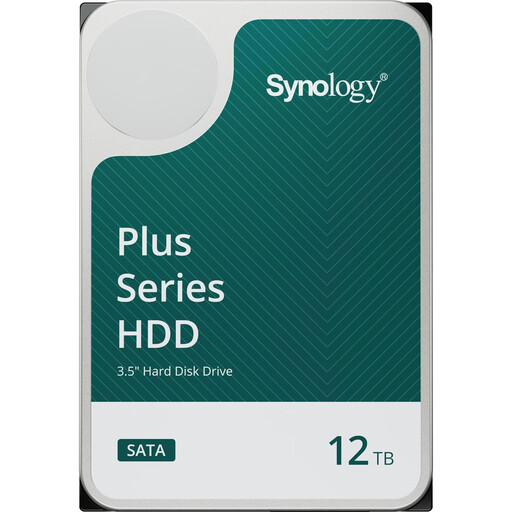 Image unavailable
For a growing archive, provided your specific Synology NAS supports this drive model.
12 TB, CMR, 3.5-inch, SATA III, 7200 rpm and 512 MB cache.
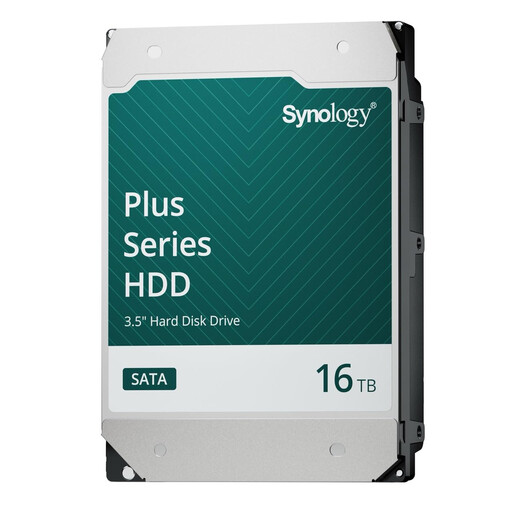 Image unavailable
For an archive with higher storage needs, provided your specific Synology NAS supports the drive.
16 TB, CMR, 3.5-inch, SATA 6 Gb/s and 7200 rpm.
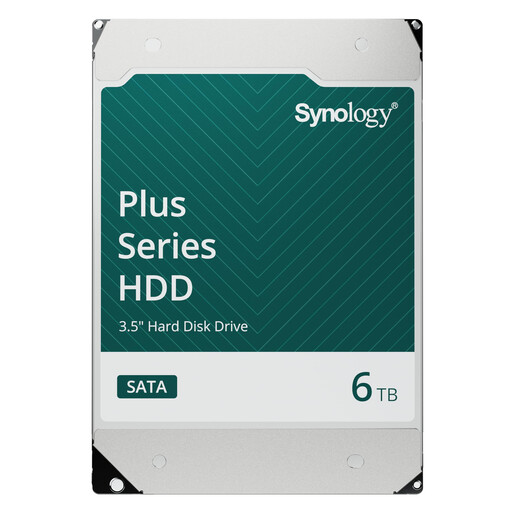 Image unavailable
A 6 TB option for an archive, provided your specific Synology NAS supports this drive model.
6 TB, CMR, 3.5-inch, SATA 6 Gb/s and 5400 rpm.
No. The WD40EFPX’s up to 180 MB/s and the Synology HAT3300-4T’s typical maximum of 202 MB/s are drive specifications. To work out actual transfer speeds, you also need to consider the NAS connections and the rest of the path between your computer and NAS.
No. The BSI distinguishes RAID mirroring from a backup because changes can be copied to mirrored drives. Plan for a separate backup destination and check that you can restore your files from it.
Check the exact NAS model and full HDD model number against the NAS manufacturer’s compatibility list. Synology recommends checking the specific model; a matching brand or product range alone doesn’t confirm that the drive is supported.
Allow for the storage space available in your NAS configuration and a separate backup destination with a recovery process you’ve tested. Western Digital lists a limited three-year warranty for the WD40EFPX; Synology lists a three-year warranty for the HAT3300-4T. These details apply to the models specified and don’t mean that data recovery is free.
There’s no blanket permission. If the GDPR applies to an organisation’s processing of personal data, that organisation needs an appropriate legal basis; the requirements for a particular recording or disclosure depend on the circumstances. The EU explains that personal processing outside professional or commercial activities may be exempt, but this is not general permission to record people or publish those recordings.