Archivists with a growing video library
If you keep original footage and completed versions, you’ll want to plan for future storage needs. Western Digital, Seagate and Toshiba offer NAS hard drives in a range of capacities.


Choose the capacity based on your existing video library, how much you expect it to grow and the project versions you want to keep. The usable storage available in your NAS configuration is what matters. The hard drive itself won’t create versions: you’ll need a suitable NAS feature and a separate backup destination for that. Synology recommends keeping a copy at another destination for extra protection, while Germany’s Federal Office for Information Security (BSI) stresses that backups must be recoverable. Before you buy, check the full drive model number against your NAS compatibility list; Synology warns that support may be limited for drives that aren’t listed.
If you keep original footage and completed versions, you’ll want to plan for future storage needs. Western Digital, Seagate and Toshiba offer NAS hard drives in a range of capacities.
If you want to return to an earlier version after making changes, you’ll need a suitable backup or snapshot feature as well as the HDD. Synology describes local multi-version copies as a way to restore files after accidental deletion or damage.
If you’re looking for a drive for a particular NAS, check the full model number against the manufacturer’s compatibility list. Synology warns that support may be limited for drives that aren’t listed.
| Consideration | What to check before buying | Who is it important to? |
|---|---|---|
| Space for videos and versions | Calculate your existing library and expected growth; take the usable capacity of your NAS configuration into account. | If I want to keep originals and earlier versions, the storage needs to suit my current library and its expected growth. Around 29% of consumers need space for a growing video library. |
| Earlier project versions | Check which versioning or snapshot features your NAS supports, as well as its retention settings. | If I want to retrieve an earlier edit after making a change, I need a feature that actually keeps previous versions. Around 29% of consumers prioritise being able to restore earlier versions. |
| Protection if the NAS fails | Plan for a separate backup destination and check that you can restore files from it. | If I want to access my video files even if the whole NAS fails, an additional copy should be available independently of the device and be recoverable. Around 24% of consumers prioritise protection against device failure. |
| Fit and support | Check your NAS model and the full HDD model number against the compatibility list. | If I’m keeping my existing NAS, I want to know whether it supports that specific drive model. Around 18% of consumers say compatibility with their NAS is most important to them. |
Synology points out that local multi-version copies don’t necessarily protect against data loss if there’s a RAID or drive problem.
Plan local recovery and a backup to another destination as two separate tasks. Also check that you can restore the stored data; the BSI specifically highlights the importance of recoverability.
A product family can include several variants. Synology warns that support may be limited for drives that aren’t listed.
Before buying, check the exact NAS model and full HDD model number against the manufacturer’s current compatibility list.
Seagate’s IronWolf Health Management requires a compatible NAS system; according to Seagate, Rescue Services aren’t available in every country.
Check the terms for your NAS model and location. Whatever the case, keep a separate, recoverable copy of your data.
WD Red Plus is a range of NAS HDDs designed for home offices and more demanding NAS use. Capacity and suitability depend on the specific model.
IronWolf is a range of NAS HDDs that Seagate recommends for uses including multimedia storage; individual models are available in different capacities.
Toshiba describes the N300 as a range of internal NAS HDDs for the EMEA market, including for multimedia storage.
The HAT3300-4T Plus Series HDD is a 4 TB option for anyone looking for a drive for a Synology system.
The Synology NAS hard drives below offer different storage capacities. Check the full model number against your NAS compatibility list; you’ll also need a suitable NAS feature to manage project versions.
 No image available
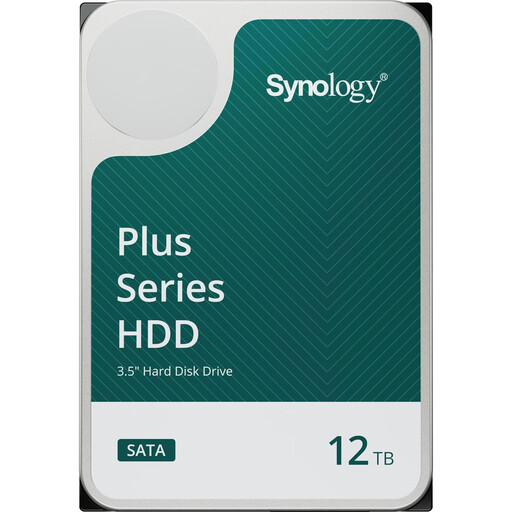
For a growing video library, if 12 TB meets your calculated storage needs. A suitable NAS feature manages project versions; the HDD itself doesn’t.
12 TB, SATA III, 3.5 inches, 7200 RPM, 512MB cache, CMR, helium.
Use only with a compatible Synology NAS; check the exact drive and NAS combination.
 No image available
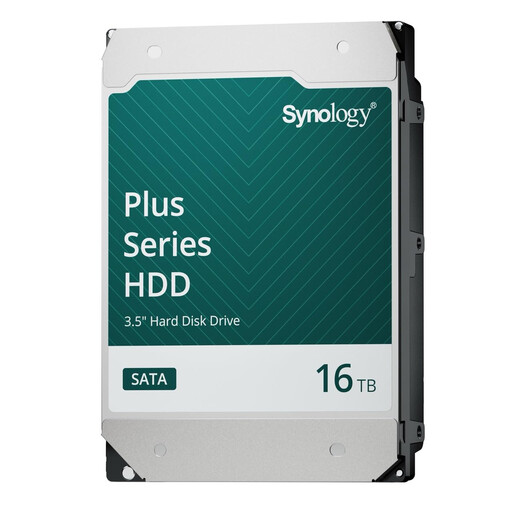
For a larger video library, if 16 TB fits your plans. Keeping earlier project versions requires a suitable backup or snapshot feature on your NAS.
16 TB, SATA 6 Gb/s, 3.5 inches, 7200 RPM, CMR, 1.2M Hours MTBF.
Use only with a compatible Synology NAS; check the exact drive and NAS combination.
 No image available
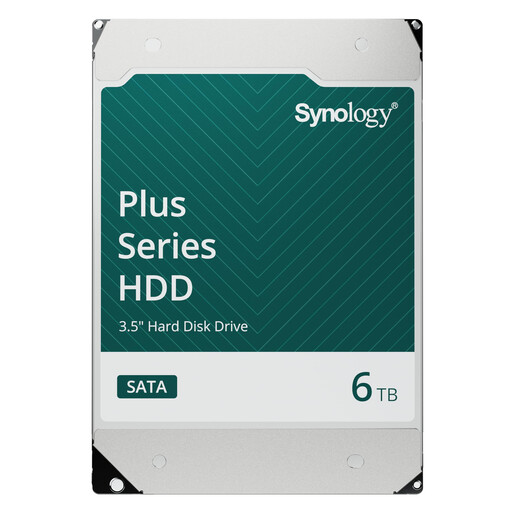
For a smaller video library, if 6 TB is enough based on your existing files and expected growth. The HDD doesn’t create project versions.
6 TB, SATA 6 Gb/s, 3.5 inches, 5400 RPM, CMR, 1M Hours MTBF.
Use only with a compatible Synology NAS; check the exact drive and NAS combination.
No. Keeping earlier versions depends on the backup or snapshot feature set up on your NAS. Synology describes local multi-version copies; Snapshot Replication requires Btrfs on supported models.
Try restoring a project version you need. Germany’s Federal Office for Information Security stresses that backed-up data must be recoverable.
No. According to the European Commission, the GDPR doesn’t apply to processing carried out solely for personal or household purposes with no professional or commercial connection. For professional processing of personal data, controllers and processors must put appropriate technical and organisational safeguards in place that are proportionate to the risks, as explained by the European Data Protection Board. This doesn’t mean there’s a general requirement to use a particular HDD brand or capacity.