Growing video libraries
If your video files and project folders are growing, plan for the usable storage of your entire NAS setup – not just the capacity stated on the drive.


Start by planning the usable storage you’ll need for your video library, project folders and backup versions. Then check that the specific hard drive is compatible with your NAS. For the standard ranges mentioned here – WD Red Plus, Seagate IronWolf and Toshiba N300 – manufacturers specify a workload rating of 180 TB/year. This doesn’t guarantee how fast your NAS will run. Germany’s Federal Office for Information Security (BSI) distinguishes RAID mirroring from a separate backup: to make projects recoverable, you’ll also need a separate backup destination.
If your video files and project folders are growing, plan for the usable storage of your entire NAS setup – not just the capacity stated on the drive.
If you want to recover earlier, readable versions of your projects, plan for a separate backup in addition to your NAS. The BSI notes that RAID mirroring copies changes at the same time, so it doesn’t replace a standalone backup.
If you back up frequently or have several people accessing the system, the workload rating of the specific drive and its suitability for your NAS are important points to compare. Manufacturer specifications describe the drive range, not the performance of your entire system.
First, plan the usable storage you need and check compatibility with your NAS. Then choose a drive class that suits the expected workload. A separate backup is an additional consideration, alongside your choice of internal HDD.
| Priority | What to check before buying | Who values it |
|---|---|---|
| Usable storage and room to grow | Calculate your existing data, planned growth, backup versions and the usable capacity of your NAS setup separately; check the TB capacity for the exact model number. | As my video library grows, I need room for complete project folders and earlier versions. Around 36% of consumers put usable capacity and room to grow first. |
| Recoverability | Check where versioned backups are saved and whether you can test restoring a complete project folder. | If a project is accidentally overwritten, I want to be able to recover an earlier version. Around 29% of consumers prioritise recoverability over extra capacity or a higher drive rating. |
| Continuous workloads and large file transfers | Compare your expected annual read and write volumes with the workload rating for the exact model; take simultaneous access into account. | For frequent large transfers or several people accessing the system, the drive’s intended continuous workload is crucial. Around 21% of consumers put this need first. |
| NAS compatibility and total cost | Match the exact NAS and HDD model numbers to the intended drive bay; factor in additional backup destinations and warranty terms. | If I’m using an existing or planned NAS, the specific drive needs to fit and work with my backup plan. Around 14% of consumers prioritise compatibility and the total cost of the solution. |
Mirroring copies changes at the same time. That doesn’t necessarily let you recover deleted or damaged files from an earlier version.
Plan for a separate backup destination and test whether you can restore a project folder from it.
Depending on your plan, you may need more drives or an additional backup destination.
The workload rating describes how the drive is designed to be used; it doesn’t guarantee a particular backup speed or the lifespan of an individual drive.
Estimate your annual read and write workload, then compare standard and Pro models alongside the rest of your NAS setup.
WD Red Plus is a range of NAS HDDs for small to medium-sized setups. Western Digital says WD Red Pro is designed for more intensive multi-user use.
IronWolf is a range of NAS HDDs for smaller systems; Seagate says IronWolf Pro is designed for larger multi-user RAID setups.
Toshiba positions the N300 range for uses including multimedia storage and backups.
Synology says its Plus Series includes NAS hard drives for Synology systems.
This selection includes internal Synology hard drives for compatible NAS systems, with nominal capacities of 6 TB, 12 TB or 16 TB. The same stated capacity doesn’t necessarily mean the same amount of usable storage in your NAS setup.
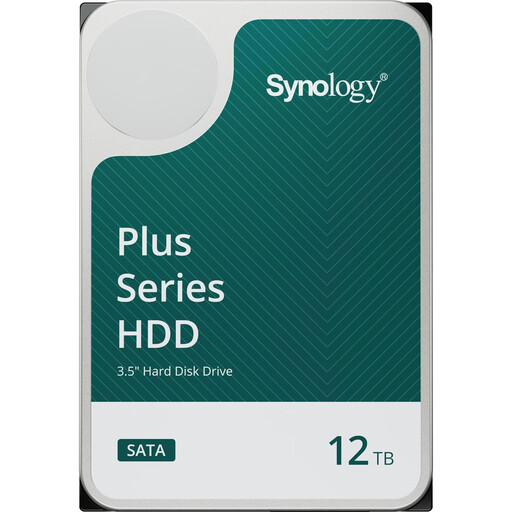 No image available
A 12 TB option for regular NAS write workloads, provided your Synology NAS is compatible with this model.
CMR; workload rating: 180 TB/year; SATA III, 3.5 inches; 7200 rpm; 512 MB cache.
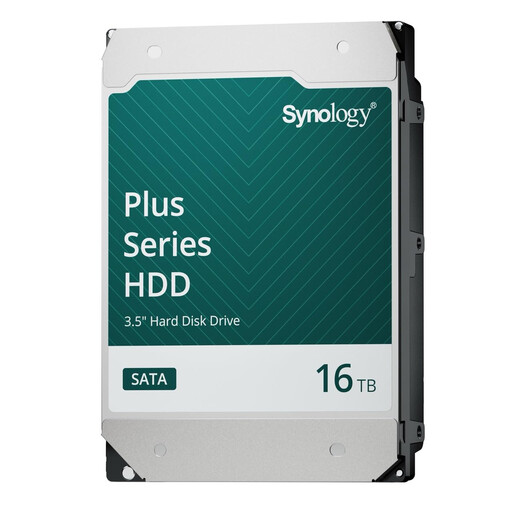 No image available
A 16 TB option for larger video libraries, provided your Synology NAS is compatible with this model.
CMR; workload rating: 180 TB/year; SATA 6 Gb/s, 3.5 inches; 7200 rpm; 512 MB cache. The stated data rate of 281 MB/s isn’t a guarantee of the performance of your entire NAS.
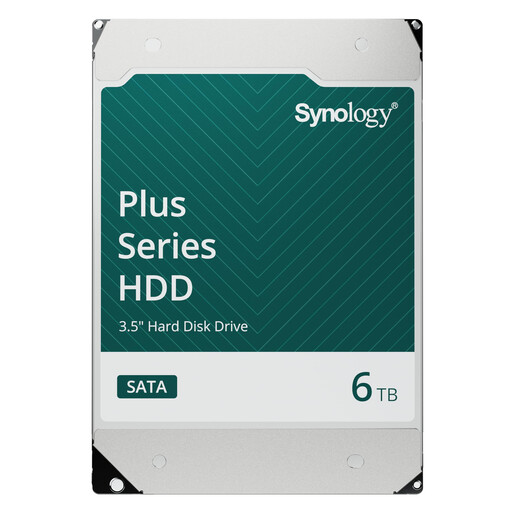 No image available
A 6 TB option for a smaller planned storage setup, provided your Synology NAS is compatible with this model.
CMR; workload rating: 180 TB/year; SATA 6 Gb/s, 3.5 inches; 5400 rpm; 256 MB cache. The stated read speed is up to 202 MB/s.
No. The BSI distinguishes RAID mirroring from data backup because mirrored changes are copied at the same time. To keep earlier project versions, plan for a separate backup and test whether you can restore the files you need from it.
Check the form factor, connection and exact model number for your NAS and the intended drive bay. Synology recommends using its compatibility list for each model. A general NAS hard drive label doesn’t confirm that a drive will fit every device.
Test restoring a complete project folder and check that the files you need are readable. The BSI notes that backup software must be able to handle the data formats in use.
No. In Germany, your statutory rights against the seller are set out by law; a manufacturer’s warranty is an additional voluntary benefit subject to its own terms. So check the terms for the specific hard drive and seller.