If you’d rather not use a plug socket while the yoghurt is setting, a non-electric insulated maker could be an option – but you’ll need boiling water and somewhere to chill the finished yoghurt. If you have a socket available, an electric maker with individual jars is a good choice if you want to store portions separately. Choose a batch size that suits how much you’ll use and the space in your fridge. You don’t necessarily need a specialist appliance: the German consumer advice centre also describes making yoghurt in screw-top jars.
Who are the different options suitable for?
Holidaymakers without a spare socket
If you don’t want to tie up a socket for a yoghurt maker while it sets in your holiday home, you could consider a non-electric option. You’ll need to boil water and chill the finished yoghurt; My.Yo lists these steps in its instructions.
Holidaymakers who want individual portions
Several individual jars are useful if you want to store small portions separately in the fridge. The manufacturers’ information for the jars supplied with the Severin JG 3518 and Rommelsbacher JG 40 describes the respective models’ contents.
Occasional yoghurt makers
If you only make natural yoghurt occasionally, consider whether you can use screw-top jars you already have instead of buying another appliance. The German consumer advice centre describes making yoghurt in screw-top jars and chilling it afterwards.
What should you consider when choosing?
Non-electric insulated yoghurt maker
A good fit if: you don’t want to use a socket for the yoghurt maker while it sets and can boil water at your holiday home.
Things to consider: You’ll still need hot water and somewhere to chill the yoghurt afterwards. My.Yo’s instructions give a setting time of 12–14 hours.
Electric yoghurt maker with individual jars
A good fit if: you have a socket available and want to chill several portions separately.
Things to consider: The appliance needs electricity and worktop space while it’s running. You’ll also need to clean several jars and protect them in transit.
Screw-top jars without a specialist appliance
A good fit if: you don’t want to buy or take an extra appliance for a short stay.
Things to consider: The German consumer advice centre recommends leaving the yoghurt undisturbed for around twelve hours, then chilling it. This method doesn’t guarantee consistent results at every room temperature.
| What matters |
What to look for when buying |
Who it matters most to |
| Socket and heat |
Check whether you’ll have a socket available while the yoghurt sets, or be able to boil water, and whether there’ll be a fridge for chilling it afterwards. My.Yo says its maker doesn’t need to be connected to the mains; the instructions specify around 750 ml of boiling water for natural yoghurt. |
If I can’t be sure there’ll be a spare socket in my holiday home, I want to know whether I can heat water and chill the finished yoghurt. Around 33% of consumers put being able to let yoghurt set without tying up a socket first. |
| Portions and fridge space |
Compare the amount you want to make and the number of jars with how much you’ll use and the space available in your fridge. The manufacturers specify seven 150 ml jars for the Severin JG 3518, eight 150 ml jars for the Rommelsbacher JG 40 and a 1-litre container for the My.Yo maker. |
If I want to chill just the right amount of yoghurt and finish it during my stay, the shape of the container matters most to me. Around 27% of consumers prioritise portion sizes and fridge space. |
| Ease of use and setting time |
Read the instructions for the specific model and allow time for the yoghurt to set and then chill. Rommelsbacher specifies a timer of up to 18 hours for the JG 40; the Clatronic product description lists an illuminated on/off switch for the JM 3344. |
If you need clear steps and a setting time that fits your plans in an unfamiliar kitchen, ease of use should be a key factor in your choice. Around 20% of consumers prioritise straightforward, predictable operation. |
| Luggage and accessories |
Check which jars and lids you already have, how they need to be cleaned and whether you want to take an extra appliance with you. The German consumer advice centre describes making yoghurt in screw-top jars without a specialist maker. |
If I want to take as little extra equipment and as few accessories as possible for a short stay, I weigh up the effort against how much I plan to use it. Around 20% of consumers prioritise keeping equipment and transport to a minimum. |
What mistakes should you avoid?
-
Assuming “non-electric” means “no hot water or fridge needed”
My.Yo’s instructions call for boiling water and chilling the yoghurt as soon as it has set. So “non-electric” doesn’t mean the whole process is free from energy or cooling requirements.
Before choosing, check that you’ll be able to boil water and chill the finished yoghurt in your holiday home.
-
Choosing the biggest batch instead of the right amount
A large batch is only practical if you can eat the yoghurt during your stay and fit it in the fridge afterwards.
Choose the container size and number of jars to suit how much you plan to use and the fridge space available.
-
Assuming similar model names mean identical features
The manufacturer’s data sheet gives a power rating of 40 W for the Ariete Yogurella 0621/10, while a Joybuy listing for the Yogurella 621 gives 20 W. Similar names alone don’t confirm that these are the same model or have the same features.
Before buying, check the full model number and the details for the specific version on offer.
Relevant brands and product ranges
My.Yo
The non-electric 1-litre maker is an option if you can boil water in your holiday home and chill the finished yoghurt.
- The manufacturer says the maker works without a power connection. Its instructions specify around 750 ml of boiling water and a setting time of 12–14 hours.
- Non-electric doesn’t mean you can skip boiling the water or chilling the yoghurt afterwards.
Severin
The JG 3518 is aimed at people who want to store natural yoghurt in individual jars.
- The manufacturer says the box includes seven 150 ml individual jars and lists replacement jars for this model.
- The model needs a socket, so check one will be available where you plan to use it.
Rommelsbacher
The JG 40 and JG 80 Jona yoghurt makers have different features, so compare them by model.
- The manufacturer specifies eight 150 ml jars and a timer of up to 18 hours for the JG 40. For the JG 80 Jona, it lists features including a natural yoghurt programme at 42 °C.
- The JG 80’s programmes and container details don’t apply to the JG 40.
Clatronic
The JM 3344 is an electric option for making natural yoghurt in individual jars.
- The manufacturer says it comes with seven 160 ml jars; the product description lists an illuminated on/off switch.
- If you need a timer, check the product details for the specific model.
Ariete
The Yogurella range may appeal if you’re considering making strained yoghurt as well as natural yoghurt.
- Ariete’s data sheet for the 0621/10 version describes a container and filter basket.
- The power and container details for the 621 listing don’t clearly match those for the 0621/10 version. Check the full model number and the features of the specific version before buying.
Yoghurt makers at Joybuy
Joybuy yoghurt maker options for holiday homes, with a range of container and portion sizes.
 No image available
FOHERE yoghurt maker with two XXL glass containers
The two container sizes let you choose between different batch quantities.
The Joybuy product listing specifies glass containers of 2.000 ml and 1.400 ml.
View at Joybuy
 No image available
Fosmet yoghurt maker, 1,6 L SUS304, 9 jars
The jars and inner pot give you different containers for making and storing yoghurt.
The Joybuy product listing specifies a 1,6-litre inner pot, nine borosilicate glass jars, temperature control, a timer and an OLED display.
View at Joybuy
 No image available
FOHERE yoghurt maker with 8 jars and timer
The eight jars are a good option if you want to store yoghurt in several containers.
The Joybuy product listing specifies a total capacity of 1.440 ml, digital temperature control and a 48-hour timer.
View at Joybuy
 No image available
Yoghurt maker, 1,5 L, 20 W, with sieve
The sieve and lid are included in the features listed on the Joybuy product page.
The product listing specifies a capacity of 1,5 litres and 20 W.
View at Joybuy
 No image available
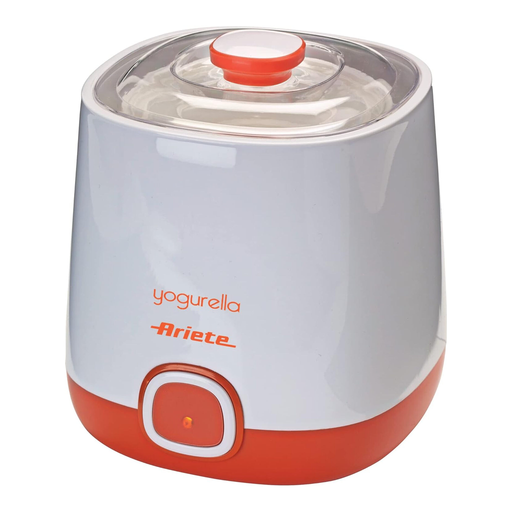
Ariete Yogurella 621, 20 W
The product listing describes the appliance as a yoghurt maker with a 1-litre capacity.
The listing gives a power rating of 20 W. Check the full model number before choosing, as Ariete’s data sheet gives a different power rating for the 0621/10 version.
View at Joybuy
Frequently asked questions
Do I need to take a yoghurt maker to my holiday home?
No. The German consumer advice centre describes making yoghurt in screw-top jars without a specialist appliance. Leave the jars undisturbed while the yoghurt sets for around twelve hours, then put them in the fridge. This method doesn’t guarantee the same results at every room temperature.
What do I need on hand to use the non-electric My.Yo maker?
According to the manufacturer’s instructions, you’ll need milk and a starter culture, around 750 ml of boiling water for natural yoghurt, 12–14 hours for it to set and somewhere to chill it afterwards. “Non-electric” describes the maker while the yoghurt is setting; it doesn’t mean you won’t need to heat the water.
How should I store finished natural yoghurt?
Chill the yoghurt once it has set. For dairy products such as yoghurt, the German consumer advice centre recommends the middle shelf of the fridge at 5 to 7 °C. This recommendation doesn’t guarantee how long homemade yoghurt will keep.
What should I do if I’m missing jars or the appliance is faulty?
For the Severin JG 3518, check the replacement jars EG 3513 and EG 3514 listed by the manufacturer. For Rommelsbacher, check the accessories for the specific model you’ve chosen. If the appliance has a fault, your statutory rights against the seller are separate from any voluntary guarantee; check the terms for your particular appliance.


