
Lieferung heute & morgen

Qualitätsgarantie

Willkommens-Angebote freischalten: KOSTENLOSE Lieferung | Bis zu 80 % RABATT | Kostenlose 30-Tage-JoyPlus-Testphase
App herunterladen
LED neon strips promise a striking and modern atmosphere for any room. Whether as dynamic gaming room decor, stylish indirect lighting in the bedroom, or a highlight at parties—the possibilities seem endless. However, the market is flooded with products of widely varying quality. Many buyers only realise after installation that the result doesn't meet their expectations. This guide reveals the three most common pitfalls and explains which technical features you should look for to make an informed decision.
To avoid the problems mentioned above, you should check three core technical aspects before buying. These are crucial in determining the quality, longevity, and functionality of your RGB neon light.
The key to a true neon effect lies in the diffuser. Look for products that explicitly specify a dense silicone diffuser. This material effectively scatters the light from individual LEDs, creating a homogeneous, continuous line of light without visible dots. Equally important is a highly flexible FPC board. It allows the strip to be bent into tight radii to create lettering or complex shapes without damaging the internal circuitry.
Reliable control is fundamental. Check which options are offered:
The operating voltage, specified in Volts (V), directly impacts performance, especially for longer installations.
Based on the criteria above, we have identified a few products that are well-suited for specific use cases and user profiles.
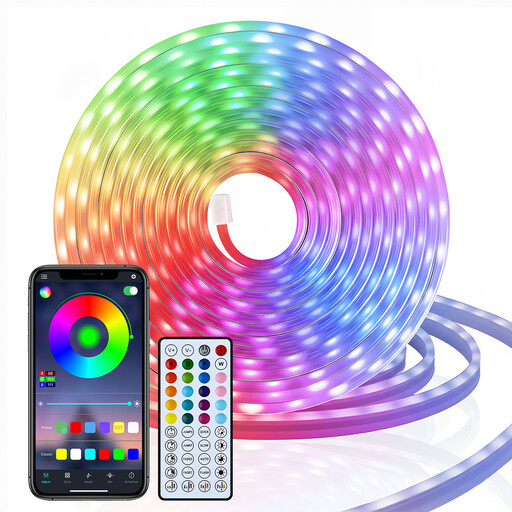
Why This Fits Their Persona: Ideal for gamers and creatives who want to design custom gaming room decor. The high flexibility allows for shaping logos or lettering, while the music sync creates an immersive experience.
The silicone diffuser ensures a continuous, dot-free light, bypassing the "hotspot" trap. The FPC board, described as "highly flexible," addresses the problem of brittle materials.
Combines a true neon effect, high flexibility for DIY projects, and dual control via app and remote.
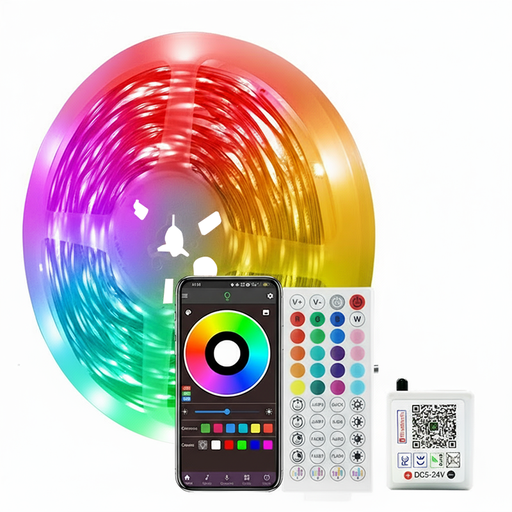
Why This Fits Their Persona: A cost-effective solution for users who want to try out smart lighting. Well-suited for simple indirect lighting behind furniture or a bed, where a diffused neon look is not the highest priority.
This model avoids the unstable control trap by offering a 40-key remote in addition to the Bluetooth app. This creates redundancy and a reliable backup control method.
Great value for money for beginners. Offers all essential smart features with app control, a remote, and music sync.
Why This Fits Their Persona: Perfect for illuminating large rooms, long hallways, or entire ceiling perimeters. The 15-metre length allows for a seamless installation without unsightly connectors or extensions.
By using a 24V system, it counteracts the problem of voltage drop over long distances. This ensures consistent brightness and colour intensity from the beginning to the end of the 15-metre strip.
Extended length (15 m) for seamless installations. The 24V system provides uniform light output across the entire strip.
Many of these lighting systems are enhanced by advanced controllers. Discover more ways to make your home smarter.
High-quality neon strips are designed to be flexible. Always bend the strip along its flat axis (horizontally), never vertically or by creasing it. Avoid extremely sharp angles. Most manufacturers specify a minimum bending radius that should not be exceeded to protect the internal circuit paths.
The lifespan of LED products is measured in operating hours and is often between 25,000 and 50,000 hours for quality models. The actual lifespan depends heavily on usage. Factors that can shorten it include continuous use at maximum brightness, inadequate ventilation (heat build-up), and an unstable power supply.
Yes, most LED neon strips can be cut to size. Look for the designated cutting marks on the strip, usually indicated by a scissor icon. Only cut at these marks, otherwise the circuit will be interrupted and the segment will become unusable. After cutting, the open end must be sealed with an end cap for safety and protection against moisture.