
Lieferung heute & morgen

Qualitätsgarantie

Willkommens-Angebote freischalten: KOSTENLOSE Lieferung | Bis zu 80 % RABATT | Kostenlose 30-Tage-JoyPlus-Testphase
App herunterladen
A night light should provide guidance without unnecessarily brightening the room. Yet unclear product specifications and flashy marketing claims often lead to poor purchases. Families, anyone who needs to find their way around at night, and avid readers in particular should check before buying whether the sensor, light colour, power supply and brightness are right for where they plan to use it.
A night light with a motion detector switches on when it detects movement. A night light with a sensor, on the other hand, may only have a twilight sensor. This responds to the ambient light level and activates the lamp as soon as it gets dark.
For a hallway or staircase, a motion sensor is practical because the light only comes on when needed. In a children’s room, a permanently dimmed orientation light can be more pleasant. So check whether the product has a motion sensor, a twilight sensor or a combined one.
A warm white night light is typically around 2,700 to 3,000 Kelvin. This light colour is suitable for bedrooms, children’s rooms and subtle ambient lighting. A colour temperature of 6,500 Kelvin, on the other hand, appears much cooler and is more reminiscent of daylight.
Terms like “soft” or “gentle” are no substitute for technical specifications. Look out for the Kelvin value, lumens and available brightness levels.
A rechargeable model is flexible to use but needs regular charging. Battery capacity, charging time and stated operating duration are crucial. A small clip-on book light needs less light output than a portable table lamp, but can be particularly lightweight and portable as a result.
With a plug-in night light, there’s no need to charge it. However, where you can use it is tied to a free socket. The position of the sensor and its proximity to furniture should also be considered before buying.
For getting around at night, a low light output is usually sufficient. Lumens describe the luminous flux: the higher the value, the brighter the lamp can shine. For a reading lamp or a dimmable table lamp, higher values make more sense than for a small orientation light.
With a night light that has a motion detector, the detection angle and range are important. A model with a 120-degree detection angle and a range of up to 3 metres can be sufficient for short hallways or landings. The automatic shut-off time is also important.
A twilight sensor, on the other hand, switches on and off depending on the ambient light level. This is practical for a permanent plug-in night light in a bedroom or children’s room. The sensor should not be blocked by curtains, furniture or decorations.
Plug-in night lights don’t need batteries and can remain connected permanently. Pay attention to the intended indoor use and to details such as IP20 or the exclusion of moisture.
Rechargeable models can be used without a socket on a bedside table, shelf or when travelling. With a clip-on book light, weight, clamping range and adjustability are also important. In a children’s room, the lamp should be positioned so that cables and the device don’t become a trip hazard.
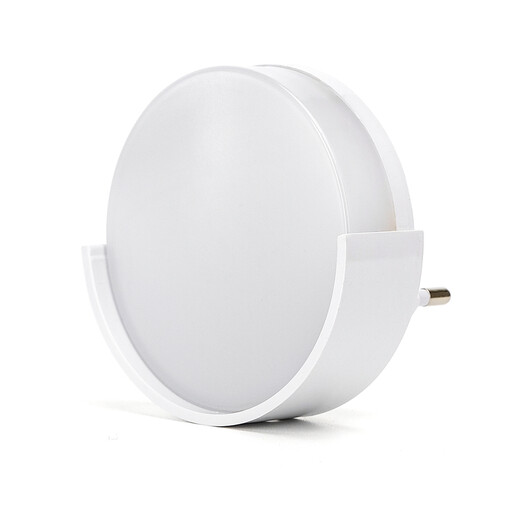
Why this product fits the profile: This compact plug-in night light works without batteries and switches on automatically when the ambient light level drops.
The stated twilight sensor works without manual switching on and off. However, the light colour is 6,500 Kelvin and is therefore not warm white.
1 W LED, 40 lumens, 120-degree beam angle and a stated lifespan of 25,000 hours.
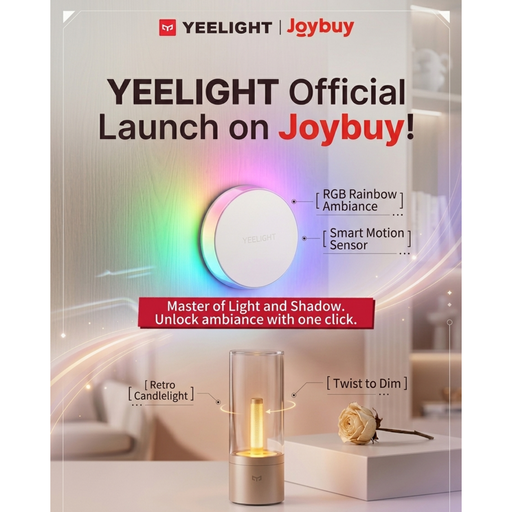
Why this product fits the profile: This rechargeable ambient light is intended for bedrooms, living rooms or play areas and can be positioned flexibly.
The integrated motion sensors and USB-C charging make the functions clear. Before buying, you should check the specific battery level or runtime.
USB-C rechargeable, magnetic attachment and 11 preset light effects according to the product description.

Why this product fits the profile: Avid readers get a lightweight, portable light for bed, travel, train or plane.
The lamp states specific values for luminous flux, charging time and operating duration. Two brightness levels are available, but there is no stepless adjustment.
16 lumens, 3,000 Kelvin, 37 grams weight, 350-degree rotation and up to 8 hours of operating time according to the manufacturer’s specifications.

Why this product fits the profile: This portable table lamp is suitable for a bedside table, desk and living area when a higher light output than an orientation light is needed.
The three colour temperatures and touch dimming allow it to be adapted to different activities. Because of its higher light output, it is not primarily intended as a subtle night light.
400 lumens, 3,000/4,000/5,000 Kelvin, touch operation and integrated battery with 2 × 1,800 mAh according to the product data.
We’ve put together a complete, regularly updated list of products that fully meet these strict selection criteria and the safety regulations in force in the EU.
For getting around in a hallway or children’s room, a low brightness is often sufficient. A value like 16 to 40 lumens can be enough for short distances. A reading lamp or table lamp needs significantly more light depending on the activity. What matters is that the lamp doesn’t shine directly at eye level and can be dimmed if it’s used in a bedroom.
A motion detector activates the light only when movement is detected and then switches it off again. A twilight sensor makes the night light come on automatically in the dark. For trips to the bathroom at night, a motion detector can save power; for constant orientation next to the bed, a twilight sensor may be more suitable. With both types, the fitting should be installed out of the reach of small children.
The running costs depend on the power, operating time and electricity tariff. A 0.5 W model running for 12 hours uses 0.006 kilowatt-hours per day in theory. With a 1 W or 2 W model, consumption increases accordingly. Rechargeable lamps also incur charging losses, but offer flexible placement without permanently occupying a socket.