
Lieferung heute & morgen

Qualitätsgarantie

Willkommens-Angebote freischalten: KOSTENLOSE Lieferung | Bis zu 80 % RABATT | Kostenlose 30-Tage-JoyPlus-Testphase
App herunterladen
A night light should provide orientation without brightening the room unnecessarily. In practice, however, poor purchases often happen because of unclear brightness specifications, unsuitable mounting methods, or batteries whose charging needs are underestimated. Families with children in particular should also look out for safe materials, a stable placement, and suitability for the intended location.
A specification like 6500 Kelvin describes the light colour, not automatically the actual brightness. Higher Kelvin values generally appear cool white, whereas around 2800 to 3200 Kelvin is described as warm white. For nighttime orientation, warm light can feel more pleasant; for work surfaces or cupboards, a more neutral or cooler light colour is often more practical.
So also pay attention to the luminous flux in lumens. A night light with 40 lumens shines differently from a powerful room lamp, even if both operate with a similar colour temperature.
A night light with a sensor can react either to ambient brightness or to movement. A twilight sensor switches the light on when it gets dark and off when there is sufficient light. A motion sensor night light, on the other hand, only activates when movement is detected.
This distinction is important for how you use it:
A plug-in night light doesn't need a battery, but it does occupy a socket. A rechargeable night light can be placed more flexibly, but it needs to be charged regularly. With a children's night light, you should also check whether small parts, cables or removable components are within reach.
For the kitchen, wardrobe and hallway, flat lights with adhesive strips are practical. The mounting surface must be clean, dry and sufficiently load-bearing. On painted or uneven walls, the adhesive bond may come loose sooner.
For bedrooms and children's rooms, warm white light colours are often suitable. A dimmable lamp offers more adjustment options if you need different brightness levels. With an RGB mood light, on the other hand, colour changes and ambience take centre stage. Such lights can be a nice addition, but they don't automatically replace a functional orientation light.
Check before you buy:
With a battery-powered night light, battery capacity and charging port are crucial. The capacity is given in milliampere-hours, but on its own it doesn't tell you exactly how long the light can run. Brightness, sensor operation and the chosen light colour all affect power consumption.
USB-C is widely used on modern lights. Older or simpler models may use a different USB connection. Having a fixed charging spot will stop the night light from running flat in daily use.
A night light for a socket should not block the neighbouring sockets. For damp rooms or outdoor use, a standard model with IP20 is not suitable. The Aigostar light from our selection is, according to the product details, designed exclusively for indoor use and operates on 220–240 V.
For mains-powered lights, you should also check for compatible bulbs, the maximum wattage and the manufacturer's specifications. The Keli floor lamp, for example, uses an E27 fitting, accepts bulbs up to 40 W according to the product description, and is supplied without a bulb.
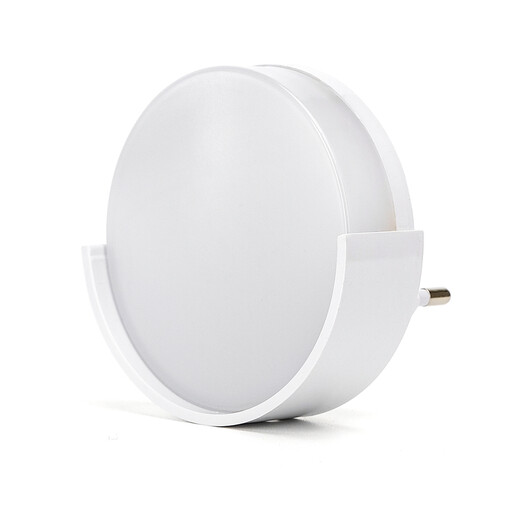
Why this product fits the profile: This plug-in night light goes straight into an existing socket and, according to the product details, requires neither batteries nor charging. The built-in light sensor switches on when the ambient light falls below 20 lux.
The automatic twilight control reduces the need for manual switching on and off. The specifications also state 1 W power, 40 lm luminous flux and indoor use only.
Compact design, 120-degree beam angle and, according to the product data, CE and RoHS certification.
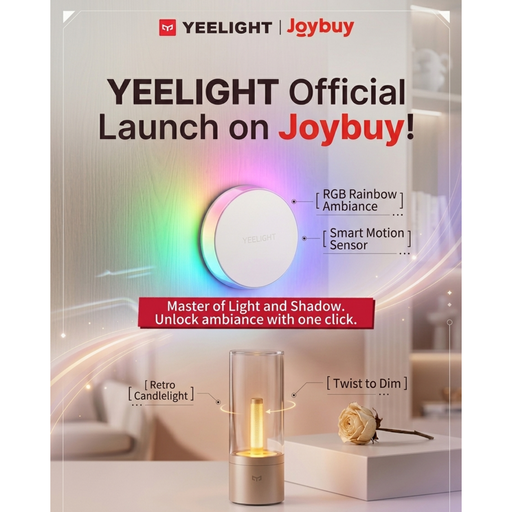
Why this product fits the profile: This light combines RGB ambient lighting with motion sensors. It is designed for living rooms, bedrooms and gaming areas, and can be positioned flexibly thanks to its magnetic mount.
The sensor function is an explicit feature of this model. This means the light doesn't have to stay on permanently when motion detection is desired.
11 preset light effects, USB-C charging port and rechargeable design according to the product name.

Why this product fits the profile: Two flat LED lights with PIR sensors are suitable for kitchen cupboards, shelves, wardrobes and hallways. According to the description, they are mounted without drilling using adhesive strips.
The motion sensor range is stated as 3 to 5 metres. In addition, three colour temperatures are available instead of just one fixed light colour.
200 × 38 × 10 mm per light, 800 mAh battery and 21 integrated LEDs according to the product data.
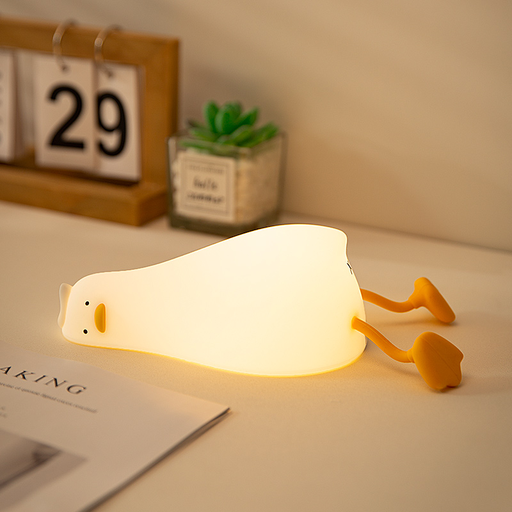
Why this product fits the profile: This soft silicone duck-shaped model is described as lighting for children's rooms and bedrooms. The built-in battery allows cordless use by the bed or on a shelf.
This model requires no fixed mounting and no permanently connected cable. For young children, however, adult supervision is recommended according to the product information.
1200 mAh battery, soft silicone material and USB charging function according to the product description.
A night light isn't always enough when you need to illuminate a living room, bedroom or work area evenly. The Keli Straight Floor Lamp is a 150 cm tall metal floor lamp with a concrete base. It has an E27 fitting, a 180 cm long cable and a switch. The bulb is not included. Details on assembly, maximum 40 W and placement can be found on the product page for the Keli floor lamp.
We have put together a complete, regularly updated list of products that fully meet these strict selection criteria and the safety regulations in force in the EU.
That depends on the power, operating time and switching behaviour. A model with 1 W theoretically uses 10 Wh when running for ten hours. A twilight or motion sensor can reduce the actual running time. With battery-powered lights, the electricity consumption occurs during charging.
Yes, as long as the detection range matches the size of the room. Check the range, switch-on time and mounting height. For a long hallway, a single sensor light may react too late; several smaller lights can provide more even orientation.
The lifespan depends on the design and usage. For fixed built-in LEDs, the manufacturer often gives a figure in hours. With rechargeable models, the condition of the battery is also relevant. If the brightness drops significantly or the battery becomes unusually warm, you should stop using the light and check it according to the manufacturer's instructions.