
Lieferung heute & morgen

Qualitätsgarantie

Willkommens-Angebote freischalten: KOSTENLOSE Lieferung | Bis zu 80 % RABATT | Kostenlose 30-Tage-JoyPlus-Testphase
App herunterladen
A night light in a child’s room should provide orientation without brightening the space unnecessarily. At the same time, it needs to suit the child’s age, the socket type and where you plan to use it. However, there are clear differences between a decorative children’s lamp, an automatic plug-in night light and a rechargeable night light.
Three typical buying mistakes often lead to poor decisions:
What really matters, therefore, isn’t the number of features, but the right combination of light colour, control, power supply and a safe location.
A warm white night light at around 2700 to 3000 Kelvin is often perceived as more subtle than cool white light. That doesn’t mean everyone prefers the same light colour. For hallways, stairs or work areas, a more neutral or white light can be more practical.
Also pay attention to:
A product with 40 lumens and 6500 Kelvin, for example, should be assessed differently from a dimmable night light with 20 lumens and 2800 to 3000 Kelvin. However, the numbers alone don’t tell you whether it’s personally suitable for your particular room.
A night light with a twilight sensor switches on when the ambient brightness falls below a certain level. With the Aigostar model, this threshold is stated as below 20 lux according to the product information. Such a plug-in night light is suitable for areas that should remain dimly lit throughout the dark period.
A night light with a motion sensor works differently: it only activates when movement is detected in a dark area. For the corresponding Grifema model, the product description states a range of up to 3 metres and a detection angle of 120 degrees. Before buying, check whether the bed, door or stairs actually fall within the detection area.
For cupboards, kitchen units and shelves, a cabinet light with a motion sensor can be more practical than a plug-in solution. With rechargeable models, you should also consider the charging port, battery capacity and expected charging intervals.
A plug-in night light doesn’t need batteries and is ready to use immediately. However, it does occupy the socket and is tied to the installation location. A rechargeable night light, on the other hand, can be placed more flexibly but needs to be charged regularly.
Also check:
For electrical devices, you should consider markings such as CE marking, voltage range and the instruction manual. A night light should not be used in areas with water or splashes unless a suitable protection rating is stated. Even a baby night light should be fixed or placed out of the child’s reach and not treated as a toy.
The following models cover different requirements. The features mentioned correspond to the product information provided.

Why this product fits the profile: This two-piece plug-in set offers a simple solution for a child’s room, hallway, bathroom or stairs. Three brightness levels and 2700 Kelvin warm white light allow basic adjustment.
The three dimmable steps reduce the risk of having to use a setting that’s too bright for every room. The twilight sensor takes care of switching on and off.
Two lights, 0.5 W power consumption and a slim ABS casing according to the product description.
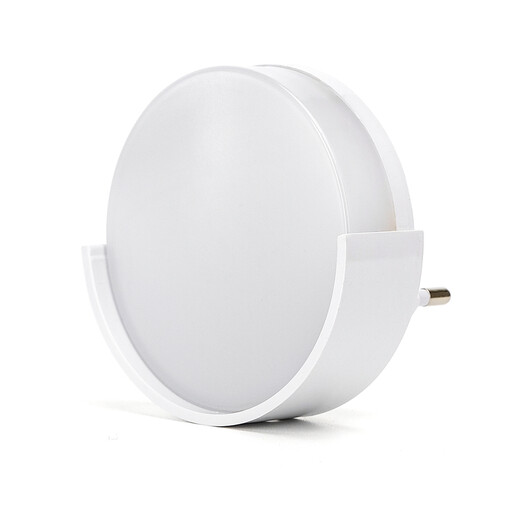
Why this product fits the profile: If you want permanent orientation without battery or rechargeable battery changes, this plug-in model for indoor use is a straightforward choice.
The stated twilight sensor makes a manual switch unnecessary. The indoor and IP20 note clearly defines the intended use.
1 W LED, 40 lumens, 220–240 V and, according to the product information, a stated lifespan of 25,000 hours.

Why this product fits the profile: According to the product description, this baby night light combines projections, music, sounds, dimming, a timer and an adjustable cry sensor.
The features are clearly named: 23-minute auto shut-off, USB-C charging and selectable sound options. This makes it easy to check whether the feature set is actually needed.
Rechargeable operation, four sound options according to the product information, plus projection and timer in one device.
We’ve put together a complete, regularly updated list of products that fully meet these strict selection criteria and the safety regulations in force in the EU.
The consumption depends on the power and the operating time. A model with 0.5 W theoretically uses 0.5 kWh over 1,000 hours of operation. With a twilight sensor, the actual running time may be lower if the light stays off during the day. For a realistic estimate, you should look at the stated wattage and the daily usage time.
That depends on the room. A twilight sensor is suitable for even orientation lighting in a hallway or child’s room. A motion sensor saves light during unused periods and is practical for walkways, stairs, cupboards or nighttime trips to the toilet. Near a child’s cot, the detection range should be set or chosen so that accidental activation is avoided as much as possible.
The lifespan is sometimes given in operating hours for certain products. The Aigostar model, for example, states 25,000 hours according to the product information. This figure is a manufacturer’s claim and not a guarantee of a specific service life in a household. With rechargeable devices, you also need to consider battery ageing. LED components are not necessarily replaceable, so check the maintenance and disposal instructions.