
Lieferung heute & morgen

Qualitätsgarantie

Willkommens-Angebote freischalten: KOSTENLOSE Lieferung | Bis zu 80 % RABATT | Kostenlose 30-Tage-JoyPlus-Testphase
App herunterladen
A night light for a child’s room should provide orientation at night without brightening the room unnecessarily. For parents, it’s often about more than just a pretty design: the light needs to be practical for feeding, nappy changing or trips to the bathroom, mustn’t be fiddly to operate, and should suit the child’s age.
However, some common marketing claims can lead to the wrong purchase:
For night-time orientation, a warm white night light is usually the most comfortable choice. Technically, warm white light is often around 2,700 to 3,000 Kelvin. Cooler light colours can appear much brighter in a child’s room, even if the stated light output is similar.
A night light with a dimming function offers more flexibility:
Also look for specific details such as lumens, colour temperature and brightness levels. Claims like “gentle” or “sleep-friendly” are only meaningful if backed up by technical data. A night light should not be expected to have any therapeutic or medical effect.
A night light with a sensor can make daily life easier, provided the function suits where you plan to use it:
Check whether the sensor works reliably in your chosen position and whether the automatic function can be turned off. A sensor that plugs into a socket isn’t automatically suitable for use by the cot if the light needs to stay on continuously.
A rechargeable night light doesn’t need replacement batteries and can be moved flexibly between the child’s room, the bedroom and your travel luggage. Important things to consider are:
With a night light for the bedroom that plugs into the mains, there’s no need to recharge. However, it is tied to a socket. For younger children, the product should be placed outside the cot and out of reach of cables. Look for CE marking, complete safety instructions and the intended conditions of use. The marking doesn’t replace checking the specific product details, but it is an important formal criterion.
The models below differ in terms of power supply, operation, sensors and features. The information is based on the respective product details.
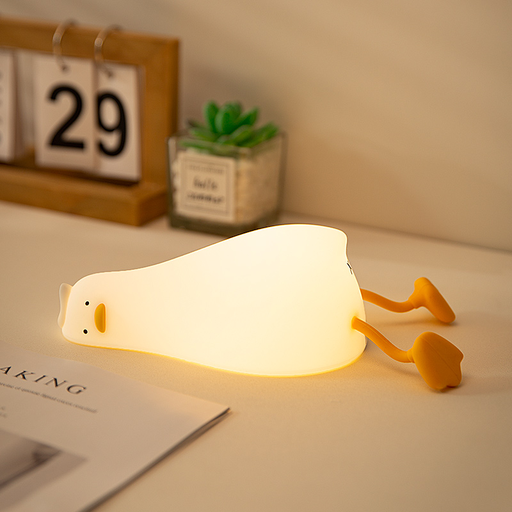
Why this product suits the profile: The compact silicone housing, duck design and built-in 1200 mAh battery combine decorative styling with cordless use by the cot or in the child’s room.
The product description clearly states the battery, material and cleaning instructions. This makes the power supply transparent, rather than relying solely on an attractive design.
Rechargeable 1200 mAh battery and soft silicone. Designed for indoor use; do not submerge in water or use near heat sources.
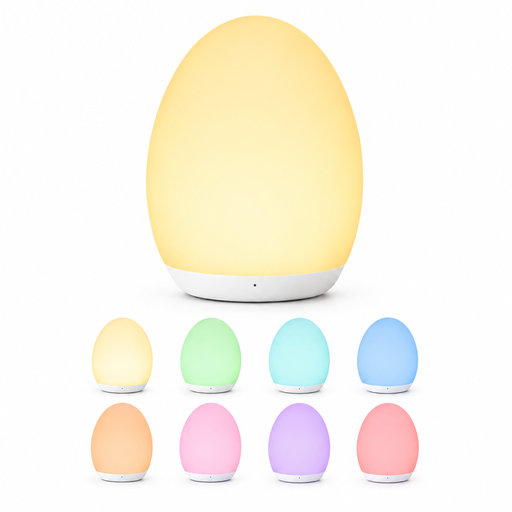
Why this product suits the profile: For night feeds, nappy changes and travel, this model offers touch control, warm white dimmable light, eight colour modes, a timer and a memory function.
The run time is broken down by brightness: approximately 7 hours at maximum brightness and up to 100 hours at the lowest setting.
2000 mAh battery, touch operation, 1-hour timer and portable format weighing approximately 155 g.
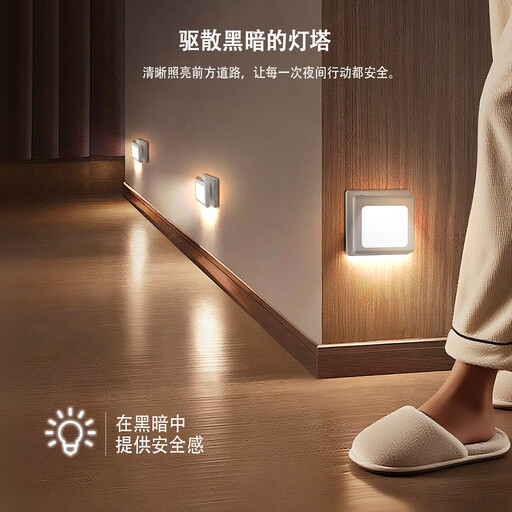
Why this product suits the profile: Two plug-in lights are ideal for a child’s room and hallway when you need a permanent orientation light without changing batteries.
The built-in dusk sensor is clearly described. This makes it less likely that buyers will confuse it with a motion sensor for short bursts of light.
Two lights in a set and steplessly adjustable brightness. The lights are intended for indoor use and are not designed as toys.
We’ve put together a full, regularly updated list of products that meet these strict selection criteria and the safety regulations in force in the EU.
For night-time orientation, warm white light in the range of approximately 2,700 to 3,000 Kelvin is often chosen. A low brightness level and good placement are also crucial. The specific suitability depends on the size of the room, the distance and personal perception.
That depends on the battery, brightness level and features. Manufacturer claims should always be read together with the setting used. With the VAVA light, up to 100 hours refers to the lowest brightness, while at maximum brightness approximately 7 hours is stated.
For a hallway, a PIR motion sensor is practical because it only activates the light when movement is detected. In a child’s room, a dusk sensor may be more suitable if you want a faint orientation light throughout the hours of darkness. Check the sensor type, detection range and switch-off behaviour before you buy.